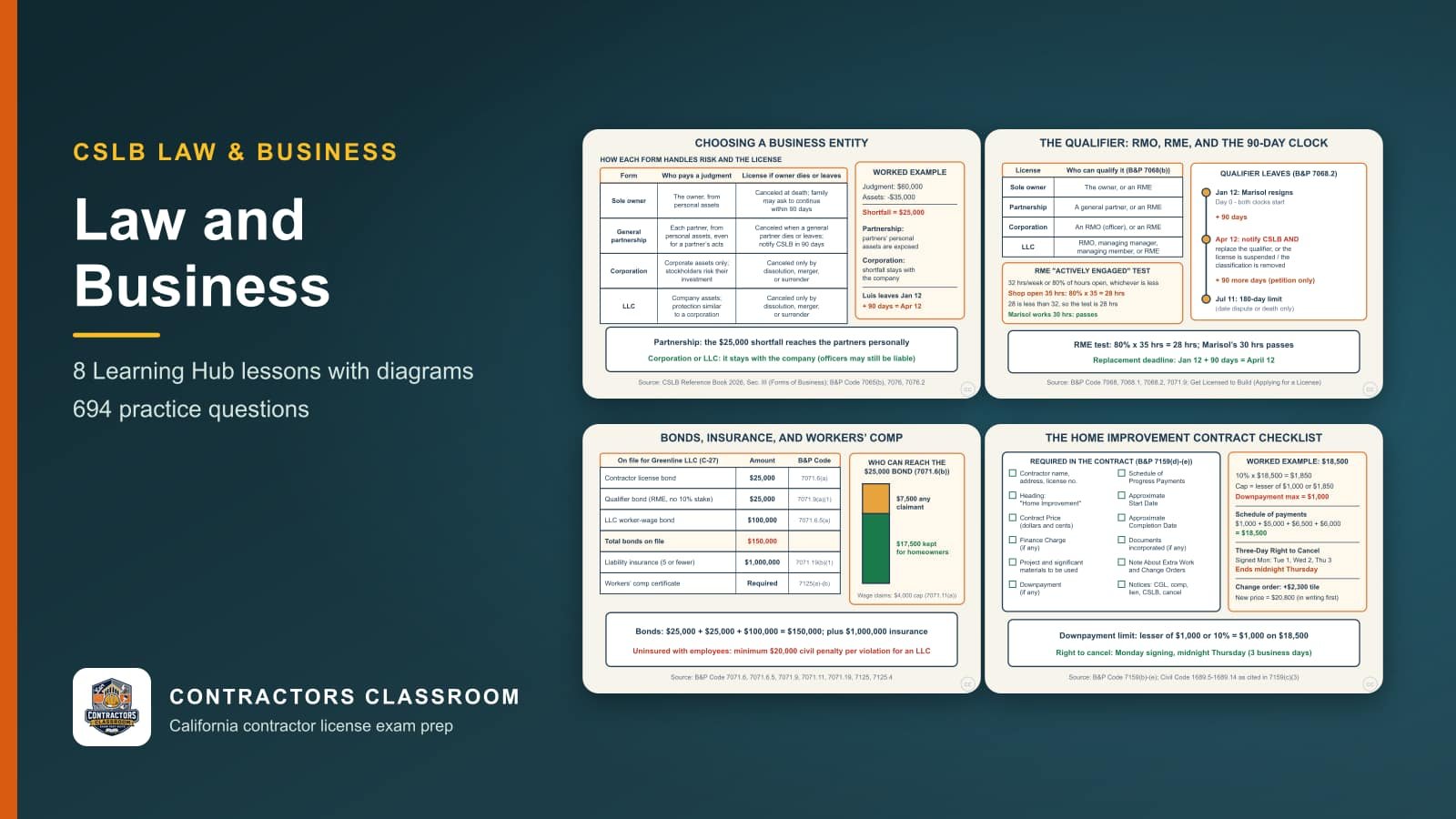
- Responsible managing officer (RMO)
- A corporate officer whose name is on file with the license board and who passes the exams to qualify the company's license. The RMO must supervise and control construction operations, and a corporation or LLC cannot hold a license without a qualifier of this kind or an RME.
- Responsible managing employee (RME)
- A permanent, bona fide employee, not an owner or officer, who qualifies the license for a classification. The RME must be actively engaged in that kind of work for a substantial share of the business's operating hours, and usually needs a qualifier bond because ownership does not exempt this person.
- Qualifier bond
- An extra $25,000 bond filed when the person qualifying the license is not the sole owner, a general partner, or an owner holding enough of the company. It exists to protect the public from that employee's misconduct and is separate from the company's own license bond.
- Contractor license bond
- A $25,000 surety bond required to obtain and keep any license. It pays valid claims from homeowners, injured customers, and unpaid workers, but capped amounts apply to non-homeowner claimants. Do not confuse it with project performance or payment bonds, which cover one job.
- Limited liability company (LLC)
- A business form that protects its members from business debts in a way close to a corporation, yet follows its own tax treatment. A licensed LLC faces added security duties: a separate wage-claim bond and higher minimum liability insurance limits that rise with the number of people on its personnel record.
- Preliminary notice
- The early warning a subcontractor or supplier sends to the owner, prime contractor, and lender after first providing labor or materials. Serving it on time keeps lien and stop notice rights alive; missing the deadline can weaken them, while prime contractors and wage-earning laborers are not required to send one.
- Mechanics lien
- A claim recorded against the improved property by someone who supplied labor or materials and went unpaid. Strict timelines govern recording the claim and then suing to enforce it. It cannot be used on public projects, where other remedies replace it.
- Stop payment notice
- A claim aimed at money, not at the real estate: it asks the owner or lender to hold back funds still owed to the prime contractor so the claimant can be paid. It is the main collection tool on public works and may be used alongside a lien on private jobs.
- Home improvement contract
- A written agreement for repairing or improving a residence above a small price threshold. The law prescribes its headings, type size, payment schedule, change order form, subcontractor disclosure, and consumer notices, and omitting required content can bring discipline.
- Downpayment limit
- In a home improvement contract, the advance a contractor may collect before work starts is capped at the lesser of a fixed dollar amount or a percentage of the contract price. Questions often give a price and ask you to compute the legal maximum.
- Right to cancel
- A consumer's window to back out of certain home contracts, such as those signed away from the contractor's own premises. The written notice must be in the contract, the period is longer for seniors and for disaster repair, and refunds must follow within a set number of days.
- ABC test
- California's three-part standard for deciding whether a worker is an employee. The hiring business must prove the worker is free from its control, does work outside its usual business, and runs an independent trade of the same kind. Failing any one part means employee status and payroll duties.
- Employment Training Tax (ETT)
- One of four California payroll levies, paid only by the employer, at a very small rate on each worker's first slice of annual wages. Along with unemployment insurance it is a true employer cost, whereas disability insurance and income tax come out of the employee's pay.
- Payroll deposit schedule
- The calendar that tells an employer when withheld taxes must reach the government. Federal timing is monthly or semiweekly depending on a past lookback total, not on how often you pay people, and California's schedule generally follows the federal one once amounts grow.
- Working capital
- Current assets minus current liabilities: the cushion of short-term resources left after near-term debts are covered. Lenders and bonding companies watch it because a profitable contractor can still fail by running short of cash while waiting on receivables.
- Current ratio
- Current assets divided by current liabilities, a measure of ability to pay bills as they come due. A result above one means more short-term resources than short-term debts; exam items usually hand you a small balance sheet and ask you to compute and interpret it.
- Quick ratio
- A stricter liquidity test that leaves inventory out of current assets before dividing by current liabilities. For a contractor, jobs in progress can tie up cash, so the quick ratio can look much weaker than the current ratio on the same statement.
- Prevailing wage
- The locally determined pay rate for each craft on public works, made up of a base hourly wage together with employer-paid fringes such as health, pension, and training contributions. Underpaying it brings back wages and daily penalties, and the rates must be posted at the job site.
- Certified payroll record
- A weekly payroll report for public work listing each worker's classification, hours, rate, and deductions, signed under penalty of perjury. Prime contractors must collect their subcontractors' records too, and late or incomplete submissions can lead to withheld progress money.
- DIR registration
- Enrollment with the state labor department that a contractor or subcontractor must hold to bid on, be listed for, or be awarded public work. Subcontractor lists on bid proposals ask for that registration number, so an unregistered firm cannot simply be listed.