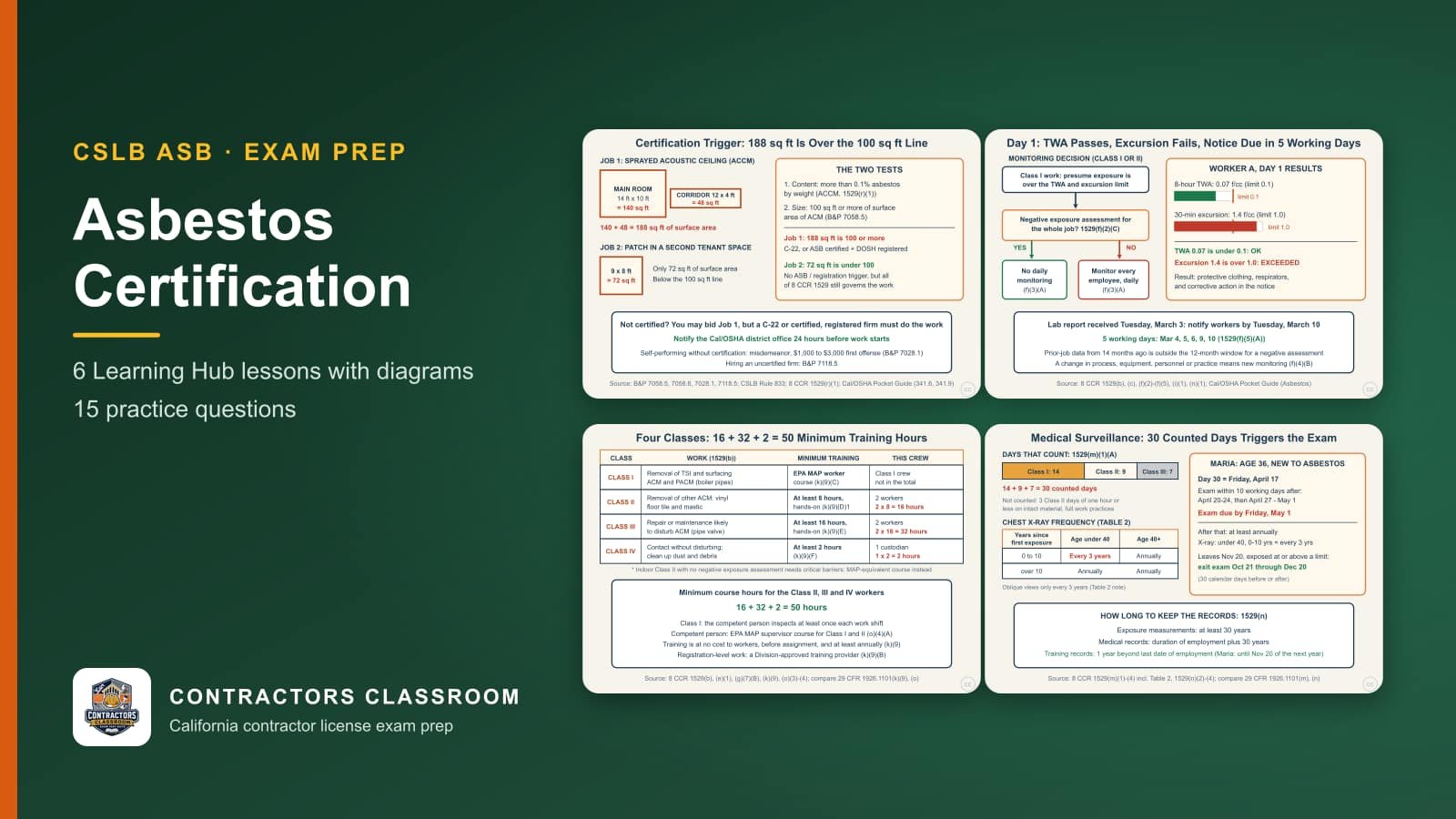
- Asbestos-containing construction material (ACCM)
- A factory-made building product containing over 0.1 percent asbestos by weight. California uses this lower content line, not the one percent line for ordinary ACM, when deciding who needs certification, registration, and certified consultants for larger asbestos jobs.
- Presumed asbestos-containing material (PACM)
- Pipe and boiler insulation or sprayed and troweled surfacing found in a building put up no later than 1980. Owners and contractors must treat it as asbestos unless sampling or an accepted inspection proves otherwise, so the label drives both caution and cost.
- Thermal system insulation (TSI)
- Material wrapped on pipes, fittings, boilers, tanks, and ducts to hold heat or cold. Removing it, along with surfacing material, is the highest tier of asbestos work, so recognizing pipe lagging and boiler wrap as TSI matters for classifying a job.
- Surfacing material
- Material sprayed, troweled, or otherwise applied to a surface for sound control, fireproofing, or decoration, such as acoustic ceiling texture. Its removal is treated as the same top-tier work as TSI removal, and sampling rules count it by uniform areas.
- Friable material
- Dry material that hand pressure can crumble, pulverize, or reduce to powder, so its fibers escape easily into the air. Whether a product is friable influences how it is handled, how heavily it is wetted, and how serious a disturbance becomes.
- Initial exposure assessment
- A judgment a competent person makes at or before the start of an operation, using monitoring, observations, and earlier data, about how much airborne fiber workers will meet. It determines whether the planned controls are right from the first shift.
- Negative exposure assessment
- A job-specific showing that worker exposure will stay below the limits, built from objective data, recent monitoring on closely similar jobs, or initial monitoring of the present job. If one is not in hand, extra protections such as protective clothing apply.
- Excursion limit
- The short-duration ceiling for airborne asbestos, set at ten times the eight-hour limit and averaged over thirty minutes. It catches brief spikes during messy tasks that a full-shift average could hide, so samples are taken during the likeliest high-release operations.
- Four classes of asbestos work
- A ranking by task. Class I removes pipe insulation or surfacing; Class II removes other ACM such as floor tile or wallboard; Class III is repair that disturbs ACM; Class IV is custodial contact and cleanup. The class dictates training, controls, and respirators.
- Asbestos competent person
- The on-site supervisor who can spot asbestos hazards, choose controls, and has authority to stop and correct problems. This person checks enclosures, entry control, monitoring, respirators, and suits each shift and must have the right training course for the class of work.
- Model Accreditation Plan (MAP) course
- The federal training standard for asbestos workers and supervisors. Class I workers, and Class II workers needing barriers or negative pressure, must take training equal in content and length to the worker course, while competent persons take the supervisor-level equivalent.
- DOSH registration
- The enrollment with the state occupational safety division that follows certification. A contractor doing registrable asbestos work must hold it, show it in advertising next to the certification number, and notify the nearby district office ahead of starting.
- Asbestos consultant
- A separately certified professional hired by the owner for building surveys, project design, sample collection, and clearance air monitoring. Because the role demands independence, a consultant may not hold a financial stake in the abatement contractor on the same project.
- Site surveillance technician
- A certified field representative who works for a consultant, watches the abatement crew, and collects area and personal air samples. Contractors should confirm a technician's certification card before accepting sampling results.
- Homogeneous sampling area
- A section of surfacing material with the same texture, color, and installation period, treated as one unit for sampling. Each such area needs a minimum number of cores from different spots, and similar-looking material applied at different times is split into separate areas.
- Polarized light microscopy
- The standard laboratory method for examining bulk samples of building material. An analyst identifies asbestos by its optical properties and estimates its percentage by weight, which decides whether the material counts as ACM.
- Asbestos medical surveillance
- A physician-run program for workers who perform Class I, II, or III work, or are exposed at the limit, for thirty or more days in a year. Exams occur before respirator assignment, shortly after the thirtieth day, and yearly after that, with lung tests and chest X-rays.
- Physician's written opinion
- The document an examining doctor gives the employer after an asbestos exam, naming conditions that raise risk, any restriction on tasks or on wearing a respirator, and that the worker was told the results. The employee gets a copy within a set period.
- Exposure measurement record
- The file of air monitoring results listing date, operation, method, sample duration, respirators worn, and the worker's identity. These records must be kept for decades, longer than training files, which is a frequent memory item in the Documentation section.
- Operations and maintenance program
- A written plan for buildings where asbestos is intentionally left in place. It limits disturbance, trains custodial staff, and schedules periodic checks of the material so damage is caught early, instead of removing everything at once.