CSLB C-17

Glazing Contractor License Exam Prep (C-17)

Getting ready for the California glazing contractor license exam (CSLB C-17)? Study with 762 practice questions in 5 categories and 5 Learning Hub lessons, made for glaziers and glass installers, with the Law and Business exam included.

One-time purchase, no subscription. Law & Business included.

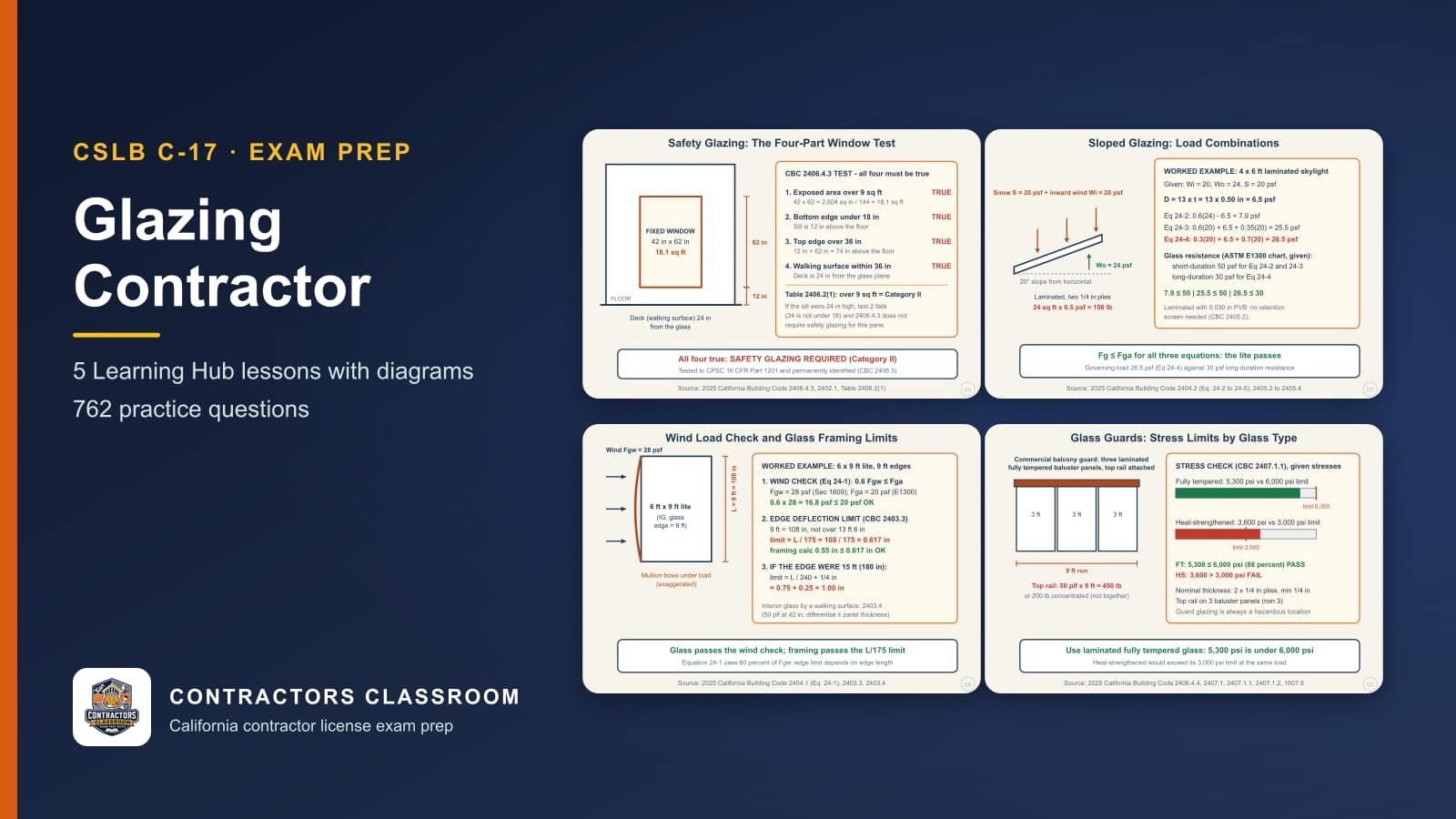
Diagrams from the C-17 glazing contractor lessons: Safety Glazing: Is This Pane a Hazardous Location?, Sloped Glazing and Skylights: Load Combinations, Wind Load Check and Glass Framing Deflection Limits and Glass Guards and Handrails
762practice questions
5categories
5Learning Hub lessons
$249Law & Business included

What the exam covers: Glazing (C-17)

The CSLB exam for the California glazing contractor license (C-17) is a closed-book, multiple-choice test. CSLB's official study guide divides it into five major sections and gives each an approximate weight: Planning and Estimating (about 27%), Fabrication and Installation of Framing Systems (about 21%), Fabrication and Installation of Glazing Materials (about 18%), Glazing Replacement and Retrofit Projects (about 15%), and Safety (about 19%).

Planning and Estimating carries the most weight, about 27%, so it deserves roughly that share of your study time, with Fabrication and Installation of Framing Systems next at about 21%.

Contractors Classroom turns that outline into 762 practice questions in 5 categories (Planning and Estimating, Glass & Glazing Fabrication, Architectural Storefront, Curtain Wall & Windows, Cal-OSHA Glass Handling & Fall Protection, and Cal-OSHA Safety), plus 5 Learning Hub lessons with diagrams (such as "Safety Glazing: Is This Pane a Hazardous Location?" and "Sloped Glazing and Skylights: Load Combinations"). Law and Business, which most applicants take alongside their trade exam, is included at no extra charge.

Exam sections and approximate weights

  • Planning and Estimating~27%
  • Fabrication and Installation of Framing Systems~21%
  • Fabrication and Installation of Glazing Materials~18%
  • Glazing Replacement and Retrofit Projects~15%
  • Safety~19%

Practice question categories

  • Planning and Estimating75 practice questions
  • Glass & Glazing Fabrication154 practice questions
  • Architectural Storefront, Curtain Wall & Windows193 practice questions
  • Cal-OSHA Glass Handling & Fall Protection325 practice questions
  • Cal-OSHA Safety15 practice questions

What the Glazing Contractor exam covers, section by section

Planning and Estimating (~27%)

Glazing jobs are won or lost on paper. Reading drawings and specifications reveals the glass types, framing, finishes, and performance requirements a project calls for, along with any conflicts that need resolving before ordering. Calculations then turn that information into glass sizes, material quantities, labor hours, and cost. Mistakes here are expensive, since custom glass cannot simply be trimmed or returned when the numbers are wrong. Takeoffs list each lite by height, width, thickness, edge treatment, and coating, so one wrong dimension means a costly remake.

  • Studying drawings and written requirements to identify glass, framing, finish, and performance expectations
  • Working out dimensions, quantities, weights, and costs that drive ordering, staffing, and pricing

Fabrication and Installation of Framing Systems (~21%)

Frames hold the glass, so their accuracy decides how the whole opening performs. Careful field measurements and allowances for tolerances lead to cut lengths, then members are cut, machined, and assembled in the shop or on site. Installation sets the frame plumb, level, and square in its opening, anchors it, and seals it against water and air. Small errors compound quickly in metal framing. Thermal movement in long metal runs is allowed for with expansion joints and slotted fasteners, and shims keep members true while anchors are tightened.

  • Taking opening measurements and figuring cut sizes with allowances for clearances and movement
  • Cutting, machining, and joining metal members into frames that are ready to receive glass
  • Setting frames plumb and level in openings, anchoring them, and sealing joints against leaks

Fabrication and Installation of Glazing Materials (~18%)

Setting glass takes patience and the right handling equipment. Installers move heavy lites into frames with suction cups or lifts, support them on setting blocks, and secure them with gaskets, tape, or sealant. Specialty work, such as mirrors or tempered, laminated, and insulating units, brings extra handling needs. The last stage covers sealants, trim, cleanup, and the touches that leave an installation watertight and presentable. Glazing tape and structural silicone each suit different conditions, and glass edges must stay clean and dry during bedding so adhesion is dependable.

  • Setting glass lites in frames with correct supports, spacing, and securing materials for lasting performance
  • Handling mirrors, safety glass, and other special products whose weight, edges, or coatings demand extra care
  • Applying sealants, trim, and cleanup so the completed opening is weathertight and ready for inspection

Glazing Replacement and Retrofit Projects (~15%)

Not every job starts with a bare opening. Replacement work means removing broken or failed glass safely, checking the existing frame and stops, and fitting new glass that suits what is already there. Retrofit work goes further, upgrading an existing opening with different glazing or components to improve its performance, so the installer must judge what the old assembly can support and how new parts will connect to it. Old putty, stops, and cracked sealant often have to be chipped out first, and an opening that has shifted may need shimming before new glass will sit square.

  • Removing damaged glass without hurting people or framing, then fitting a matching unit in the same opening
  • Upgrading existing openings with new glazing or components while adapting to older frames and conditions

Safety (~19%)

Glass is heavy, brittle, and sharp, which makes handling the central hazard of the trade. Workers need cut-resistant gloves, eye protection, and sound lifting methods, along with equipment for carrying large panels. On the site, installers also deal with scaffolds, lifts, falling objects, and passersby, so barricades, cleared walkways, and prompt disposal of broken pieces are as important as personal precautions. Suction cup condition, glass racks, and clear travel paths between the truck and the opening are all checked before heavy lites are moved.

  • Wearing proper protection and using safe lifting techniques when handling heavy, sharp-edged glass panels
  • Managing hazards around the work zone, including overhead work, public access, and broken glass cleanup

Code books behind the Glazing Contractor exam

The exam outline published for this trade lists these references.

  • 2025 California Building CodeThe building code chapter on glass and glazing, along with its loads, accessibility and energy-related provisions, is the legal backbone of glazing work. It defines hazardous locations needing safety glazing, wind and deflection checks, sloped glazing rules, glass guards and handrails, so it feeds Planning and Estimating, framing systems and the glazing materials portions of the exam.
  • 2025 California Residential CodeThe residential code has its own rules for glazing in houses: safety glazing near doors, tubs and stairs, window and skylight requirements, fall-prevention features for operable windows, and exterior door and window installation details. A glazier doing home work uses it for replacement and retrofit questions and for many safety-glazing decisions.
  • AAMA Curtain Wall Series: Glass and GlazingThis industry series describes glazing in aluminum curtain wall and storefront systems: how glass is captured in the frame, the clearances that let it move, the roles of gaskets, sealants and setting blocks, and typical failure causes. It supports questions about framing systems and glazing in commercial buildings, including water management.
  • ASTM Standard Practice for Installation of Exterior Windows, Doors and SkylightsThis practice sets out step-by-step methods for installing windows, doors and skylights in a way that keeps water and air out: rough opening preparation, sill pans, flashing sequence, sealant placement, fastening and shimming. It is the reference for installation and replacement questions where the order of flashing and sealing makes the difference.
  • GANA Glazing ManualThe glass industry's main glazing manual covers glass types and properties, handling, storage, bite and clearance, setting blocks, thermal and wind stress, and glazing methods for many system types. It is the practical reference behind most of the glass installation, specialty glazing and finish work topics.
  • GANA Sealant ManualThis manual explains sealants for glazing: silicone, polyurethane and other chemistries, joint design, backer rods, adhesion and compatibility, surface preparation, tooling and weathering. Sealant joints keep glazing watertight and allow movement, so it feeds questions on weatherproofing, structural glazing and finish installation work.
  • State of California Construction & Electrical Safety Orders (Cal/OSHA)The construction safety orders contain the rules for handling glass: lifting and carrying large lites, vacuum cups, A-frames and racks, scaffolds and lifts at height, edge protection, power tools and cut-injury prevention. The orders are the reference for the Safety section, which is weighted at nearly a fifth of the exam.

Key terms for the Glazing Contractor exam

Lite
The trade word for a single pane of glass in a frame or sash. Sizes are quoted in inches, and converting them to square feet is a staple calculation for ordering, weighing and pricing.
Tempered glass
Glass heated and rapidly cooled to build surface compression, making it several times stronger than ordinary glass and causing it to crumble into small blunt pieces when broken. It cannot be cut or drilled afterward, so sizes must be right at the factory.
Laminated glass
Two or more lites bonded around a plastic interlayer so that, when cracked, the fragments stay stuck to the layer. It resists impact, keeps a broken pane in the opening, and qualifies as safety glazing for many uses.
Insulating glass unit
Two lites separated by a spacer and sealed at the edges to enclose an air or gas space, which reduces heat flow. A failed seal lets moisture in and fogs the unit, so edges must stay dry and the edge seal protected.
Low-E coating
An extremely thin metallic layer on a glass surface that reflects heat radiation while letting light through. Its position inside an insulating unit and its orientation matter, so a lite installed backward changes performance.
Setting block
A small pad, often neoprene or similar, placed beneath the glass at the bottom edge to carry its weight and keep it off the metal frame. Material, hardness, length and location matter, and blocks must not block weep paths.
Glass bite
How far the edge of a lite sits inside the frame's channel. Too little bite lets glass pull out under wind or stress, too much lowers the visible area and causes edge stress, so the bite is set by size and system.
Backset area
The recess behind the glass in a frame or sash where the edge, tape, sealant and blocks sit. Debris left there creates pressure points that can break glass later, so it must be cleaned before the lite goes in.
Glazing bead
A removable strip, snapped or screwed in, that holds glass in the frame and compresses tape or gasket against it. It lets a glazier set or replace a lite from the interior or exterior, according to the system.
Structural silicone glazing
A method that bonds glass to a frame with silicone instead of mechanical caps, producing flush exterior faces. The sealant carries loads, so cleanliness, compatibility, cure time and correct joint size are essential.
Weep path
The route through which water that gets into the frame is guided out through small openings. Blocked weeps, glue or oversized blocks trap water that corrodes parts and leaks inside.
Mullion
A vertical or horizontal framing member that divides glazed areas and carries wind load back to the structure. Its stiffness limits how far it may bend, which in turn protects the glass edges.
Storefront
A ground-level aluminum framing system for shop fronts and entrances, usually glazed from the outside or inside in one-story runs. It is lighter and simpler than curtain wall and relies on the building for lateral support.
Curtain wall
A non-load-bearing exterior wall of glass and metal framing hung on a building's structure, spanning multiple stories. It must handle wind, movement and water by itself, so its anchors, joints and drainage get close attention.
Hazardous location
A place where people are likely to strike or fall against glass, such as near doors, low in walls, beside stairs or around tubs. The code requires safety glazing there, and deciding if a pane qualifies is a recurring question.
Thermal stress
Cracking that comes from different parts of a lite being at different temperatures, such as a shaded edge next to sun-warmed center. Edge damage, tinted glass, shadows and heaters increase the risk.
Solar heat gain coefficient
The fraction of the sun's heat that gets through a window assembly into the building, from zero to one. Energy rules limit it along with U-factor, and the figure is area-weighted when different windows are used.
U-factor
The rate at which heat flows through a window or storefront assembly from warm to cold side. A lower value means better insulation, and the energy code sets maximums by climate zone and product type.
Sloped glazing
Glass installed more than a small angle from vertical, such as skylights and canopies. Loads from snow, dead weight and wind combine, falling glass is a hazard, so laminated or protected glass and curbs are involved.
Vacuum cup lifter
A handling tool that grips a large lite by suction so it can be carried, rotated and set. Seal quality, surface cleanliness and a working gauge or alarm are checked before each lift to prevent drops.

Where to spend practice time for the Glazing Contractor exam

  • Calculations and planning (27 percent)Planning and Estimating is the biggest block at about 27 percent. Practice converting inches to square feet for a lite, computing perimeter for tape or sealant, estimating glass weight from thickness and area, figuring framing lengths and counts, and reading dimensions from elevations and details. Check units before you check the answer.
  • Glass handling and fall hazardsThe largest practice category by far is glass handling and fall hazards, which fits safety's 19 percent weight. Study lifting methods, vacuum cups, carts and racks, working at height, edge protection and cut prevention. For each task, ask what can fall, who is below, and how the load will be controlled from storage to final placement.
  • Framing systems and measurements (21 percent)The framing section covers measurements, calculations, fabrication and installation, mainly aluminum storefront and curtain wall. Practice laying out openings, cutting and assembling members, allowing for tolerances and expansion, and anchoring correctly. Sketch a storefront elevation and label mullions, sill, head, anchors and weeps.
  • Glass types and installation (18 percent)This section covers setting glass and related materials, specialty glazing and finish work. Compare tempered, laminated, insulating, coated and specialty glass by how each is made and where each is used. Review tape, gasket and wet glazing, setting blocks, bite and clearances, and cleanup, then explain what goes wrong when any of them is skipped.
  • Safety glazing and code locationsQuestions about hazardous locations, sloped glazing, glass guards and energy ratings tie the building code to real openings. Practice judging a pane from the drawing: its distance from doors, floors and tubs, its size, its slope and its exposure. Drill the idea that a location decides the glass type, then compare area-weighted energy figures.
  • Replacement and retrofit (15 percent)Replacement and Retrofit covers swapping glass in existing frames and upgrading windows and storefronts. Practice measuring an installed opening for the right lite, diagnosing causes of failure such as fogged units or broken thermal panes, planning safe removal of damaged glass, and choosing replacements that meet current safety and energy requirements.

Scenarios to talk through before the Glazing Contractor exam

  • Window beside a showerA bathroom window sits next to a bathtub with a shower, close to the floor. Decide whether this is a hazardous location, which glass types qualify as safety glazing, how the pane is marked, and which code applies for a house compared with a commercial building. What would you confirm before ordering the replacement lite?
  • Replacing a leaking skylightA skylight leaks and its glass is cracked. Think through sloped glazing, laminated or protected glass, loads from snow and wind, curbs, retention screens and how you would work safely on the roof. What must you learn about the existing assembly before you choose a replacement, and what do you protect below you?
  • Fogged insulating unitA homeowner complains that an insulating glass unit has fogged between the panes. Consider seal failure, measuring the existing unit, cleaning the backset area, setting blocks, glass bite and glazing bead. What would you inspect in the frame during removal, and what would you do differently so the new unit does not fail the same way?
  • Storefront that leaks at the sillA new aluminum storefront leaks at the bottom during the first rain. Trace the weep path, the mullion joints, blocked drains, sealant continuity and the setting blocks. Where would you look first, and which installation mistakes would cause water to stay in the frame instead of draining out?
  • Glass guard on a terraceA terrace plan uses full-height glass panels as a guard with a handrail on top. Think about the loads a guard must resist, the glass type and its stress limits, what happens if one pane breaks, and how the rail and fittings connect. What would you ask about the design before cutting any glass?
  • Moving a big lite on a windy dayTwo glaziers must carry a very large lite from a delivery truck to the opening on a gusty day. Consider the vacuum cup lifter, its gauge or alarm, the cleanliness of the surface, carts or racks, path of travel and who is on the ground. When would you decide the lift should wait or be done another way?
  • Energy ratings on a window scheduleA commercial project lists windows with different U-factors and solar heat gain coefficients, and your replacement units are not identical. Work out how the energy code compares area-weighted averages, what the low-E coating does, which orientation matters, and what you would do if one average fails. What documents would you keep?
  • A crack starting at the edgeA lite cracks a few weeks after installation, starting at an edge with no sign of impact. Discuss thermal stress, tinted or coated glass, shadows from an overhang, edge damage from nipping and a blocked or crowded glazing pocket. How would you gather evidence, and what would you change in the replacement?

Learning Hub lessons

Each lesson has guided steps, a diagram, a worked example and a quick check inside the classroom.

Preview the lesson diagrams

  1. Safety Glazing: Is This Pane a Hazardous Location?Steps: What Safety Glazing Means and Who Marks It; The Four-Part Window Test (CBC 2406.4.3); Doors, Beside Doors, Wet Areas, Guards; Know Which Code Applies: CBC or CRC; Find the Area, Pick the Category, Protect the Glass
  2. Sloped Glazing and Skylights: Load CombinationsSteps: What Counts as Sloped Glass; Glass Dead Load: D = 13 t; The Three Load Combinations (Equations 24-2 to 24-4); Which Resistance You Compare To; Allowed Materials, Retention Screens, and Curbs
  3. Wind Load Check and Glass Framing Deflection LimitsSteps: What the Code Calls Vertical Glass; Equation 24-1: The Wind Check; Firmly Supported: The Edge Deflection Limit; Interior Glazing Next to a Walking Surface; When the Standard Rules Do Not Apply
  4. Glass Guards and HandrailsSteps: Guard Glass Is Always a Hazardous Location; What Section 2407.1 Allows; Loads the Guard Must Resist (CBC 1607.9); Stress Limits for the Glass (CBC 2407.1.1); Top Rails, Balusters, and Special Cases
  5. Storefront Energy Compliance: Area-Weighted RatingsSteps: What the Energy Code Asks of Glazing; The Three Ratings and the Window Area Limit; Read the Right Row and Climate Zone in Table 140.3-B; Do the Area-Weighted Average; If One Average Fails

See the classroom in action

Frequently asked questions

How do I get a California glazing contractor license?

A glazier or glass installer who wants to contract independently applies under C-17. CSLB generally requires documented journey-level experience, a bond, and passing scores on both the Law and Business exam and the C-17 exam. Rules change, so confirm them with CSLB.

What does the glazing contractor exam ask about planning and estimating?

Planning and Estimating is the heaviest part of the C-17 exam, at about 27%. Expect questions on studying drawings and written requirements to identify glass, framing, finish, and performance expectations and working out dimensions, quantities, weights, and costs that drive ordering, staffing, and pricing. Next in weight come fabrication and installation of framing systems (about 21%) and safety (about 19%).

What kinds of questions are on the glazing contractor exam?

The three sample questions in CSLB's C-17 study guide ask about the area of a glass lite, the key step before setting a new pane, and how to seal an aluminum patio door frame. Like every question on the exam, each has four choices and one best answer.

Which codes and books does the C-17 exam reference?

CSLB's C-17 study guide lists the 2025 California Building and Residential Codes (Title 24), the Cal/OSHA safety orders (Title 8), and trade references such as AAMA Curtain Wall Series: Glass and Glazing, ASTM Standard Practice for Installation of Exterior Windows, Doors and Skylights, and GANA Glazing Manual. Use them to study; the exam itself is closed-book.

Is the glazing contractor exam open book?

No. The C-17 study guide says no reference materials may be used, even though it names AAMA Curtain Wall Series: Glass and Glazing and ASTM Standard Practice for Installation of Exterior Windows, Doors and Skylights among the books to study from. A calculator is provided, and guessing is not penalized.

Can I take the glazing contractor exam outside California?

CSLB's exam FAQ says trade exams are given in California or Oregon only, so C-17 is not offered in other states, although Law and Business can be taken out of state. Check the current PSI list when you schedule.

How are the 762 C-17 practice questions organized?

They are split into 5 categories, largest first: Cal-OSHA Glass Handling & Fall Protection (325), Architectural Storefront, Curtain Wall & Windows (193), Glass & Glazing Fabrication (154), Planning and Estimating (75), and 1 more. Cal-OSHA Glass Handling & Fall Protection holds about 43% of the questions. 5 Learning Hub lessons add diagrams and worked examples for the harder topics. The missed-question review collects every question you get wrong.

Is there a free trial for glazing contractor exam prep (C-17)?

Yes. The free C-17 preview opens the real classroom with no sign-up and gives you the first question from every C-17 category, including Cal-OSHA Glass Handling & Fall Protection and Architectural Storefront, Curtain Wall & Windows, plus Law and Business. The full course is a one-time $249 purchase.

Is glazing contractor exam prep available in Spanish?

The website and the eight demo videos are available in Spanish. The classroom and the 762 C-17 practice questions are in English for now; translating the questions is not part of the course yet.

Ready to practice for real?

Try the real classroom free, no sign-up, or get the full course for your trade.

Independent exam preparation. Contractors Classroom is not affiliated with the Contractors State License Board, and no course can guarantee a passing result.


