- Pre-demolition survey
- A written evaluation, made before workers start by a qualified person, of how sound the structure's frame is and whether any adjoining building could be affected. It looks for the chance of unplanned collapse, and its findings drive shoring, sequence and what must be corrected before the first cut.
- Hazardous materials survey
- An inventory of materials such as asbestos insulation, lead paint, fuel tanks and chemical residue found in a building. It is reviewed while the job is being priced and its materials are removed or controlled first, under their own rules, before general demolition.
- Demolition shear
- A hydraulic jaw attachment on an excavator that cuts steel beams, pipe and rebar. It lets crews dismantle a frame from a distance, reduces torch work and is chosen when the structure includes heavy steel members.
- Grapple attachment
- A clawed attachment for an excavator or loader used to pick, sort and load demolition debris. It makes separation of wood, metal and concrete practical on site and helps load trucks without hand labor.
- Free-standing wall
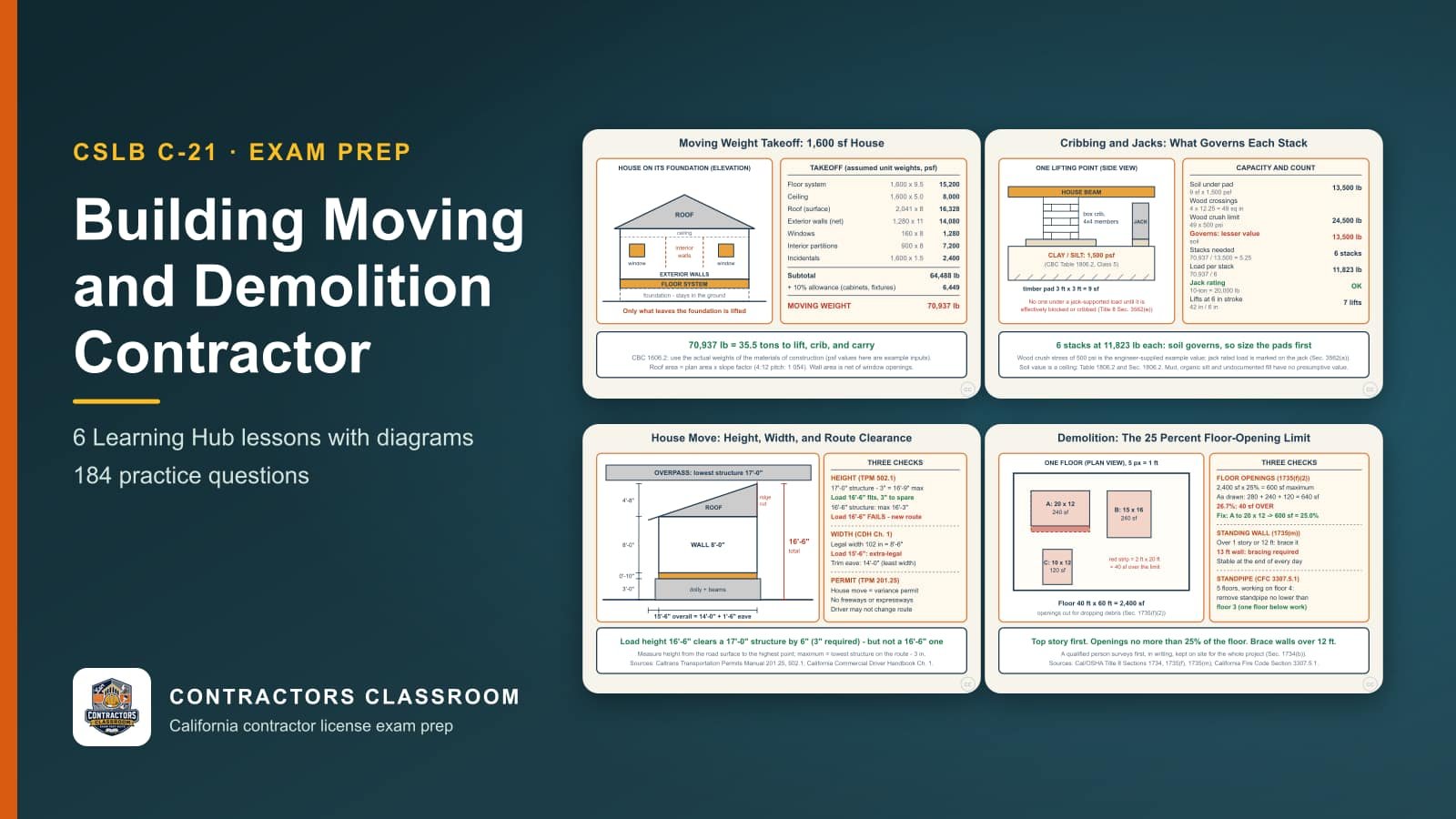
- A tall wall left unsupported after floors and roof have been removed. Beyond a set height it needs lateral bracing unless an engineer shows it can stand alone, and it has to be stable whenever the crew goes home for the day.
- Standpipe
- A vertical fire-service water pipe inside a building. During demolition it stays usable by firefighters and may be taken down with the structure, but only a limited number of floors below the level being removed.
- Covered walkway
- A protected sidewalk passage under a canopy built to carry a stated live load, with minimum width, clear height and lighting. It is one of several levels of pedestrian protection, selected from the work's height and how close it sits to the property boundary.
- Debris chute
- An enclosed inclined tube that drops waste from upper floors to a container below. Openings that are loaded by equipment need bumpers, and steep chutes need to be fully enclosed so material cannot leave the intended path.
- Debris landing area
- The ground zone where material falls through floor openings or chutes. It is fenced or barricaded back from the edge of the opening above, marked with warnings at every floor and kept free of people.
- Waste management plan
- A written plan listing which materials will be diverted from landfill, whether they are sorted on site or mixed, which facilities will accept them and how waste will be reduced. Its tickets prove the diversion percentage.
- Diversion rate
- The share of nonhazardous waste, counted in one consistent unit, that is recycled or salvaged rather than landfilled. A code threshold applies unless a stricter local ordinance sets a higher one, and excavated soil is treated separately.
- Deconstruction
- Taking a building apart in careful stages to recover reusable fixtures, lumber, metals and masonry rather than crushing everything. It takes more labor than mechanical demolition but raises salvage value and diversion.
- Needle beam
- A heavy steel beam passed through openings cut in the foundation or floor system to carry a building during raising and moving. Together with the main beams it spreads the structure's weight to the jacks and dollies.
- Moving dolly
- A wheeled carriage set under the support beams so a lifted structure can roll to the truck or onto the route. Its capacity must exceed the load on it, and the whole assembly adds to the height of the move.
- Cribbing
- Stacks of timber laid in alternating layers to hold a lifted load while people work beneath. The jack does the lifting; the stack carries the load and is only as strong as its crossings and the ground below.
- Lifting point
- A planned location where a jack and beam attach to the structure. Splitting the building's weight evenly among these locations gives each jack and stack its share of the weight, and that share has to stay below the rating marked on the jack.
- Presumptive bearing value
- A code-listed safe pressure a given soil type can carry without a special study, expressed in pounds per square foot. It is a ceiling, and very soft or undocumented fill gets no presumptive value, which governs how large cribbing pads must be.
- Oversize load
- A vehicle and cargo wider, taller or longer than the standard legal limits. A house on dollies is one, so it moves only on an authorized route, with warning signs, escorts as required, and within daylight and visibility limits.
- Least dimension
- The smallest size a load can be reduced to before being moved. Authorizations are issued for that reduced size, so roof overhangs, chimneys and projections are cut or removed first, and the true widest point is then measured.
- Abrasive cut-off saw
- A gas or electric saw with a spinning abrasive wheel for cutting steel beams and pipe. It throws sparks and fragments, so it calls for a face shield and gloves, and brings fire risk wherever flammable debris is present.