CSLB C-51

Structural Steel Contractor License Exam Prep (C-51)

Getting ready for the California structural steel contractor license exam (CSLB C-51)? Study with 184 practice questions in 2 categories and 6 Learning Hub lessons, made for structural steel erectors and ironworkers, with the Law and Business exam included.

One-time purchase, no subscription. Law & Business included.

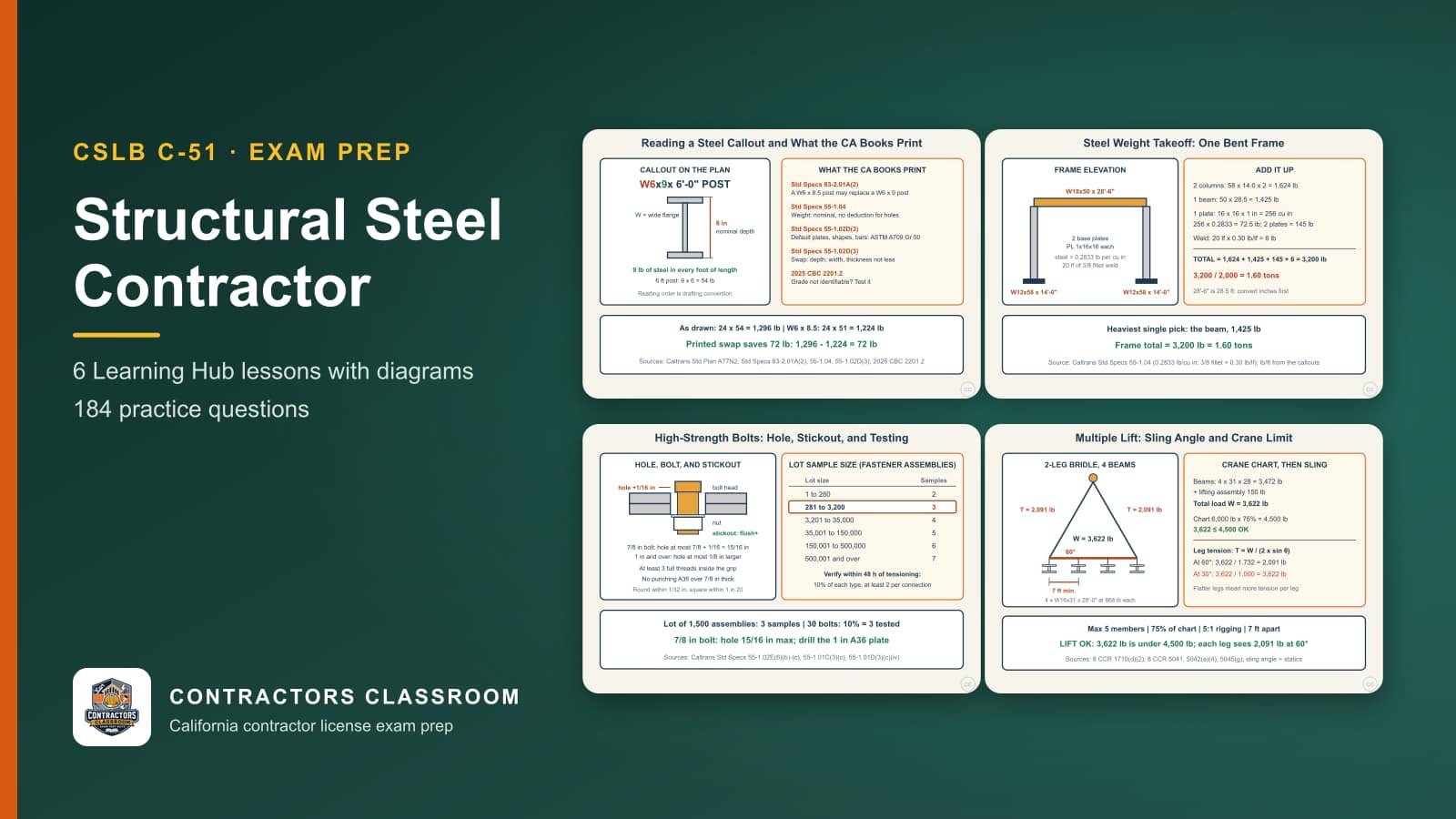
Diagrams from the C-51 structural steel contractor lessons: Reading Steel Callouts, Substitutions, and Material Identity, Steel Weight Takeoff: Pounds per Foot, Plates, Welds, and Tons, High-Strength Bolts: Assemblies, Holes, and Caltrans Verification Testing and Sling Angles and the Multiple-Lift Rules
184practice questions
2categories
6Learning Hub lessons
$249Law & Business included

What the exam covers: Structural Steel (C-51)

The CSLB exam for the California structural steel contractor license (C-51) is a closed-book, multiple-choice test. CSLB's official study guide divides it into five major sections and gives each an approximate weight: Planning and Estimating (about 20%), Job Preparation (about 13%), Shop Fabrication (about 18%), Field Erection (about 25%), and Safety (about 24%).

Field Erection carries the most weight, about 25%, so it deserves roughly that share of your study time, with Safety next at about 24%.

Contractors Classroom turns that outline into 184 practice questions in 2 categories (Planning and Estimating and Cal-OSHA Steel Erection Safety Orders (Article 29)), plus 6 Learning Hub lessons with diagrams (such as "Reading Steel Callouts, Substitutions, and Material Identity" and "Steel Weight Takeoff: Pounds per Foot, Plates, Welds, and Tons"). Law and Business, which most applicants take alongside their trade exam, is included at no extra charge.

Exam sections and approximate weights

  • Planning and Estimating~20%
  • Job Preparation~13%
  • Shop Fabrication~18%
  • Field Erection~25%
  • Safety~24%

Practice question categories

  • Planning and Estimating75 practice questions
  • Cal-OSHA Steel Erection Safety Orders (Article 29)109 practice questions

What the Structural Steel Contractor exam covers, section by section

Planning and Estimating (~20%)

Steel erection projects are planned from the design documents, which list members, connections and finishes. A visit to the site reveals access routes, crane positions, overhead lines and soft ground that affect the erection method. Because the steel work interacts with foundations, concrete, decking and other trades, schedules and sequences must be coordinated. Equipment needs and material quantities are then priced into a bid that covers the field and shop work.

  • Studying drawings and specifications to understand members, connections, finishes and tolerances
  • Walking the site for access, lifting space, overhead hazards and ground conditions
  • Aligning delivery and erection timing with foundation, deck and other trades on the job
  • Figuring tonnage, bolts, cranes and lifts to cover equipment and material costs

Job Preparation (~13%)

Ahead of fabrication, the steel contractor turns the design into detailed shop and erection drawings that show every piece and its mark. Delivered steel needs a suitable storage area off the ground, organized so members are easily found and not bent or corroded. Planning where each piece will sit at the site lets the crew pick in the order of erection and reduces handling.

  • Producing shop and erection drawings that show each member, mark and connection detail
  • Stacking steel on blocking in a dry spot to prevent warping, rust and damage
  • Staging pieces near their final positions in erection order to cut down repeated handling

Shop Fabrication (~18%)

In the fabrication shop, raw steel is turned into members ready for the field. Processing means cutting to length, shaping and assembling parts. Holes and slots for bolts are made to precise locations so everything lines up when erected. After fabrication, surfaces are cleaned and primed to resist corrosion, and the finished members are loaded and hauled in a way that avoids distortion and delivers them in the order needed.

  • Cutting, shaping and fitting plates and shapes into members to dimension
  • Punching or drilling holes and slots accurately so bolted connections align in the field
  • Removing mill scale and rust then coating members with primer to guard against corrosion
  • Loading, blocking and securing members for transport in the order they will be erected

Field Erection (~25%)

On site, steel goes up in a planned sequence: columns first, then beams and trusses lifted, plumbed and secured. Temporary bracing keeps the frame stable until permanent connections are made. High-strength bolts are tightened by approved methods so connections carry load as designed, and welded joints are made, inspected and finished so the structure acts as a unified frame.

  • Lifting and setting columns, plumbing them and bracing the frame during erection
  • Placing beams and trusses accurately and securing them with temporary connections
  • Tightening high-strength bolts in the proper pattern so joints grip as intended
  • Welding connections and grinding or touching up joints for strength and appearance

Safety (~24%)

Ironworkers spend their days at height, under suspended loads and around heavy equipment, so safety planning is part of every lift. Elevated work needs fall protection and secure footing. Hoisting and rigging depend on sound slings, signals and clear drop zones. Hazards must be reported and corrected before work proceeds, lift equipment must be operated by trained people, and personal protective equipment (PPE) such as hard hats, harnesses and eye protection must be worn consistently.

  • Using harnesses, lanyards and secure footing while moving along beams and decks above ground
  • Inspecting slings and hardware and signaling clearly so loads travel under control
  • Reporting and fixing hazards such as loose materials or missing protection straight away
  • Operating booms, lifts and similar machines only after training and equipment checks
  • Wearing hard hats, eye protection and other personal protective equipment all day

Code books behind the Structural Steel Contractor exam

The exam outline published for this trade lists these references.

  • 2025 California Building CodeThe building code chapters on structural steel, structural design and special inspections frame how steel buildings must be built and verified. For an erector it ties together material identification, bolting and welding verification, seismic detailing requirements and fabricator documentation, so it supports Planning and Estimating, Job Preparation and the connection work in Field Erection.
  • California Vehicle CodeThe vehicle code matters to steel work because members are long, heavy and often oversize when hauled from the shop to the site. It addresses load dimensions, projection flags, permits for oversize and overweight transport, and securement, which feeds the loading-and-transporting items of Shop Fabrication and the delivery logistics of Job Preparation.
  • Standard Symbols for Welding, Brazing, and Nondestructive Examination, A2.4This is the standard for reading a weld symbol on a shop drawing: reference line, arrow side and other side, fillet and groove designations, field-weld flags, all-around marks and the tail for notes or process references. A candidate uses it to decode what size, type and location a joint calls for, relevant to Shop Fabrication and Field Erection.
  • State of California Construction & Electrical Safety Orders (Cal/OSHA)The construction safety orders include the steel erection article: column anchorage, connector and decking-zone fall rules, bolting of beams before release, hoisting and rigging, crane and lift equipment, welding and cutting practices. They feed the Safety section, about a quarter of the exam, and the erection steps in Field Erection where safe sequence is part of the correct answer.
  • Steel Construction ManualThe main steel designer's and detailer's reference lists shape dimensions and weights, section properties, member and connection tables, bolt and weld data, and the governing specification. A contractor leans on it to look up weights for estimating, understand connection types and recognize shape designations, so it feeds Planning and Estimating and Job Preparation heavily.
  • Structural Welding Code – SteelThe principal welding code for structural steel covers joint design, prequalified procedures, welder and procedure qualification, workmanship, preheat, inspection and acceptance criteria. For this trade it explains when a welding procedure specification needs supporting qualification data and what makes a weld acceptable, so it is the core reference for welding and finishing joints in Field Erection.
  • Structural Welding Code – Sheet SteelThis companion code applies to thin steel, such as light-gauge framing, formed decking and cold-formed shapes, where burn-through, distortion and joint types differ from heavy plate work. It matters when an erector welds deck, studs or light members to the frame, and it supplements the heavier-steel code in the welding items of erection and fabrication.
  • Structural Welding Code – Reinforcing SteelThis code deals with welding reinforcing bars, including splices, attachments to structural shapes, preheat and the effect of bar chemistry on weldability. Erectors meet it where rebar connects to embedded plates, base plates or steel members, so it supports the joint and connection questions at the point where steel meets concrete reinforcement.

Key terms for the Structural Steel Contractor exam

Wide-flange shape
The familiar I-shaped rolled steel section with parallel flanges, named by its nominal depth and weight per foot. Reading a designation such as depth followed by pounds per foot tells you what to order, how much it weighs and how to rig it.
Base plate
The flat steel plate welded to the bottom of a column that spreads its load onto the concrete foundation and receives the anchor rods. Setting it level and on the right bearing material is a key step before columns are plumbed.
Anchor rod
A threaded rod cast or drilled into foundation concrete to hold a column base. Its projection, location and nuts must match the drawings, and the concrete must be strong enough before erection loads it.
Continuity plate
A stiffener welded between a column's flanges, level with a beam flange, in a moment connection so the column web and flange do not buckle or distort under the beam's force. It is the plate most associated with rigid frames.
Moment connection
A beam-to-column joint designed to resist rotation and transfer bending, not just shear, so the frame resists lateral loads such as earthquakes. It uses bolted or welded flanges, and workmanship on it is closely inspected.
Shear tab
A single plate welded to a support and bolted to a beam web, carrying vertical reaction but little moment. Simple and common, it lets the erector hang a beam quickly and secure it with a few bolts before final tightening.
Snug-tight
The condition reached when plies are in firm contact, typically after a few impacts of an impact wrench or the full effort of a worker using an ordinary spud wrench. Many connections only require this, while others need pretension.
Turn-of-nut method
A way to pretension a high-strength bolt by first snugging it, match-marking the nut, then rotating a prescribed fraction of a turn that depends on bolt length. Proper marks make the work verifiable by inspection.
Direct tension indicator
A hardened washer with small protrusions that flatten as a bolt is tightened, so a feeler gauge shows whether required clamping force was reached. It makes pretension measurable at the joint without special torque equipment.
Faying surface
The contact surface between two plies joined by bolts or welds. Its coating, paint, oil or rust condition can change friction in a slip-critical joint, so surfaces are prepared and kept clean according to the connection type.
Welding procedure specification
A written recipe for making a weld: process, filler metal, joint design, position, preheat, current and travel details. It must be backed by qualification data unless it falls under a prequalified category in the welding code.
Procedure qualification record
The documented test evidence showing that a given welding procedure actually produces a sound weld, listing parameters used and mechanical test results. A non-prequalified procedure specification is paired with one.
Complete joint penetration weld
A groove weld that fills the full thickness of the joint so the weld carries the same stress as the base metal. It often needs backing, back-gouging and ultrasonic or other testing, especially in moment connections.
Fillet weld
A roughly triangular weld joining two surfaces at right angles, such as a tab to a beam web. Its size is measured by leg length, and undersized or poorly fused fillets are among the most common field defects.
Weld symbol
The shorthand mark on a drawing that tells a welder what to make: a reference line carrying the weld type, size and length, an arrow pointing to the joint, optional field-weld flag and a tail for notes.
Camber
A slight upward curve built into a beam in the shop so that it flattens to level when the expected dead load is applied. The ironworker needs to set it with the curve up, or the floor will sag further.
Sling angle
The angle between a sling leg and the horizontal. The flatter the angle, the greater the tension in each leg for the same load, so a low angle can overload a sling even though the load is well within the hook's capacity.
Controlled decking zone
A defined area, in a building under construction, where decking crews work with limited fall-protection rules while following strict limits on size, access and training. It is a narrow exception used only for initial deck laying.

Where to spend practice time for the Structural Steel Contractor exam

  • Field erection (25 percent)Field Erection is the largest section at about a quarter of the exam. Rehearse the full sequence: anchor rods and base plates, columns, beams, trusses, temporary bolts, plumbing up, final bolting and welding. Compare connection types and the checks that follow each one, and be able to say which step must be complete before the next.
  • Bolts and welds, cause and checkBecause erection includes installing high-strength bolts and welding joints, those items deserve their own review. Study the three tightening methods and when each is accepted, what the weld procedure paperwork must show, how to read a weld symbol, and common weld defects. Practice describing a correct connection from the drawing to the final inspection.
  • Safety: hoisting, rigging and heights (24 percent)Safety is about 24 percent, only a point below erection, and the practice categories lean heavily on the steel erection orders. Work through sling angles and capacity, multiple-lift limits, connector and perimeter protection, column anchorage rules and lift equipment. Ask who is competent to decide, and what must be inspected before work begins.
  • Planning, weights and takeoff mathPlanning and Estimating is about 20 percent and often involves weight arithmetic. Practice pounds per foot times length, plate weight from dimensions, galvanizing priced by the ton, converting pounds to tons and adding connection material. Learn to read callouts such as shape, grade and length so the quantities you pull are for the right member.
  • Shop fabrication (18 percent)Shop Fabrication processes steel before it ships. Review cutting, drilling, punching and slotting; hole types and sizes; cleaning and priming; camber; marking; and how members are loaded and secured for the road. Practice linking a shop drawing note to the operation it requires, and thinking about what an erector needs to be marked on each piece.
  • Job preparation and site coordination (13 percent)Job Preparation is the smallest section, but it connects planning to erection. Study how erection drawings are developed, how material is stored off the ground and sorted for sequence, and how placement is determined. Review how other trades' work, such as foundations and embeds, affects when steel can start and what must be verified first.

Scenarios to talk through before the Structural Steel Contractor exam

  • Rods short of the planThe erection crew arrives and finds that several anchor rods stick out less than the drawings show, and the footing was poured only two days ago. Consider base plates, nuts, rod location and the concrete's readiness. What do you stop, who decides what to do about the rods, and what must be documented before columns are set?
  • Choosing how to tighten boltsA connection on the drawings calls for high-strength bolts, and the erector must choose how to bring them up. Compare snug-tight, the turn-of-nut method and a direct tension indicator washer. Which details does the drawing decide, what must the faying surfaces look like, and how will an inspector verify the result?
  • Field splice weld paperworkA splice must be welded in the field, and the weld symbol on the drawing has a note in its tail. Work through the weld symbol, the welding procedure specification, the procedure qualification record, the welder's qualification and whether the joint is a fillet or a complete joint penetration weld. What paperwork would you want in hand before striking an arc?
  • A low sling angle on a long beamA long beam is to be picked from the storage area with a two-leg sling, but the leg length forces a very flat angle. Reason through sling angle, tension in each leg, the marked capacity, a spreader beam, tag lines and camber orientation. What would you change before the hook takes any weight?
  • Decking crew at mixed heightsConnectors are working at one floor level while a decking crew starts laying deck on the floor above. Consider the controlled decking zone, perimeter cables, openings around columns and the heights that drive the rules. Who is allowed where, what training is assumed, and what would make you stop and rearrange the work?
  • Moment frame without stiffenersWhile reviewing a beam-to-column joint for a rigid frame, you notice the column delivered has no continuity plates, yet the shop drawing shows them. Think through moment connections, base plates, the shop drawing and what the plates do. Who do you contact, what do you not install, and what records do you keep?
  • Hauling long tubes to the siteThe shop will truck several very long tubes to a job across town. Consider galvanizing and vent holes, how the pieces are loaded and secured, projecting-load rules in the vehicle code, shipping marks and where they will be stored at the site. What could go wrong in transit, and what would you check on arrival?
  • Site visit before erectionBefore bidding an erection job, you walk the site. Think about crane access and overhead lines, storage and sorting of members by sequence, how foundations and embedded items will be checked, and who else is working in the area. Which findings would change the plan, the sequence or the equipment you intend to bring?

Learning Hub lessons

Each lesson has guided steps, a diagram, a worked example and a quick check inside the classroom.

Preview the lesson diagrams

  1. Reading Steel Callouts, Substitutions, and Material IdentitySteps: A Callout Is a Recipe, Not a Name; Weights Are Nominal Weights; A Substitution Is Written Permission, Not a Shop Habit; The Material Grade Rides with the Shape; Special Inspection Follows the Steel
  2. Steel Weight Takeoff: Pounds per Foot, Plates, Welds, and TonsSteps: Why Every Steel Bid Starts with Weight; Linear Members: Pounds per Foot x Length in Decimal Feet; Plates: Volume x 0.2833 Pounds per Cubic Inch; Count the Small Steel the Payment Rules Count; Total It, Then Convert to Tons
  3. High-Strength Bolts: Assemblies, Holes, and Caltrans Verification TestingSteps: What Makes Up a High-Strength Fastener Assembly; Hole Sizes and Preparation; Installing the Assembly; Test the Lot Before You Install; Verification Testing After Tightening
  4. Sling Angles and the Multiple-Lift RulesSteps: Sling Tension Depends on the Angle; Find the Angle, Then Check the Marking; The Multiple-Lift Rules in California; Capacity Limits: 5-to-1 and 75 Percent; Rigging Order, Spacing, and Who Stands Under the Load
  5. Column Anchorage, Two-Bolt Release, and Double ConnectionsSteps: Do Not Start Until the Concrete Is Ready; Four Anchor Rods and the 300 Pound Test; Competent Person and Rod Changes; The Two-Bolt Rule Before the Load Is Released; Double Connections at a Column
  6. Fall Protection on Skeleton Steel: Connector Heights, Perimeter Cable, and the CDZSteps: Connector Fall Protection Depends on Two Heights; Whichever Is Less: Story Height Changes the Limit; Perimeter Cable and Column Holes; The Controlled Decking Zone Is a Narrow Exception; CDZ Layout Limits

See the classroom in action

Frequently asked questions

How do I get a California structural steel contractor license?

A structural ironworker or steel erector who wants to contract independently applies under C-51. CSLB generally requires documented journey-level experience, a bond, and passing scores on both the Law and Business exam and the C-51 exam. Rules change, so confirm them with CSLB.

What does the structural steel contractor exam ask about field erection?

Field Erection is the heaviest part of the C-51 exam, at about 25%. Expect questions on lifting and setting columns, plumbing them and bracing the frame during erection, placing beams and trusses accurately and securing them with temporary connections, and tightening high-strength bolts in the proper pattern so joints grip as intended. Next in weight come safety (about 24%) and planning and estimating (about 20%).

What kinds of questions are on the structural steel contractor exam?

The three sample questions in CSLB's C-51 study guide ask about the cost of galvanized steel tubes, what a weld procedure specification needs for a non-qualified weld, and what a moment connection usually contains. Like every question on the exam, each has four choices and one best answer.

Which codes and books does the C-51 exam reference?

CSLB's C-51 study guide lists the 2025 California Building Code (Title 24), the Cal/OSHA safety orders (Title 8), and trade references such as Steel Construction Manual (AISC), AWS D1.1, D1.3 and D1.4 structural welding codes, and Standard Symbols for Welding, Brazing, and Nondestructive Examination. Use them to study; the exam itself is closed-book.

Is the structural steel contractor exam open book?

No. The C-51 study guide says no reference materials may be used, even though it names Steel Construction Manual (AISC) and AWS D1.1, D1.3 and D1.4 structural welding codes among the books to study from. A calculator is provided, and guessing is not penalized.

Can I take the structural steel contractor exam outside California?

CSLB's exam FAQ says trade exams are given in California or Oregon only, so C-51 is not offered in other states, although Law and Business can be taken out of state. Check the current PSI list when you schedule.

How are the 184 C-51 practice questions organized?

They are split into 2 categories, largest first: Cal-OSHA Steel Erection Safety Orders (Article 29) (109) and Planning and Estimating (75). Cal-OSHA Steel Erection Safety Orders (Article 29) holds about 59% of the questions. 6 Learning Hub lessons add diagrams and worked examples for the harder topics. The missed-question review collects every question you get wrong.

Is there a free trial for structural steel contractor exam prep (C-51)?

Yes. The free C-51 preview opens the real classroom with no sign-up and gives you the first question from every C-51 category, including Cal-OSHA Steel Erection Safety Orders (Article 29) and Planning and Estimating, plus Law and Business. The full course is a one-time $249 purchase.

Is structural steel contractor exam prep available in Spanish?

The website and the eight demo videos are available in Spanish. The classroom and the 184 C-51 practice questions are in English for now; translating the questions is not part of the course yet.

Ready to practice for real?

Try the real classroom free, no sign-up, or get the full course for your trade.

Independent exam preparation. Contractors Classroom is not affiliated with the Contractors State License Board, and no course can guarantee a passing result.


