CSLB C-57

Well Drilling Contractor License Exam Prep (C-57)

Getting ready for the California well drilling contractor license exam (CSLB C-57)? Study with 184 practice questions in 2 categories and 6 Learning Hub lessons, made for water well drillers, with the Law and Business exam included.

One-time purchase, no subscription. Law & Business included.

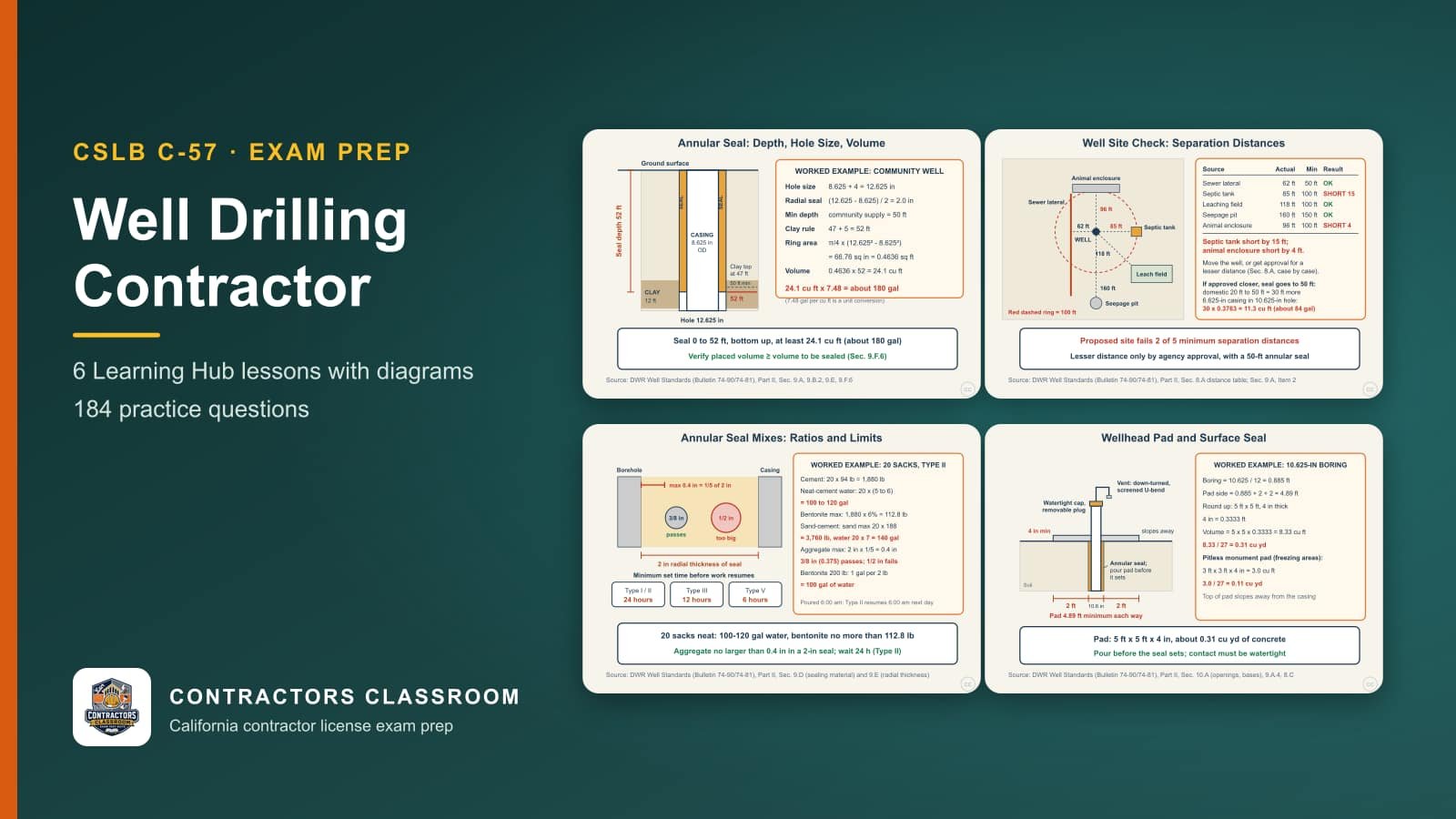
Diagrams from the C-57 well drilling contractor lessons: Annular Seal: Depth, Hole Size, and Seal Volume, Siting a Well: Separation Distances and the Encroachment Seal, Annular Seal Mixes: Ratios, Additives, and Set Times and Wellhead Pad and Surface Seal: Sizing the Base and Sealing Openings
184practice questions
2categories
6Learning Hub lessons
$249Law & Business included

What the exam covers: Well Drilling (C-57)

The CSLB exam for the California well drilling contractor license (C-57) is a closed-book, multiple-choice test. CSLB's official study guide divides it into seven major sections and gives each an approximate weight: Planning and Estimating (about 18%), Water Well Drilling and Well Development (about 24%), Geotechnical Borings and Environmental Wells (about 7%), Water Distribution System Installations (about 12%), Water Distribution System Repairs (about 7%), Water Well Rehabilitation and Destruction (about 11%), and Safety (about 21%).

Water Well Drilling and Well Development carries the most weight, about 24%, so it deserves roughly that share of your study time, with Safety next at about 21%.

Contractors Classroom turns that outline into 184 practice questions in 2 categories (Planning and Estimating and Cal-OSHA Drilling Rig Safety & Environmental Protection), plus 6 Learning Hub lessons with diagrams (such as "Annular Seal: Depth, Hole Size, and Seal Volume" and "Siting a Well: Separation Distances and the Encroachment Seal"). Law and Business, which most applicants take alongside their trade exam, is included at no extra charge.

Exam sections and approximate weights

  • Planning and Estimating~18%
  • Water Well Drilling and Well Development~24%
  • Geotechnical Borings and Environmental Wells~7%
  • Water Distribution System Installations~12%
  • Water Distribution System Repairs~7%
  • Water Well Rehabilitation and Destruction~11%
  • Safety~21%

Practice question categories

  • Planning and Estimating75 practice questions
  • Cal-OSHA Drilling Rig Safety & Environmental Protection109 practice questions

What the Well Drilling Contractor exam covers, section by section

Planning and Estimating (~18%)

Drilling jobs are won or lost on early judgment. Before a rig arrives, the contractor studies the location and likely ground conditions, picks a drilling method and the casing and screen materials that fit, and works out what time, machinery, and consumables the job will really cost.

  • Study the location, access, and expected underground formations before committing to a plan
  • Choose drilling rigs, casing, screens, and other supplies suited to the job
  • Add up labor, equipment time, and materials into a dependable price

Water Well Drilling and Well Development (~24%)

This is the central craft of the license: taking a well from bare ground to a working source of water. The work moves from positioning the rig and preparing the site, through boring the hole, to installing casing and screen and sealing the annulus, and then keeping watch over how the well performs.

  • Position the rig, prepare the pad, and arrange fluids and tooling
  • Advance the borehole while logging the soil and rock encountered
  • Install casing, screen, filter pack, and seals that protect the aquifer
  • Track water levels and output to confirm the well performs as intended

Geotechnical Borings and Environmental Wells (~7%)

Not every hole is meant to produce water. Some are drilled to learn what the ground is made of before building on it, and others are installed to sample or watch groundwater for contamination. Each purpose affects how deep the work goes, what gets collected, and how the opening is finished.

  • Drill test holes that reveal soil and rock properties for engineers
  • Install monitoring wells that sample groundwater without spreading contamination

Water Distribution System Installations (~12%)

A good well is only useful if water actually reaches the people or crops that need it. This area covers the pumping equipment that lifts and pressurizes water, along with the pipes, tanks, and controls that carry it from the wellhead to the point of use.

  • Select and install pumps and motors sized to lift and pressurize the water
  • Lay out piping, storage, and controls that deliver water to where it is used

Water Distribution System Repairs (~7%)

When water stops flowing or pressure drops, the cause could be anywhere between the pump and the faucet. Repair work depends on diagnosing which part has failed, pulling and servicing mechanical equipment, and fixing the lines and fittings that carry water onward.

  • Diagnose, pull, and rebuild or replace worn pumps and motors
  • Locate and fix leaking or damaged lines, fittings, and related components

Water Well Rehabilitation and Destruction (~11%)

Wells age. Screens clog, production slips, and eventually some are no longer worth keeping. This area looks at restoring an older well to useful output and at permanently closing one that is abandoned, so it cannot become a path for surface pollution to reach the aquifer or a hazard to people.

  • Clean and treat an aging well to bring its output back
  • Seal an unused well permanently to protect groundwater and public safety

Safety (~21%)

A drilling site combines tall masts, rotating tools, high-pressure fluids, and heavy trucks, so mistakes can hurt someone quickly. Safety covers how crew members protect themselves and each other, how the rig and surrounding area are controlled, and how any chemicals or contaminated material encountered are handled responsibly.

  • Protect crew members through training, protective gear, and clear communication
  • Control the rig area, moving parts, overhead hazards, and power lines nearby
  • Handle fuels, additives, and potentially contaminated cuttings and water correctly

Code books behind the Well Drilling Contractor exam

The exam outline published for this trade lists these references.

  • AIM Manual, 60 Hz Submersible MotorsA motor manufacturer's application, installation and maintenance manual for submersible pump motors. It covers motor and pump matching, cable size and voltage drop, cooling flow past the motor, control boxes, amperage readings, insulation resistance testing and troubleshooting. It is the reference behind the pump systems topics in Water Distribution System Installations and the pump system repair topics in Repairs.
  • Bulletin 74-81: Water Well Standards and Bulletin 74-90: California Well StandardsThese state bulletins set the minimum rules for building, repairing and destroying wells: how far a well sits from pollution sources, annular seal depth and materials, casing, surface features, disinfection and destruction of abandoned wells. They are the reference behind the water well drilling sections, the environmental wells topic, and rehabilitation and destruction of wells.
  • California Commercial Driver HandbookDrill rigs, pump hoists and supply trucks are heavy commercial vehicles, and this handbook covers their legal weights and sizes, air brakes, load securement, pre-trip checks and road hazards. A driller relies on it for moving equipment between sites, which affects both Planning and Estimating (mobilization) and the equipment safety items in Safety.
  • The Drilling ManualAn industry training text on drilling methods and equipment: cable tool, rotary, air, mud and auger techniques, bits, drilling fluids, casing and sampling, rig operation and drilling hazards. It gives the vocabulary and judgment for choosing a method to suit the formation, so it feeds Water Well Drilling, Geotechnical Borings, and equipment selection in Planning.
  • Groundwater and WellsA classic text on groundwater hydrology and water well design. It explains aquifers, confining layers, well hydraulics, screen and filter pack selection, development, pumping tests, corrosion and incrustation, and rehabilitation. It builds the understanding behind site evaluation, well construction and monitoring, and the Well Rehabilitation topics.
  • State of California Construction & Electrical Safety Orders (Cal/OSHA)The construction safety orders cover hazards that drilling crews meet daily: raising and lowering masts, overhead power lines, rotating shafts and drill rod handling, excavations and pits, noise and dust, and hazardous substances at contaminated sites. They are the reference for the Safety section, which spans employee, job site and equipment safety and hazardous materials.

Key terms for the Well Drilling Contractor exam

Annular space
The ring-shaped gap left between the outside of the pipe lining a well and the wall of the hole around it. Because it can carry surface water straight down along the casing, it is filled and sealed through the required interval, and the hole is drilled oversized to leave room for that fill.
Annular seal
Cement, concrete or bentonite placed in the annular space so contamination cannot travel down beside the casing. Its minimum depth depends on well use, it must be continuous, and the volume actually placed should at least match the volume of the space.
Conductor casing
A temporary or permanent outer pipe set through loose, caving ground at the top of a borehole to keep it from collapsing during drilling and sealing. When temporary, it is pulled back as the seal material is placed.
Tremie pipe
A pipe lowered to the bottom of an interval so grout or sealing material is delivered from the bottom upward. It prevents free-fall, bridging and dilution by water, which would leave voids or weak spots in the seal.
Neat cement
Portland cement mixed only with water, with no sand or aggregate, at a stated water-to-cement proportion per sack. It is a standard sealing material, and variations from the stated proportions need prior agreement from the enforcing agency.
Centralizer
A spring or rigid guide fastened to the casing that holds it in the middle of the borehole. It keeps an even thickness of seal material all the way around, which is why it is required unless removable tools center the casing.
Pitless adapter
A fitting bolted or welded to the casing below the frost line that carries water sideways out of the well and leaves the top clean. It removes the need for a pit or vault and lets the pump be pulled without opening the discharge line.
Well screen
A slotted or wire-wound section of casing set opposite the water-bearing layer. Its slot size is matched to the grain size of the formation or filter pack so water enters freely and sand stays out.
Gravel pack
Clean, sized gravel placed around a screen to increase its effective opening, filter out fine particles and stabilize the hole. It must come from a clean source, be washed and receive disinfectant as it is placed.
Well development
Working a new well with surging, jetting or pumping to remove drilling fluid and fines near the screen and open the formation. A well that is properly developed produces clear water at its best yield.
Static water level
The depth to water in a well when no pumping is occurring and levels have settled. It is the starting point for every drawdown reading and for measuring the water-filled length of casing.
Drawdown
How far the water level in a well drops below the static level while it is being pumped. It rises with pumping rate and is used with the yield to judge the well's performance and where to set the pump.
Specific capacity
The yield of a well per foot of drawdown, usually in gallons per minute. A decline in this figure over time signals a clogging screen or falling aquifer, so it is a basic measure of both performance and need for rehabilitation.
Mud rotary drilling
A method where a rotating bit cuts the hole while circulating drilling fluid carries cuttings up and holds the borehole open. The fluid must be clean enough not to contaminate the well and is removed during development.
Hollow-stem auger
A continuous-flight auger with an open center that lets samplers or casing pass through while the flights hold the hole open. It is common in shallow, unconsolidated ground for geotechnical and environmental borings, and its tools can center casing.
Split-spoon sampler
A tube that splits lengthwise, driven into the soil at the bottom of a boring to bring up a sample and a blow-count record. Geotechnical borings use it to learn soil layers and strength at set depths.
Monitoring well
A small-diameter well built to sample groundwater or measure its level, rather than to supply water. Environmental versions need clean construction, careful sealing and decontaminated tools so the sample represents the aquifer.
Submersible pump motor
A sealed electric motor mounted below the pump bowls and operated under water inside the casing. It depends on adequate flow past it for cooling, correct cable size and voltage, and proper control equipment to avoid burnout.
Sounding tube
A small pipe or access fixed beside the pump so a probe can measure water level without disturbing the equipment. The opening must be capped or plugged, since any hole at the wellhead can admit contaminants.

Where to spend practice time for the Well Drilling Contractor exam

  • Drilling, casing, sealing and developmentThe water well drilling section is about 24 percent of the exam, covering setup, drilling, construction and monitoring. Practice choosing a drilling method for a formation, sequencing casing, screen, gravel pack and annular seal, working out seal volume from hole and casing diameters, and describing development and pumping tests. Compare minimum seal depths by well type and the separation distances from pollution sources.
  • Rig, equipment and chemical safetySafety is about 21 percent and covers the crew, the site, the rig and hazardous materials. Review mast raising near overhead lines, guarding of rotating parts, handling of drill rods and pipe, noise and dust, fuel and chlorine storage, and what to do when drilling meets contaminated soil. Practice identifying the single safest action in each scenario.
  • Site evaluation and cost calculationPlanning and Estimating is about 18 percent and spans evaluating the site, picking equipment and materials, and calculating cost. Practice reading hydrogeology clues about depth and formation, selecting casing and screen for a depth and water quality, and converting drilling footage, material and equipment hours into a price that actually covers the job. Take care with the arithmetic that separates a loss from a gain when actual cost exceeds the estimate.
  • Pumps, pitless units and delivery pipingWater Distribution System Installations (about 12 percent) and Repairs (about 7 percent) together make a substantial block. Review pump and motor selection, wiring and controls, pitless adapters, pressure tanks, piping to the point of use, and trench rules where electrical, telephone and water lines meet. For repairs, practice a stepwise approach to failed pumps, low pressure and leaking delivery lines.
  • Rehabilitation and destruction of wellsWater Well Rehabilitation and Destruction is about 11 percent. Compare ways to restore a declining well, such as cleaning screens, chemical treatment and redevelopment, with the procedure for destroying an abandoned one. Practice reading a fill plan by formation, placing material from the bottom up, verifying volume, and remembering disinfection dosing by casing diameter and water-filled length.
  • Geotechnical borings and environmental wellsGeotechnical Borings and Environmental Wells are about 7 percent, the smallest block, yet the vocabulary differs from water supply work. Review sampling devices, hollow-stem and other auger methods, logging soil layers, building monitoring wells with clean materials, decontaminating tools between holes and sealing borings when they are finished.

Scenarios to talk through before the Well Drilling Contractor exam

  • A hole larger than plannedMidway through a borehole the bit has cut a larger diameter than the plan assumed, and the casing is already on the rack. Think about the oversize requirement, the thickness of seal around the pipe, centralizers, how the volume to place is recalculated, and what to confirm afterward.
  • Clay near the seal bottomThe driller logs a significant clay layer a few feet below the planned bottom of the surface seal for a small domestic well. Consider what that does to the seal depth, what the well type sets as a minimum, and how the logging record supports the decision.
  • A site close to a septic fieldThe only open spot for a new domestic well is near a leach field and an animal enclosure. Walk through the separation distances to compare, when a smaller distance could even be considered, what extra seal protection results, and which conditions of gradient and flooding to check.
  • Cement mix in the cold morningA crew mixing neat cement for the annular seal wants to add more water for easier pumping and use plastic casing. Discuss the allowed proportions, who must agree to a variation, why heat of hydration matters for the casing, and the waiting time before work continues.
  • Finishing the wellheadThe pump is set and the drilling rig is leaving. Look at the top of the casing: which openings must be capped or screened, how the concrete base is shaped and sized, how a pitless adapter changes the surface details, and what keeps backflow and flood water out.
  • A new domestic well is ready for useThe well is developed and the pump is running, but the owner wants to connect to the house tonight. Describe the disinfection step, how the chlorine quantity relates to casing diameter and water-filled length, what waiting and flushing follow, and what laboratory result closes the job.
  • A submersible pump trips repeatedlyA customer's submersible pump runs briefly and then trips, and the water level has been dropping each summer. Think about drawdown, specific capacity, cable and voltage readings, the motor's cooling flow, and whether the pump setting, the screen or the controls are the likelier cause.
  • Abandoned well on a lot to be builtA developer finds an old unused well on a residential lot. Discuss how the well is investigated and cleaned first, how fill is chosen by formation, how material is placed from the bottom and checked against the empty volume, and how the upper part is finished below grade.

Learning Hub lessons

Each lesson has guided steps, a diagram, a worked example and a quick check inside the classroom.

Preview the lesson diagrams

  1. Annular Seal: Depth, Hole Size, and Seal VolumeSteps: What the Annular Seal Is For; Minimum Depth by Well Type; Clay Layers Near the Bottom of the Seal; Oversized Hole and Radial Thickness; Seal Volume and Placement
  2. Siting a Well: Separation Distances and the Encroachment SealSteps: Why Location Is a Code Item; The Four Printed Distances; Greater or Lesser Distances; Gradient, Flooding, Drainage, and Access; Shallow Large-Diameter Community Wells
  3. Annular Seal Mixes: Ratios, Additives, and Set TimesSteps: What Is Allowed in a Seal; Neat Cement and Sand Cement Ratios; Concrete and Additive Limits; Bentonite Seals; Set Time and Heat
  4. Wellhead Pad and Surface Seal: Sizing the Base and Sealing OpeningsSteps: Why the Wellhead Is Regulated; Seal Every Opening; The Concrete Base; Pitless Adapters, Vaults, and Enclosures; Backflow, Blowoff, and Air Vents
  5. Disinfecting a Well: Chlorine Dose from Table 6Steps: When Disinfection Is Required; The Dose: 50 mg/L or 100 mg/L; Scale Table 6 to the Water Column; The Disinfection Procedure; Gravel and Lubricants
  6. Destroying an Abandoned Well: Fill Plan and Volume CheckSteps: When a Well Must Be Destroyed; Investigate and Clean Out First; What Goes Where; Placing the Fill and Verifying; Urban Lots and Temporary Covers

See the classroom in action

Frequently asked questions

How do I get a California well drilling contractor license?

A well driller or water well contractor who wants to contract independently applies under C-57. CSLB generally requires documented journey-level experience, a bond, and passing scores on both the Law and Business exam and the C-57 exam. Rules change, so confirm them with CSLB.

What does the well drilling contractor exam ask about water well drilling and well development?

Water Well Drilling and Well Development is the heaviest part of the C-57 exam, at about 24%. Expect questions on position the rig, prepare the pad, and arrange fluids and tooling, advance the borehole while logging the soil and rock encountered, and install casing, screen, filter pack, and seals that protect the aquifer. Next in weight come safety (about 21%) and planning and estimating (about 18%).

What kinds of questions are on the well drilling contractor exam?

The three sample questions in CSLB's C-57 study guide ask about the profit or loss on a pitless-adapter job, how to run electrical and telephone conduit in one trench, and what overcutting means when replacing pavement. Like every question on the exam, each has four choices and one best answer.

Which codes and books does the C-57 exam reference?

CSLB's C-57 study guide lists the Cal/OSHA safety orders (Title 8) and trade references such as California Well Standards bulletins, The Drilling Manual, and Groundwater and Wells. Use them to study; the exam itself is closed-book.

Is the well drilling contractor exam open book?

No. The C-57 study guide says no reference materials may be used, even though it names California Well Standards bulletins and The Drilling Manual among the books to study from. A calculator is provided, and guessing is not penalized.

Can I take the well drilling contractor exam outside California?

CSLB's exam FAQ says trade exams are given in California or Oregon only, so C-57 is not offered in other states, although Law and Business can be taken out of state. Check the current PSI list when you schedule.

How are the 184 C-57 practice questions organized?

They are split into 2 categories, largest first: Cal-OSHA Drilling Rig Safety & Environmental Protection (109) and Planning and Estimating (75). Cal-OSHA Drilling Rig Safety & Environmental Protection holds about 59% of the questions. 6 Learning Hub lessons add diagrams and worked examples for the harder topics. The missed-question review collects every question you get wrong.

Is there a free trial for well drilling contractor exam prep (C-57)?

Yes. The free C-57 preview opens the real classroom with no sign-up and gives you the first question from every C-57 category, including Cal-OSHA Drilling Rig Safety & Environmental Protection and Planning and Estimating, plus Law and Business. The full course is a one-time $249 purchase.

Is well drilling contractor exam prep available in Spanish?

The website and the eight demo videos are available in Spanish. The classroom and the 184 C-57 practice questions are in English for now; translating the questions is not part of the course yet.

Ready to practice for real?

Try the real classroom free, no sign-up, or get the full course for your trade.

Independent exam preparation. Contractors Classroom is not affiliated with the Contractors State License Board, and no course can guarantee a passing result.


