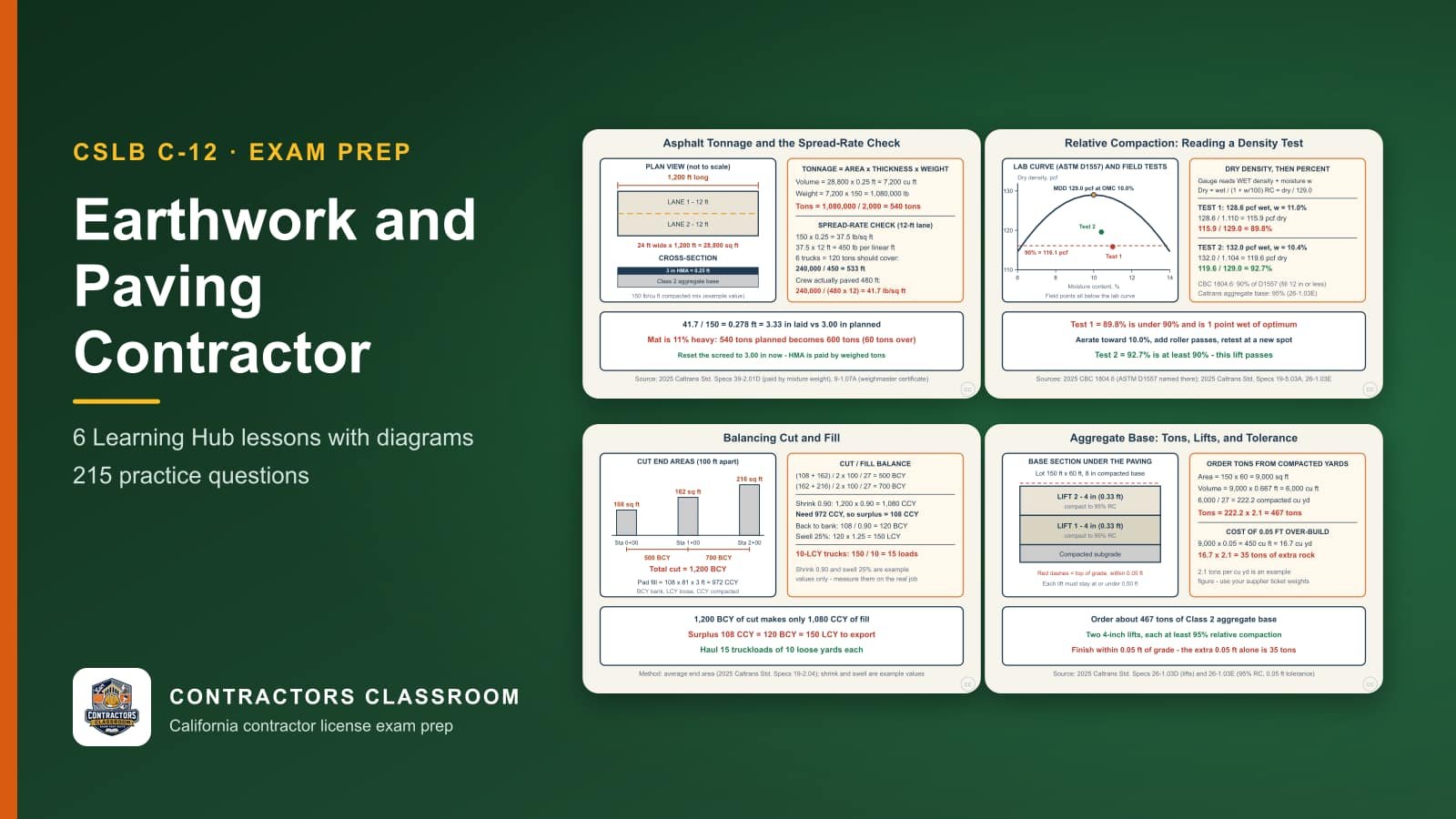
- Maximum dry density
- The heaviest dry unit weight a soil can reach in a laboratory moisture-density test, in pounds per cubic foot. It is treated as 100 percent, and every field density result is compared to it, so a wrong lab reference ruins the whole compaction check.
- Optimum moisture content
- The water percentage at which a soil packs to its greatest density under a given compactive effort. Too dry and the grains resist rearranging; too wet and water fills the voids. Crews aerate or sprinkle fill to bring it close to this value before rolling.
- Relative compaction
- The field dry density expressed as a percentage of the laboratory maximum. Specifications name a minimum percentage for each zone of fill or base, and a result below it means the lift is rejected, reworked and retested before more material covers it.
- Nuclear density gauge
- A portable instrument that measures in-place wet density and moisture by sending radiation into the ground. Because it reports wet values, the operator or inspector converts to a dry basis before comparing with the laboratory maximum. Handling it requires trained, licensed personnel.
- Bank cubic yard
- A volume of soil measured in its natural, undisturbed state, which is how surveyors and plans count excavation. The same soil becomes more yards once dug and fewer once compacted, so every cut-and-fill comparison must first convert to a common state.
- Swell factor
- The percentage by which soil grows in volume when it is dug and loosened. It sets how many yards a truck must haul compared with the yards removed from the ground, and it varies with soil type, so on a real job it comes from soils data, not memory.
- Average end area method
- A way to compute earthwork volume by averaging the cross-section areas at two stations and multiplying by the distance between them, then dividing by twenty-seven for yards. It works segment by segment along a road or pad and is the standard check on cut and fill quantities.
- Grade stake
- A marked stake set by the surveyor or layout crew that shows the vertical distance to cut or fill to reach the planned elevation at that spot. The equipment operator and the grade checker read these marks constantly, so unreadable or disturbed stakes are reset before work continues.
- Subgrade
- The prepared natural or filled soil surface that carries the pavement structure. It must be compacted, trimmed to elevation and checked before base rock goes down, since a soft or uneven subgrade shows up later as ruts, cracking and uneven thickness above it.
- Grading plane
- The finished elevation surface on which the next paving layer will sit, within a stated vertical tolerance. Where asphalt is placed, the plane is held tightly, because a plane set high makes the mat thicker than planned, and each added fraction of an inch is paid for in tons.
- Aggregate base
- A layer of crushed, graded rock placed on the subgrade to spread traffic loads and drain water. It is designed in compacted thickness, ordered by the ton, and spread in layers whose maximum thickness is limited so the roller can reach the bottom of each one.
- Lift
- One layer of fill, base or asphalt placed and compacted before the next goes on. Limiting lift thickness lets the roller energy reach the bottom, and a failed density test on a lift is corrected before it is buried under another layer.
- Leveling course
- A thin asphalt or aggregate layer spread over an irregular surface to correct its profile, so the final pavement course goes on a base that is uniform in shape and thickness. Its job is to prepare the surface for the finish grade, not to add structural strength.
- Hot mix asphalt
- A paving mixture of graded aggregate and asphalt binder heated at a plant and placed while still hot. Temperature, timing, thickness and density all control quality, and on public work it is measured and paid by weighed tons, not by plan area.
- Tack coat
- A thin sprayed film of asphalt emulsion that glues a new asphalt layer to the surface beneath, including milled surfaces and the vertical faces of curbs and joints. Too little leaves layers that slip apart; too much makes the new mat unstable.
- Residual rate
- The amount of asphalt left on the pavement after the water in an emulsion has evaporated. Specifications state tack coat by this figure, so the crew must work backward through the emulsion's residue percentage and any dilution to find how much liquid the distributor should spray.
- Weighmaster certificate
- The weight ticket issued by a licensed weighmaster for each load of asphalt, base rock or similar material. Quantities paid by the ton come from these tickets, and they let a foreman compare tons delivered against feet paved to catch a mat that is too thick or too thin.
- Material transfer vehicle
- A machine that receives asphalt from trucks, remixes it and feeds the paver hopper so the paver can keep moving. It reduces stops, heat loss and temperature segregation, which are common causes of rough, uneven mats.
- Screed
- The floating, heated plate at the rear of an asphalt paver that strikes off the mix to the set thickness, width and cross slope. Adjusting it corrects the mat thickness while paving, which is why operators watch thickness checks while the mix is still hot.
- Permeable interlocking pavers
- Concrete units with open joints, set on bedding stone over a thick open-graded stone reservoir, so rain drains through the surface and into the ground or an underdrain. They suit parking areas and driveways where stormwater must be managed, and they depend on clean joint stone.