CSLB C-27

Landscaping Contractor License Exam Prep (C-27)

Getting ready for the California landscaping contractor license exam (CSLB C-27)? Study with 184 practice questions in 2 categories and 7 Learning Hub lessons, made for landscapers, with the Law and Business exam included.

One-time purchase, no subscription. Law & Business included.

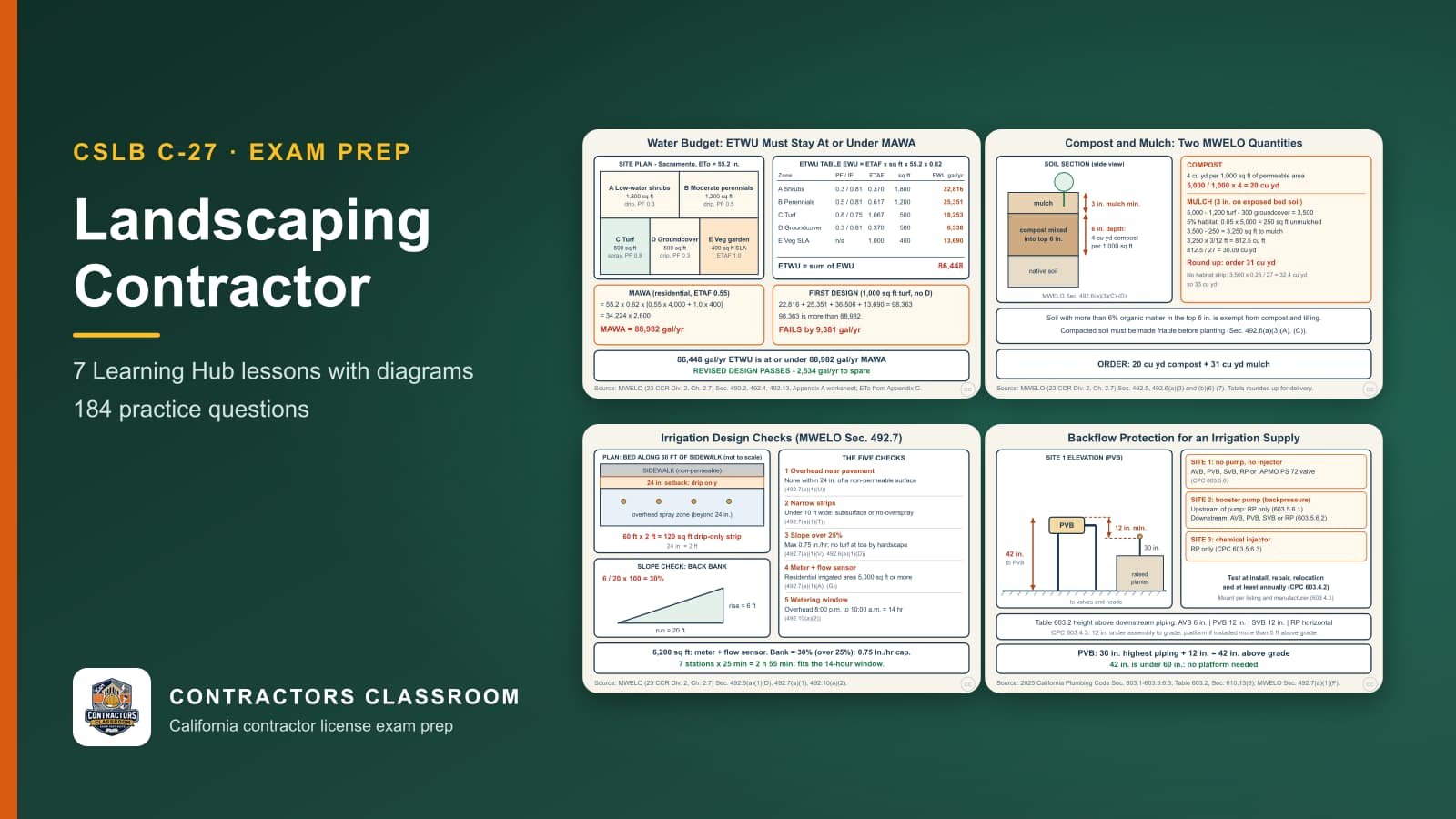
Diagrams from the C-27 landscaping contractor lessons: Landscape Water Budget: MAWA vs. ETWU, Soil Prep Takeoff: Compost and Mulch Quantities (MWELO), Irrigation Design Checks: Setbacks, Narrow Strips, Slopes, and Meters and Backflow Protection for an Irrigation Supply (CPC Sec. 603)
184practice questions
2categories
7Learning Hub lessons
$249Law & Business included

What the exam covers: Landscaping (C-27)

The CSLB exam for the California landscaping contractor license (C-27) is a closed-book, multiple-choice test. CSLB's official study guide divides it into six major sections and gives each an approximate weight: Planning and Estimating (about 18%), Construction Preparation (about 12%), Hardscape Installation (about 21%), Drainage, Irrigation, Lighting, and Plant Installation (about 21%), Maintenance and Repair (about 11%), and Safety (about 17%).

Hardscape Installation carries the most weight, about 21%, so it deserves roughly that share of your study time, with Drainage, Irrigation, Lighting, and Plant Installation next at about 21%.

Contractors Classroom turns that outline into 184 practice questions in 2 categories (Planning and Estimating and Cal-OSHA Chemical, Pesticide & Trenching Safety), plus 7 Learning Hub lessons with diagrams (such as "Landscape Water Budget: MAWA vs. ETWU" and "Soil Prep Takeoff: Compost and Mulch Quantities (MWELO)"). Law and Business, which most applicants take alongside their trade exam, is included at no extra charge.

Exam sections and approximate weights

  • Planning and Estimating~18%
  • Construction Preparation~12%
  • Hardscape Installation~21%
  • Drainage, Irrigation, Lighting, and Plant Installation~21%
  • Maintenance and Repair~11%
  • Safety~17%

Practice question categories

  • Planning and Estimating75 practice questions
  • Cal-OSHA Chemical, Pesticide & Trenching Safety109 practice questions

What the Landscaping Contractor exam covers, section by section

Planning and Estimating (~18%)

A landscape project takes shape on paper first. The contractor works out the sequence of tasks, who and what is needed, and how the finished yard should look and function. Designs for patios, walkways, drainage, and watering must fit the property and each other. Estimating then adds up plants, materials, equipment, and labor into a price that matches the plan.

  • Sequencing tasks, crews, and equipment so the project moves smoothly
  • Drawing paved areas, runoff paths, and sprinkler layouts that suit the property
  • Pricing plants, materials, equipment, and labor into a bid that matches the design

Construction Preparation (~12%)

Before anything is built or planted, the ground has to be made ready. Crews lay out work areas, stockpiles, and access routes, protect soil from washing away during storms, and shape the land so water flows where it should. Trenches for pipe and wire follow the planned paths, and grades are set carefully because mistakes in slope show up later as puddles and damage.

  • Marking work zones, storage areas, and travel paths before heavy activity begins
  • Using barriers, covers, and ground treatments to keep soil from washing away
  • Cutting trenches and shaping slopes so surfaces drain and pipes sit correctly

Hardscape Installation (~21%)

Hardscape gives a landscape its structure. Flat surfaces such as patios and paths depend on a firm base and careful finishing, while block, brick, and stone walls call for level courses and solid footings. Fences and retaining walls must resist loads and soil pressure, and ponds or fountains add pumps, liners, and plumbing to the mix. Quality shows in straight lines and long-lasting joints.

  • Forming and finishing patios and walks on firm, well-compacted bases
  • Laying brick, block, and stone in straight courses on secure footings
  • Setting posts and building fences and walls that hold back soil
  • Installing ponds and fountains with liners, pumps, and leak-free connections

Drainage, Irrigation, Lighting, and Plant Installation (~21%)

This stage brings the living and working systems into the yard. Drains and swales move or soak up stormwater, irrigation lines deliver water in zones governed by valves and timers, and low-voltage lighting needs its own power source and controls. Plants and trees then go in with attention to spacing, root care, and watering, and mulch finishes the beds while helping soil hold moisture.

  • Installing pipes, inlets, and planted channels that carry stormwater away or absorb it
  • Connecting valves and timers so each watering zone runs on schedule
  • Wiring transformers and controls that power and time outdoor lighting
  • Planting trees and shrubs correctly, then mulching to protect roots and soil

Maintenance and Repair (~11%)

Landscapes change after installation, and keeping them healthy and safe takes ongoing attention. Pruning shapes growth and removes dead or hazardous limbs, while removing a tree requires planning for how it will come down. Irrigation problems such as dry patches or pooling water call for tracing causes in pipes, heads, and controls. Cracked paving, shifted pavers, and failing walls also need repair.

  • Trimming plants properly and bringing down trees in a planned manner
  • Tracing dry spots, leaks, or soggy areas in a watering system to the cause
  • Restoring cracked paving, shifted pavers, and failing walls to a safe condition

Safety (~17%)

Landscape crews handle mowers, trimmers, saws, excavation equipment, chemicals, and heavy materials, often in heat and near the public. Staying safe means wearing the right protective gear, lifting properly, and keeping yards free of trip hazards and open trenches. Tree work carries added risks from falling limbs, ladders, climbing, power lines, and chain saws, so planning and teamwork matter more than speed.

  • Using protective gear, safe lifting, and tidy work areas to prevent injuries
  • Controlling hazards from falling limbs, cutting tools, and nearby wires during tree work

Code books behind the Landscaping Contractor exam

The exam outline published for this trade lists these references.

  • 2025 California Building CodeFor landscape work, the Building Code matters where yards meet structure: retaining wall design and stability, footings, guards at drop-offs, soil loads and the height limits that decide whether engineering and review are triggered. It is the reference behind retaining walls, posts and fences in Hardscape Installation and the grading topics in Construction Preparation.
  • 2025 California Plumbing CodeThe Plumbing Code governs how an irrigation system connects to drinking water. Its backflow provisions decide which device protects the supply, how high above the piping it sits, where it can be installed and how often it is tested. It is the reference behind valves and backflow in the Drainage, Irrigation, Lighting and Plant section.
  • Arborists' Certification Study GuideThis study guide covers tree biology, proper pruning cuts, tree risk, climbing and rigging, aerial lift use, and electrical hazards in the canopy. It informs pruning, tree removal and tree work safety, so it feeds Maintenance and Repair as well as the tree work half of the Safety section.
  • Landscape ConstructionA textbook on building the site: grading and drainage, concrete flatwork and joints, paving units, masonry and retaining walls, fences, steps, decks and water features. It teaches how each element is laid out and built, so it is the broad reference for Construction Preparation and Hardscape Installation.
  • The Landscape Lighting BookThis book explains low-voltage landscape lighting: fixture types and beam spreads, transformers and their load limits, cable sizing and voltage drop, timers and photocells, and aiming techniques. It is the reference behind the lighting controllers and transformers topic in the Drainage, Irrigation, Lighting and Plant section.
  • Model Water Efficient Landscape OrdinanceThe state water ordinance sets the water budget for new and rehabilitated landscapes, the hydrozone concept, plant factors, soil preparation, mulch, irrigation design and scheduling. It shapes how designs are checked and installed, so it feeds Planning and Estimating, the Drainage, Irrigation, Lighting and Plant section, and soil work in Construction Preparation.
  • The New Sunset Western Garden BookA regional plant encyclopedia organized by western climate zones, giving sun, water, soil and cold tolerance for thousands of plants. A landscaper uses it to match plants to site conditions and group them by water need, which supports the plant, tree and mulch installation items and the project planning topics.
  • Principles of IrrigationThis Irrigation Association text covers hydraulics, pressure and flow, sprinkler and drip components, valves, controllers, scheduling and system efficiency. It supplies the fundamentals behind sizing and zoning an irrigation system, so it is the reference for the irrigation valves and controllers topic and for troubleshooting.
  • State of California Construction & Electrical Safety Orders (Cal/OSHA)The construction safety orders apply to trenching, excavation, power equipment, chemical and pesticide handling, and work near energized lines. The separate tree work rules cover training, felling cuts, climbing and aerial work. Together they are the reference for the Safety section, including employee safety and tree work safety.
  • Trouble Shooting Irrigation Control SystemsA field guide to diagnosing controller, wiring and valve faults: testing solenoids and common wires with a meter, finding shorts and open circuits, checking sensors and decoder lines, and separating electrical problems from hydraulic ones. It is the reference for the troubleshooting irrigation systems bullet in Maintenance and Repair.

Key terms for the Landscaping Contractor exam

Hydrozone
A group of plants with similar water needs, sun exposure and soil, watered from the same valve. Mixing very thirsty and very drought-tolerant plants on one valve wastes water or kills plants, so the design plan shows each hydrozone separately.
Maximum Applied Water Allowance
The upper limit on a landscape's annual water use, calculated from local reference evapotranspiration, the allowed plant water-need factors and the size of the planted area. A design is acceptable only when its calculated total use does not exceed this ceiling.
Reference evapotranspiration
The water, in inches per year or per month, that a well-watered cool-season lawn would lose to soil evaporation and plant transpiration at a given location. Other plants' needs are expressed as a fraction of it, which makes it the base for every water budget and irrigation schedule.
Plant factor
A number between roughly zero and one that rates how much water a plant species needs relative to reference evapotranspiration. Lower values mean less irrigation, and the category assigned to a species controls how its hydrozone is counted in the water budget.
Bioswale
A shallow, planted channel shaped to slow, filter and soak up runoff from paved areas. It relies on gentle side slopes, amended soil and tolerant vegetation, and must be built with the right grade so water moves through it instead of ponding or eroding.
Master valve
A normally closed valve at the head of an irrigation system that opens only when the controller is running a program. If a zone valve sticks or a pipe breaks downstream, the master valve limits the loss.
Weather-based controller
An automatic irrigation clock that adjusts run times from evapotranspiration data or soil moisture readings instead of a fixed schedule. It keeps its settings in non-volatile memory so a power loss does not erase the program.
Pressure vacuum breaker
A backflow device with a spring-loaded check and an air inlet that must stand upright and well above the highest downstream outlet. It is common on sprinkler systems, cannot sit underground or in a flooded box, and needs yearly testing.
Swing joint
A flexible assembly of fittings that connects a sprinkler riser to the lateral pipe, letting the head absorb a bump from a mower or foot traffic without snapping the pipe. It is especially important beside walks and in busy turf.
Drip emitter
A low-volume device that delivers water in gallons per hour right at a plant's root zone, through tubing and fittings. It suits narrow strips, mulched beds and slopes because it avoids overspray and runoff when pressure is regulated and filtered.
Precipitation rate
How fast a sprinkler layout puts water on the ground, in inches per hour. Matching it to the soil's infiltration rate and the slope prevents runoff, and mixing heads with different rates on one valve causes dry and soggy spots.
Compost incorporation
Mixing a specified volume of compost per thousand square feet into the top layer of soil before planting, to rebuild structure and water-holding ability. Soils already rich in organic matter may be exempt, and compost is mixed in, not spread on top.
Segmental retaining wall
A wall built of dry-stacked, interlocking concrete units, often with layers of geogrid reaching back into the soil. It relies on gravity, setback and drainage behind it, and the units must meet the material standard that the code cites.
Patio slab control joint
A groove or saw cut in a concrete slab that makes the slab crack in a straight, planned line as it shrinks. Spacing is limited, and a patio laid out with joints too far apart will crack randomly.
Landscape lighting transformer
A box that steps household voltage down to low voltage for path and accent fixtures. Its wattage rating caps the total lamp load, and it normally includes a timer or photocell input, which is why load must be added up before choosing one.
Voltage drop
The loss of electrical pressure along a long or thin cable run, which makes the farthest fixtures dim. Landscape lighting designers fix it with heavier wire, shorter runs, splitting loads across circuits or using multiple transformer taps.
Hinge
The band of wood left intact when a tree is felled, sitting where the front notch and rear cut stop short of meeting. It steers the fall like a door hinge, and cutting through it carelessly leaves the tree uncontrolled.
Humboldt notch
A felling notch whose angled cut is made below the horizontal face cut. It is often used on large trees on steep slopes, and it limits how far the notch may reach into the trunk.
Line-clearance tree trimmer
A worker trained and qualified to prune near conductors carrying high voltage. Anyone else must stay outside the prescribed approach distance, and trimming near energized lines is never a general landscape crew task.

Where to spend practice time for the Landscaping Contractor exam

  • Flatwork, masonry, walls and fencesHardscape Installation is about 21 percent of the exam and spans flatwork, masonry, posts, fences, retaining walls and water features. Practice joint spacing in concrete, how a retaining wall is measured and what stability checks apply, post depth and footing logic for fences, and the structure of a water feature from excavation to waterproofing and plumbing connections.
  • Valves, controllers and backflowThe drainage, irrigation, lighting and plant section carries about 21 percent as well. For irrigation, drill which backflow device fits each system type, how high it mounts, how hydrozones are assigned to valves, and what controllers, sensors and master valves are required. Practice flow limits per valve size and slope effects, plus how application rate relates to soil and runoff.
  • Drainage, lighting and plantingWithin the same section, spend time on bioswales, drain lines and backfill for plants that need good drainage, then low-voltage lighting. Practice totaling fixture wattage against a transformer rating, judging voltage drop on long cable runs, and explaining planting depth, root ball handling, staking and mulch placement so trees and shrubs establish correctly.
  • Water budgets and material quantitiesPlanning and Estimating is about 18 percent and covers project planning, hardscape and irrigation design and pricing. Practice comparing a design's estimated water use against the allowance, then fixing the biggest contributor. Also work area-times-depth quantities for compost, mulch and concrete, converting to cubic yards and rounding up to what suppliers deliver.
  • Site preparation and irrigation repairsConstruction Preparation (about 12 percent) and Maintenance and Repair (about 11 percent) are smaller but concrete. Review erosion control, grading and trench practices, then pruning cuts, tree removal planning and repairing damaged hardscape. For irrigation faults, practice a logical order: check power and controller, test the solenoid, then look at pressure, filters and clogged parts.
  • Tree work, power lines and trenchingSafety is about 17 percent, split between employee and job site safety and tree work. Memorize approach distances for different voltages and who may cross them, drill felling cuts and notch depth as a fraction of trunk diameter, and review work-aloft requirements. Pair these with trench protection, chemical handling and equipment rules from the general construction orders.

Scenarios to talk through before the Landscaping Contractor exam

  • A design that exceeds its water allowanceA planting plan arrives with a calculated water use above the allowance, and most of the total comes from a large lawn on overhead spray. Which terms apply, which line would you attack first, how could the plant list and the emitter type change the result, and what hydrozone record must stay with the controller?
  • Compost and mulch for a new bedA client wants a new planting area with a thick mulch layer, and soil tests show low organic matter. Think about how compost is added and to what depth, which areas are left without mulch, how the quantities are converted to yards for ordering, and how the mulch affects the choice of emitters.
  • A sprinkler zone beside a drivewayThe irrigation drawing puts spray heads in a four-foot strip between a driveway and a fence, and overspray is already wetting the pavement. Which setback and narrow-area ideas apply, what hardware would you substitute, and what risers or fittings protect against vehicle and foot traffic?
  • Backflow device in a valve boxA new sprinkler system has a pressure vacuum breaker set inside a below-grade valve box, and a booster pump feeds part of the system. Think through what is wrong, which device type is needed upstream of the pump, how high devices must mount, and who tests the assembly and when.
  • A zone that will not turn onAt a maintenance call, one station of an automatic controller never opens its valve, while the others work. Describe a logical order of checks involving the controller output, common wire, solenoid, splices and pressure, and say what readings with a meter would separate an electrical fault from a hydraulic one.
  • Far fixtures look dimA path-lighting installation looks fine near the transformer but the last fixtures at the end of a long cable run are noticeably dim. Consider total wattage against the rating, voltage drop, wire size, layout of runs and taps, and how a timer or photocell fits into the control scheme.
  • A retaining wall near a property lineA homeowner asks for a segmental retaining wall along a sloped yard with a patio above it. Think about how wall height is measured for review, what loads act on it, what drainage goes behind it, the stability checks involved, and whether a guard is needed at the top.
  • Pruning a tree near service wiresA customer asks you to remove a large limb that hangs close to wires running to the house. Discuss how you would identify the voltage, who is permitted to work inside the approach distance, what the climbing and notch-and-hinge details would be for any felling, and when you would decline the job.

Learning Hub lessons

Each lesson has guided steps, a diagram, a worked example and a quick check inside the classroom.

Preview the lesson diagrams

  1. Landscape Water Budget: MAWA vs. ETWUSteps: What the Water Budget Is For; The Ceiling: MAWA; The Estimate: EWU for Each Hydrozone; Why Drip and Low-Water Plants Win on Paper; Compare, Then Fix the Biggest Line
  2. Soil Prep Takeoff: Compost and Mulch Quantities (MWELO)Steps: Soil Preparation Is Part of the Water Budget; Compost Rate: 4 Cubic Yards per 1,000 Square Feet; Mulch Rule: 3 Inches on Exposed Bed Soil; Do the Takeoff: Area, Then Depth, Then Yards; Why It Matters on Irrigation
  3. Irrigation Design Checks: Setbacks, Narrow Strips, Slopes, and MetersSteps: The Irrigation Design Plan Carries Rules, Not Just Pipe; Setbacks and Narrow Areas; Slopes: Rise Divided by Run; Required Hardware: Meter, Controller, Sensors, Valves; Program the Controller Inside the Watering Window
  4. Backflow Protection for an Irrigation Supply (CPC Sec. 603)Steps: Why the Irrigation Supply Is a Cross-Connection; Pick the Device by System Type - CPC Sec. 603.5.6; Mounting Height and Position - Table 603.2; Access, Clearance, and the 5-Foot Platform Rule; Testing Is Not Optional
  5. Retaining Walls: The 4-Foot Permit Line and the 1.5 Safety FactorSteps: The 4-Foot Permit Line Is Measured From the Bottom of the Footing; Exempt Does Not Mean Unengineered: Sec. 1807.2.1; Active Soil Load: Table 1610.1; Safety Factor 1.5: Sliding and Overturning; Guards at Retaining Walls
  6. Tree Work Near Power Lines: The 10-Foot Rule and Who May Cross ItSteps: Treat Every Overhead Line as Live; The 10-Foot Rule for High Voltage; Low Voltage: Inside 10 Feet but Never Inside 1 Foot; Line-Clearance Work Belongs to Qualified Line-Clearance Trimmers; Equipment and Tools Have Their Own Table
  7. Felling Cuts: Notch Depth, Back Cut, and Elevated-Work RulesSteps: A Qualified Tree Worker Runs Every Tree Job; Over 5 Inches: Notch and Back Cut Make the Hinge; The Notch-Depth Math: One-Third of the Diameter; Back-Cut Height and the Escape Route; Working Aloft: Two Means of Support, Second Person, Rated Line

See the classroom in action

Frequently asked questions

How do I get a California landscaping contractor license?

A landscaper or landscape contractor who wants to contract independently applies under C-27. CSLB generally requires documented journey-level experience, a bond, and passing scores on both the Law and Business exam and the C-27 exam. Rules change, so confirm them with CSLB.

What does the landscaping contractor exam ask about hardscape installation?

Hardscape Installation is the heaviest part of the C-27 exam, at about 21%. Expect questions on forming and finishing patios and walks on firm, well-compacted bases, laying brick, block, and stone in straight courses on secure footings, and setting posts and building fences and walls that hold back soil. Next in weight come drainage, irrigation, lighting, and plant installation (about 21%) and planning and estimating (about 18%).

What kinds of questions are on the landscaping contractor exam?

The three sample questions in CSLB's C-27 study guide ask about how a slope changes the flow limit of an irrigation valve, which backfill drains well for a plant, and the maximum joint spacing in a concrete patio. Like every question on the exam, each has four choices and one best answer.

Which codes and books does the C-27 exam reference?

CSLB's C-27 study guide lists the 2025 California Building and Plumbing Codes (Title 24), the Cal/OSHA safety orders (Title 8), and trade references such as Model Water Efficient Landscape Ordinance, Principles of Irrigation, and The Landscape Lighting Book. Use them to study; the exam itself is closed-book.

Is the landscaping contractor exam open book?

No. The C-27 study guide says no reference materials may be used, even though it names Model Water Efficient Landscape Ordinance and Principles of Irrigation among the books to study from. A calculator is provided, and guessing is not penalized.

Can I take the landscaping contractor exam outside California?

CSLB's exam FAQ says trade exams are given in California or Oregon only, so C-27 is not offered in other states, although Law and Business can be taken out of state. Check the current PSI list when you schedule.

How are the 184 C-27 practice questions organized?

They are split into 2 categories, largest first: Cal-OSHA Chemical, Pesticide & Trenching Safety (109) and Planning and Estimating (75). Cal-OSHA Chemical, Pesticide & Trenching Safety holds about 59% of the questions. 7 Learning Hub lessons add diagrams and worked examples for the harder topics. The missed-question review collects every question you get wrong.

Is there a free trial for landscaping contractor exam prep (C-27)?

Yes. The free C-27 preview opens the real classroom with no sign-up and gives you the first question from every C-27 category, including Cal-OSHA Chemical, Pesticide & Trenching Safety and Planning and Estimating, plus Law and Business. The full course is a one-time $249 purchase.

Is landscaping contractor exam prep available in Spanish?

The website and the eight demo videos are available in Spanish. The classroom and the 184 C-27 practice questions are in English for now; translating the questions is not part of the course yet.

Ready to practice for real?

Try the real classroom free, no sign-up, or get the full course for your trade.

Independent exam preparation. Contractors Classroom is not affiliated with the Contractors State License Board, and no course can guarantee a passing result.


