CSLB C-31

Construction Zone Traffic Control Contractor License Exam Prep (C-31)

Getting ready for the California construction zone traffic control contractor license exam (CSLB C-31)? Study with 184 practice questions in 2 categories and 6 Learning Hub lessons, made for traffic control crews, with the Law and Business exam included.

One-time purchase, no subscription. Law & Business included.

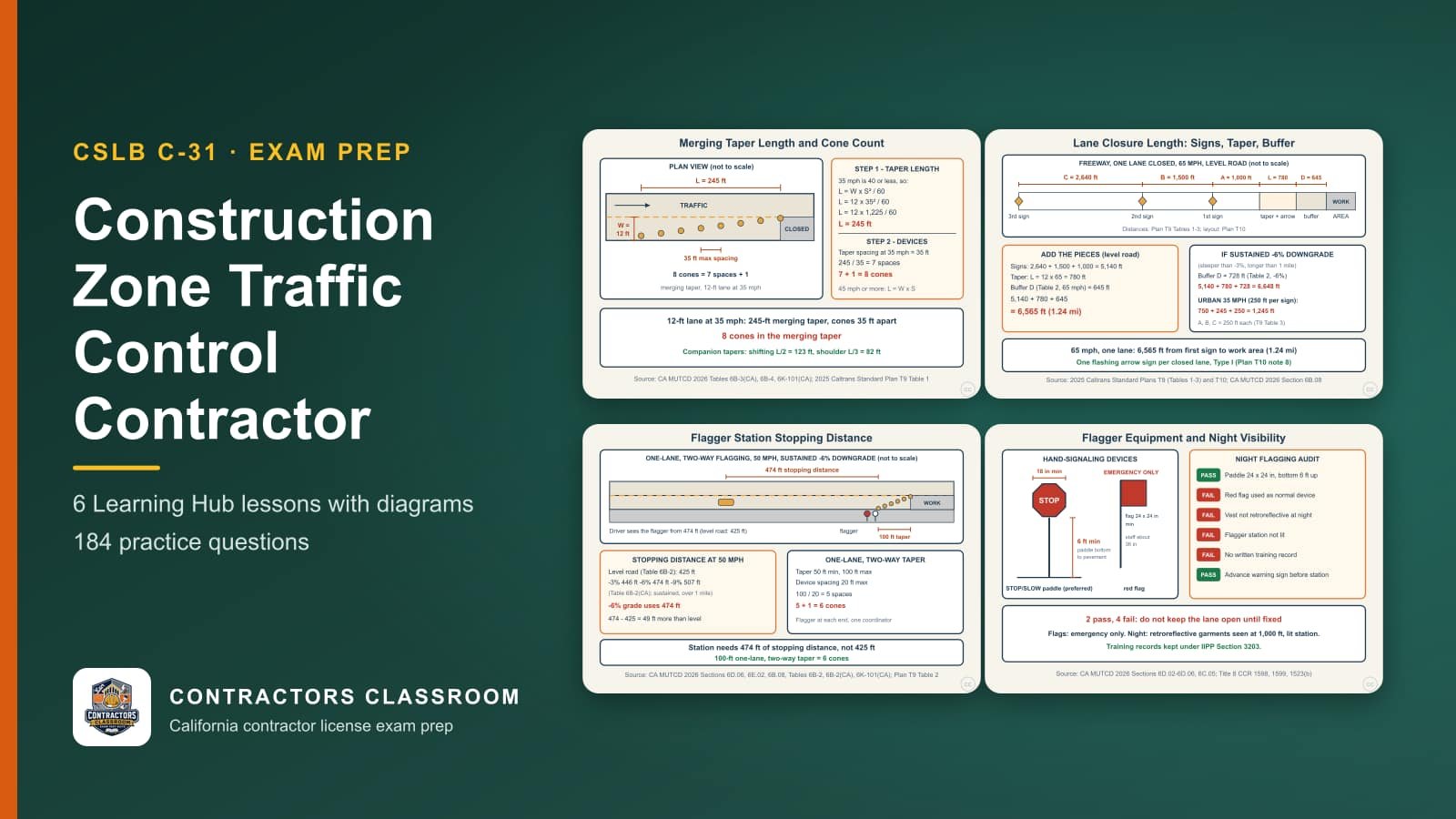
Diagrams from the C-31 construction zone traffic control contractor lessons: Merging Taper Length and Cone Count, Freeway Lane Closure Length: Signs, Taper and Buffer, Flagger Station Placement and One-Lane, Two-Way Control and Flagger Equipment, Signals and Night Visibility
184practice questions
2categories
6Learning Hub lessons
$249Law & Business included

What the exam covers: Construction Zone Traffic Control (C-31)

The CSLB exam for the California construction zone traffic control contractor license (C-31) is a closed-book, multiple-choice test. CSLB's official study guide divides it into five major sections and gives each an approximate weight: Planning and Estimating (about 18%), Notifications and Coordination (about 11%), Traffic Control Installation (about 51%), Transportation and Training (about 8%), and Safety (about 12%).

Traffic Control Installation carries the most weight, about 51%, so it deserves roughly that share of your study time, with Planning and Estimating next at about 18%.

Contractors Classroom turns that outline into 184 practice questions in 2 categories (Planning and Estimating and Cal-OSHA Title 8 & MUTCD Traffic Safety Orders), plus 6 Learning Hub lessons with diagrams (such as "Merging Taper Length and Cone Count" and "Freeway Lane Closure Length: Signs, Taper and Buffer"). Law and Business, which most applicants take alongside their trade exam, is included at no extra charge.

Exam sections and approximate weights

  • Planning and Estimating~18%
  • Notifications and Coordination~11%
  • Traffic Control Installation~51%
  • Transportation and Training~8%
  • Safety~12%

Practice question categories

  • Planning and Estimating75 practice questions
  • Cal-OSHA Title 8 & MUTCD Traffic Safety Orders109 practice questions

What the Construction Zone Traffic Control Contractor exam covers, section by section

Planning and Estimating (~18%)

Every traffic control job begins with a plan that routes motorists, cyclists and pedestrians safely around the work. The planner reads the contract drawings to find the extent of the work, checks the layout against the California MUTCD and other governing rules, and prices the signs, barricades, vehicles and people required. A sound plan and estimate prevent surprises once lanes are actually closed. Taper lengths, buffer areas and sign spacing all depend on road speed and lane layout, so the plan must account for approach conditions as well as the work itself.

  • Draw layouts that guide road users safely through or around a work zone
  • Read project plans to find where, when and how long control is needed
  • Check proposed layouts and devices against the California MUTCD and related rules
  • Price devices, vehicles, equipment and crew time to build a realistic bid

Notifications and Coordination (~11%)

Closing or narrowing a roadway affects many people beyond the crew. Before work starts, the contractor confirms the right approvals are in hand, tells residents, businesses and responsible agencies what is coming, and lines up schedules with utilities, other contractors and public agencies working nearby. Clear communication keeps emergency access open and avoids conflicting closures on the same stretch. Detour routes through neighborhoods, bus stops and driveways need advance notice, and message boards or posted notices help drivers prepare ahead.

  • Confirm required permits are issued and match the planned closure
  • Inform the public and responsible agencies before lanes change
  • Share schedules with neighboring contractors and agencies to avoid conflicting closures

Traffic Control Installation (~51%)

Installation is where the plan meets live traffic. Crews stage devices in the order that gives approaching drivers proper warning, place cones, signs and barricades with care, and keep backup options ready if conditions change. Flaggers direct vehicles with established signals, lane closures are phased in and out deliberately, and the zone is checked and corrected throughout the shift until everything is picked up safely. Cones, drums, barricades, arrow boards and portable signs each serve a distinct purpose, and a truck-mounted attenuator may shield the crew from errant vehicles. Night work adds lighting and reflective sheeting that must stay clean enough to be seen.

  • Prepare a step-by-step setup sequence with fallback options for changing conditions
  • Place signs, cones, barricades and arrow boards in proper order and spacing
  • Direct vehicles as a flagger using accepted signals, positions and communication
  • Patrol the zone often, fixing displaced devices and keeping signs visible
  • Close and reopen lanes in sequence, then retrieve devices and restore normal flow

Transportation and Training (~8%)

Traffic control depends on gear moving to and from the site and on people who know their roles. Trucks must be loaded so signs, barrels and barricades arrive undamaged and can be unloaded safely at the work location. Just as important, flaggers and other employees need instruction in procedures so each person responds the same way when traffic or conditions change. Loads are strapped and ordered so the first devices needed are the last ones on the truck.

  • Secure, haul and unload devices without damage or hazards to the crew
  • Teach flaggers and crew members correct procedures so the team acts consistently

Safety (~12%)

Working beside moving vehicles leaves little margin for error, so protection comes first. Workers wear gear that makes them visible and shields them from injury, equipment is examined to be sure it still does its job, and the work area is arranged with protected positions and escape routes. Plans for crashes or other emergencies are known by the crew before they are ever needed. Escape routes are planned in case a vehicle enters the zone.

  • Wear high-visibility clothing, hard hats and other gear suited to roadside work
  • Examine signs, lights and barriers for wear and replace anything unfit
  • Keep work areas protected and know how to react to a crash or emergency

Code books behind the Construction Zone Traffic Control Contractor exam

The exam outline published for this trade lists these references.

  • 2022 Standard PlansThe state's standard drawing set includes the traffic handling sheets that show typical lane closure layouts, sign placement, taper and buffer arrangements, device spacing and notes for different road types. It is the reference behind much of Traffic Control Installation, the largest section, and the plan reading topics in Planning and Estimating. Reading these sheets is a skill in itself: you match a situation to a layout, then adapt the distances to the speed and lane count in front of you.
  • 2022 Standard SpecificationsThe state's construction specifications describe how temporary traffic control must be furnished, installed, maintained and removed, with material requirements for devices and how the work is measured. Candidates use it to understand contract expectations, supporting Planning and Estimating and the inspect, maintain and remove topics in installation. Knowing what the specification expects keeps a plan from promising more or less than the job calls for.
  • California Manual on Uniform Traffic Control Devices for Streets and Highways, Part 6: Temporary Traffic ControlThe central reference of the trade. Part 6 sets out the principles of a work zone, its parts, how devices look and where they go, taper and spacing calculations, flagger and pilot vehicle operations, and signs and arrow boards. It feeds every section, especially Planning and Estimating, Traffic Control Installation and Safety. Many answers on the exam trace back to a table or figure in this part.
  • Flagging Instruction HandbookA training handbook for people who direct traffic on foot. It teaches how a flagger chooses a station, how to use the paddle and flag signals, how to communicate with other flaggers, and how to stay visible and safe. It feeds the flagging procedures topics and the flagger training topics in Transportation and Training. Even if you will rarely flag yourself, the exam expects you to know how stations are set up and how the signals work.
  • State of California General Industry & Electrical Safety Orders (Cal/OSHA)With the Construction Safety Orders, this Title 8 set covers worker protection on or beside traffic: high-visibility apparel, equipment and vehicle operation, backing, protection of crews from passing vehicles, and general job site hazards. It is the reference behind the Safety section and behind safe loading and transport. Expect questions on how worker protection and traffic control plans fit together.

Key terms for the Construction Zone Traffic Control Contractor exam

Advance warning area
The first part of a work zone, where signs tell drivers that a change is coming. Its length scales with road speed and type, and signs are spaced along it so drivers can react well before the taper.
Transition area
The stretch where traffic is steered out of its normal path, using tapers made of channelizing devices. How long it is depends on speed and the lateral shift being asked of drivers.
Merging taper
The longest taper type, used to close a lane so drivers can merge gradually. Its length comes from a formula based on speed and the width of the shift, and other tapers are fractions of it.
Buffer space
An empty stretch ahead of the work area that gives errant vehicles room to stop or slow before reaching workers. No materials, equipment or crews are placed in it. It is measured along the roadway, so lane closures add it into the closure length.
Activity area
The part of the zone where work actually occurs, including the workspace and the traffic space past it. Planners use it to decide how much lane width the work needs and where devices must stand.
Termination area
The end of the zone, where traffic returns to its normal path. A short taper with an END ROAD WORK sign lets drivers know the restriction is over.
Channelizing device
Any cone, drum, tubular marker or barricade used to guide traffic through a zone. The right choice depends on duration, speed and whether the lane is being closed for hours or days. Devices must be inspected so those that are knocked down or faded are replaced.
Traffic drum
A large, highly visible plastic barrel with alternating orange and white reflective bands, used where more mass and visibility than cones are needed. Drums last longer on high-speed or long-term closures.
Retroreflective band
A reflective collar on a cone that returns headlight beams to the driver at night. Where the band is placed and how many are needed depend on cone height and whether the cone is used after dark.
Tubular marker
A slim, flexible vertical post with reflective bands that fits where there is no room for drums, such as to separate lanes or mark a narrow work space. It can be struck without wrecking the setup.
STOP/SLOW paddle
The main handheld device a flagger uses, a sign on a staff with STOP on one face and SLOW on the other. Flags and flashlights are limited to emergency use, and the paddle's visibility and height matter.
Flagger station
The spot where a flagger stands, placed far enough ahead of the work so approaching drivers can stop in time. Warning signs, lighting and an escape path are planned with it.
Pilot vehicle
A marked vehicle that leads a line of traffic through a one-lane section, keeping speed down and drivers together. Its sign tells drivers to follow, and its speed sets the pace for everything behind it.
Portable changeable message sign
A trailer-mounted electronic sign that shows short messages to drivers. It has a minimum character size and a number of characters per line, and it should be placed and delineated so it is both visible and protected.
Arrow board
A lighted panel on a trailer or truck that flashes a directional arrow or caution pattern to show drivers which way to merge. It is used with lane closures, and its size depends on the road type.
Truck-mounted attenuator
A crash cushion mounted on the back of a heavy shadow vehicle that absorbs the energy of a rear-end hit. It protects both the crew behind it and the driver who strikes it.
Crash cushion
A fixed or portable energy-absorbing device placed at the end of a barrier or hazard so a vehicle that hits it is slowed gradually instead of stopping hard against a blunt end.
Positive protection
A rigid or semi-rigid barrier, such as temporary concrete rail, placed between traffic and workers or an open excavation. Plans use it when cones alone cannot protect people.
Stopping sight distance
The distance a driver needs to notice a hazard and brake to a halt. It sets how far ahead of the work a flagger must stand, and the figure grows on downgrades where vehicles take longer to stop.

Where to spend practice time for the Construction Zone Traffic Control Contractor exam

  • Lane closure layout and device countsTraffic Control Installation is about 51 percent of the exam, so it deserves the largest share of study time. Practice the chain of distances in a closure: warning signs, taper, buffer and work area. Compute taper length from speed and offset, then divide by device spacing to count cones, and multiply the count by a daily rental rate. Redo the same closure at a different speed to see which distances change.
  • Flagging stations and one-lane controlFlagging procedures are part of the installation section. Review how a station is located using stopping distance, how that distance grows on a downgrade, what the three paddle signals mean, and how two-way single-lane control works with flaggers or a pilot vehicle. Include night visibility: garments, lighting and warning signs. Sketch the station, the approach and the escape route.
  • Plans, compliance and costPlanning and Estimating is about 18 percent. It covers drawing traffic control plans, reading project plans for scope, checking compliance with the California traffic control manual and estimating materials, equipment and labor. Practice comparing a proposed plan with the standard layout and writing a quantity list from the plan. Check each quantity twice.
  • Safety around moving trafficSafety is about 12 percent: what crews wear, how traffic control gear is judged fit for use, how a safe work environment is kept and what the emergency procedures are. Review high-visibility apparel, when positive protection or a truck-mounted attenuator is called for, how to inspect devices for damage, and the steps to take after a crash or errant vehicle in the zone. Talk yourself through a mock zone, walking from the approach side to the far end.
  • Verifications, notices and coordinationNotifications and Coordination is about 11 percent and tests who must be told, and when, before lanes close. Make a chart of verifying permits, notifying the public and the agencies concerned, and coordinating with other contractors, utilities and inspectors, and note which party is responsible in each case. Practice with short scenarios, such as a closure that crosses two jurisdictions.
  • Transport, loading and flagger trainingTransportation and Training is about 8 percent. It covers loading, hauling and unloading devices and equipment, and training flaggers and crew in traffic control. Learn how to secure drums and trailers, when training must occur, and what a newly trained flagger must be able to demonstrate before taking a station. Read the handbook sections on flagger conduct to anchor the training questions.

Scenarios to talk through before the Construction Zone Traffic Control Contractor exam

  • A night freeway lane closureA crew has to shut the outside lane of a freeway for one night. Lay out the chain of distances from the first warning sign to the far end of the closure, say where arrow boards and a truck-mounted attenuator belong, and which plan sheets and notes you would check beforehand. Explain how you would brief the crew before the first device goes down.
  • Counting cones for a city streetAn urban street needs a single-lane closure at a known speed. Walk through finding the taper length, using spacing to count devices, deciding whether cones, drums or tubular markers fit the duration, and what bands and lighting the setup needs after dark. Explain how you would check your count against the plan sheet.
  • One lane for two directionsA rural road repair leaves one lane open for both directions, with a downgrade on one approach. Plan the flagger stations, how stopping sight distance is adjusted, whether a pilot vehicle helps, how flaggers communicate, and what warning signs go out. Explain how the crew keeps the setup in view.
  • A new flagger on the crewA new hire will take a flagger station at dusk. What do you cover in training about the paddle, the three signals, emergency flag use, high-visibility garments, station lighting and the escape path, and what must the flagger show you before taking the post? Explain how you would observe the flagger during the first hour.
  • Placing a message signA portable changeable message sign will announce a ramp closure. Think about message length and character size, how far ahead it goes, how the trailer is delineated and protected, and what you would do if the planned spot blocks sight lines. Explain how you would test that the message reads clearly from a distance.
  • Before the first cone goes downIt is the day before a lane closure on a busy road. Which authorizations should be verified, who needs notice, how do you coordinate with other contractors or agencies working nearby, and what would make you postpone the closure? Explain how you would record who you notified. Keep copies of each notice sent.
  • A truck clips the drumsMidway through a shift a truck knocks over several drums at the taper and drives on. Describe the immediate steps for crew safety, how you restore the taper, whether positive protection or a crash cushion should be added, and what you record. Explain how you would reinspect the whole zone afterward.
  • Taking the closure downThe work is done and the lane reopens at dawn. In what order should devices be removed, who stays protected while you do it, how do you load and secure drums, cones and trailers for transport, and what checks come before leaving the site? Explain what you would walk through with the crew at the end of the shift.

Learning Hub lessons

Each lesson has guided steps, a diagram, a worked example and a quick check inside the classroom.

Preview the lesson diagrams

  1. Merging Taper Length and Cone CountSteps: Why the Taper Length Is Calculated, Not Guessed; The Two Formulas (Table 6B-4); Other Tapers Are Fractions of L; How Far Apart the Devices Go (Table 6K-101(CA)); Count the Devices
  2. Freeway Lane Closure Length: Signs, Taper and BufferSteps: A Lane Closure Is a Chain of Distances; Advance Warning Sign Spacing (T9 Table 3); Taper and Buffer Space (T9 Tables 1 and 2); Add It Up for the Closure Length; Check the T10 Notes Before You Set Up
  3. Flagger Station Placement and One-Lane, Two-Way ControlSteps: The Flagger Station Must Give Drivers Room to Stop; Look Up the Stopping Distance (Table 6B-2); Increase It on Downgrades (Table 6B-2(CA)); One-Lane, Two-Way Control Rules; Where the Flagger Stands and What to Plan
  4. Flagger Equipment, Signals and Night VisibilitySteps: The STOP/SLOW Paddle Is the Primary Device; Flags and Flashlights Are Emergency Tools; The Three Paddle Signals; Garments and Night Visibility; Station Lighting, Warning Signs and Training
  5. Portable Changeable Message Signs and Arrow BoardsSteps: What Each Sign Is For; Arrow Board Requirements; PCMS Character Size and Capacity; Message and Mounting Rules; Placement and Delineating the Trailer
  6. Cone, Drum and Channelizing Device SpecificationsSteps: Pick the Device for the Job; Cone Height and Conditions; Where the Retroreflective Bands Go; Drums, Tubular Markers and Barricades; Keep Them Working

See the classroom in action

Frequently asked questions

How do I get a California construction zone traffic control contractor license?

A traffic control contractor or flagger who wants to contract independently applies under C-31. CSLB generally requires documented journey-level experience, a bond, and passing scores on both the Law and Business exam and the C-31 exam. Rules change, so confirm them with CSLB.

What does the construction zone traffic control contractor exam ask about traffic control installation?

Traffic Control Installation is the heaviest part of the C-31 exam, at about 51%. Expect questions on prepare a step-by-step setup sequence with fallback options for changing conditions, place signs, cones, barricades and arrow boards in proper order and spacing, and direct vehicles as a flagger using accepted signals, positions and communication. Next in weight come planning and estimating (about 18%) and safety (about 12%).

What kinds of questions are on the construction zone traffic control contractor exam?

The three sample questions in CSLB's C-31 study guide ask about cone rental costs for a lane closure, the character requirement of a portable message sign, and how a pilot-vehicle crew should treat cyclists. Like every question on the exam, each has four choices and one best answer.

Which codes and books does the C-31 exam reference?

CSLB's C-31 study guide lists the Cal/OSHA safety orders (Title 8) and trade references such as Caltrans 2022 Standard Plans and Standard Specifications, California Manual on Uniform Traffic Control Devices, Part 6, and Flagging Instruction Handbook. Use them to study; the exam itself is closed-book.

Is the construction zone traffic control contractor exam open book?

No. The C-31 study guide says no reference materials may be used, even though it names Caltrans 2022 Standard Plans and Standard Specifications and California Manual on Uniform Traffic Control Devices, Part 6 among the books to study from. A calculator is provided, and guessing is not penalized.

Can I take the construction zone traffic control contractor exam outside California?

CSLB's exam FAQ says trade exams are given in California or Oregon only, so C-31 is not offered in other states, although Law and Business can be taken out of state. Check the current PSI list when you schedule.

How are the 184 C-31 practice questions organized?

They are split into 2 categories, largest first: Cal-OSHA Title 8 & MUTCD Traffic Safety Orders (109) and Planning and Estimating (75). Cal-OSHA Title 8 & MUTCD Traffic Safety Orders holds about 59% of the questions. 6 Learning Hub lessons add diagrams and worked examples for the harder topics. The missed-question review collects every question you get wrong.

Is there a free trial for construction zone traffic control contractor exam prep (C-31)?

Yes. The free C-31 preview opens the real classroom with no sign-up and gives you the first question from every C-31 category, including Cal-OSHA Title 8 & MUTCD Traffic Safety Orders and Planning and Estimating, plus Law and Business. The full course is a one-time $249 purchase.

Is construction zone traffic control contractor exam prep available in Spanish?

The website and the eight demo videos are available in Spanish. The classroom and the 184 C-31 practice questions are in English for now; translating the questions is not part of the course yet.

Ready to practice for real?

Try the real classroom free, no sign-up, or get the full course for your trade.

Independent exam preparation. Contractors Classroom is not affiliated with the Contractors State License Board, and no course can guarantee a passing result.


