CSLB C-20

HVAC Contractor License Exam Prep (C-20)

Getting ready for the California HVAC contractor license exam (CSLB C-20)? Study with 328 practice questions in 5 categories and 6 Learning Hub lessons, made for HVAC technicians and heating and air conditioning installers, with the Law and Business exam included.

One-time purchase, no subscription. Law & Business included.

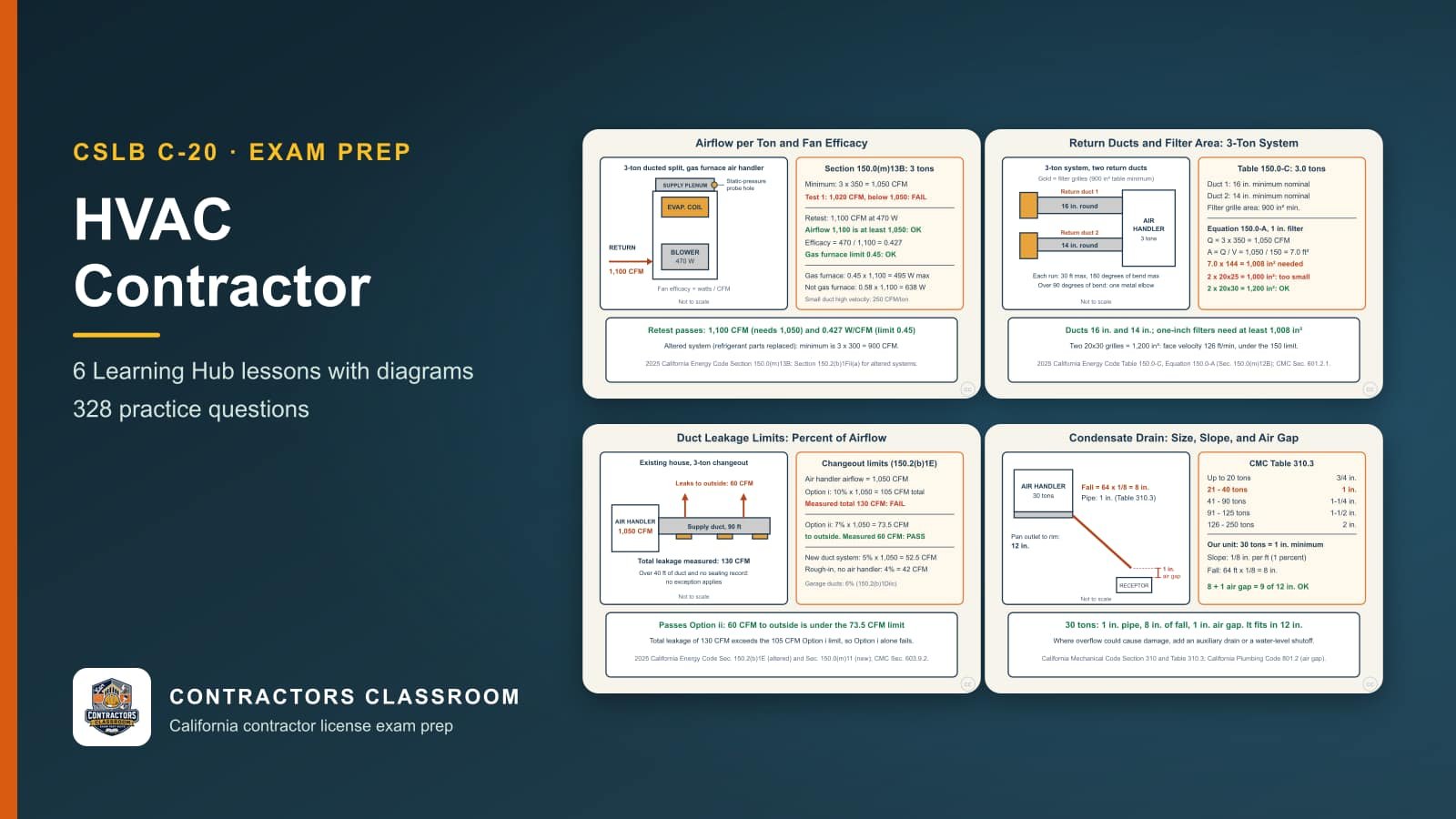
Diagrams from the C-20 hvac contractor lessons: Airflow per Ton and Fan Efficacy: The Title 24 Verification Numbers, Return Duct and Filter Sizing: Tables 150.0-B and 150.0-C, Equation 150.0-A, Duct Leakage Targets: New Dwellings, Changeouts, and CMC Testing and Condensate Drains: Pipe Size, Slope, and Overflow Protection
328practice questions
5categories
6Learning Hub lessons
$249Law & Business included

What the exam covers: HVAC (C-20)

The CSLB exam for the California HVAC contractor license (C-20) is a closed-book, multiple-choice test. CSLB's official study guide divides it into four major sections and gives each an approximate weight: Planning and Estimating (about 22%), Fabrication, Installation, and Startup (about 38%), Troubleshooting, Repair, and Maintenance (about 20%), and Safety (about 20%).

Fabrication, Installation, and Startup carries the most weight, about 38%, so it deserves roughly that share of your study time, with Planning and Estimating next at about 22%.

Contractors Classroom turns that outline into 328 practice questions in 5 categories (Planning and Estimating, System Installation and Piping, System Maintenance and Repair, Ventilation and Ductwork, and Safety), plus 6 Learning Hub lessons with diagrams (such as "Airflow per Ton and Fan Efficacy: The Title 24 Verification Numbers" and "Return Duct and Filter Sizing: Tables 150.0-B and 150.0-C, Equation 150.0-A"). Law and Business, which most applicants take alongside their trade exam, is included at no extra charge.

Exam sections and approximate weights

  • Planning and Estimating~22%
  • Fabrication, Installation, and Startup~38%
  • Troubleshooting, Repair, and Maintenance~20%
  • Safety~20%

Practice question categories

  • Planning and Estimating75 practice questions
  • System Installation and Piping90 practice questions
  • System Maintenance and Repair30 practice questions
  • Ventilation and Ductwork24 practice questions
  • Safety109 practice questions

What the HVAC Contractor exam covers, section by section

Planning and Estimating (~22%)

Planning an HVAC job begins with understanding how much heating and cooling a space needs and how air will be moved to deliver it. Load figures and air-property calculations guide equipment choice, while duct layout balances airflow, space limits, and noise. Existing systems may need to be judged for what can be reused. A sound cost estimate then ties equipment, materials, labor, and overhead into a price that holds up once work begins. Manual load worksheets and software both start from the building envelope, orientation, and occupancy, and the results then guide whether ducts, coils, and fans are sized sensibly. Return air paths deserve as much thought as supply outlets.

  • Judging whether a proposed or existing system suits the building's use, comfort needs, and constraints
  • Calculating heat gain and loss and the properties of moist air to size equipment correctly
  • Routing ducts to deliver balanced airflow while fitting framing, ceilings, and equipment locations
  • Totaling equipment, materials, labor, and overhead into a bid that holds up during construction

Fabrication, Installation, and Startup (~38%)

This is the hands-on core of the trade. Sheet metal and duct are shaped, assembled, hung, and sealed; furnaces, air handlers, condensing units, and similar equipment are set and connected; and control wiring, motors, drains, and refrigerant lines are tied in. The work ends with startup, when the system is charged, adjusted, and checked so that it runs safely and delivers the airflow and temperatures it was designed for. Brazing refrigerant joints under a nitrogen purge, sloping condensate lines, and sealing plenum seams with mastic are small habits that separate clean installs from callbacks. Flexible connections at the equipment cut vibration noise.

  • Forming, assembling, hanging, and sealing duct runs, then connecting registers and grilles that distribute air
  • Setting and securing furnaces, air handlers, and outdoor units on proper supports with adequate clearances
  • Wiring power and controls and connecting motors, dampers, and other parts that make equipment operate
  • Running condensate drains and refrigerant lines, including leak checks and charging of the circuit
  • Commissioning the finished system by verifying rotation, airflow, pressures, and temperatures before handing it over

Troubleshooting, Repair, and Maintenance (~20%)

When a system underperforms or stops, a technician works from symptoms to cause. Measuring pressures, temperatures, airflow, and electrical values narrows the possibilities, and the readings are compared against what the equipment should produce. Repairs then replace or adjust the failing part, while scheduled maintenance, such as filter changes, coil cleaning, and belt checks, keeps small problems from growing into breakdowns or energy waste. A technician might start with the thermostat and filter before moving to capacitors, contactors, and refrigerant circuit readings, working from simple, likely causes to more involved ones. Findings should be written up so the owner understands the repair.

  • Using gauges, meters, and airflow tools to test operation and judge whether performance is acceptable
  • Replacing failed parts and servicing equipment on a routine schedule to prevent breakdowns and waste

Safety (~20%)

HVAC work mixes electricity, rooftops, attics, refrigerants, fuel gas, sharp sheet metal, and heavy equipment. Safety means wearing gear suited to each task, following the site rules that govern ladders, lifts, and tight spaces, and cutting off power before touching components. Technicians also meet substances such as refrigerants, insulation fibers, and combustion byproducts, so knowing how to store, handle, and dispose of them protects both workers and occupants. Lockout and tagging of disconnects, safe handling of pressurized cylinders, and ventilating the work area before brazing or cutting address the hazards most specific to this trade.

  • Choosing gloves, eye, hearing, and respiratory protection that match the specific task at hand
  • Following workplace rules for fall protection, electrical lockout, and safe access to roofs and attics
  • Handling refrigerants and other hazardous substances with correct storage, labeling, and disposal practices

Code books behind the HVAC Contractor exam

The exam outline published for this trade lists these references.

  • 2025 California Mechanical CodeThe main installation code for the C-20 HVAC exam. It covers ducts, combustion air, appliance venting, condensate drains, refrigerant piping and equipment clearances. It is the reference behind most of the Fabrication, Installation, and Startup section, the largest section in the exam outline.
  • 2025 Building Energy Efficiency Standards for Residential and Nonresidential BuildingsThese standards set the mandatory efficiency measures a heating and cooling installer must meet: duct sealing, airflow and fan verification, filter and return sizing, ventilation rates and thermostat controls. They support the Planning and Estimating section and the testing and startup topics in Fabrication, Installation, and Startup.
  • 2025 California Energy CodeThe Energy Code is the Title 24 part that turns efficiency policy into field duties for HVAC work in new buildings and alterations, including diagnostic tests, equipment changeouts and mandatory controls. It feeds the system design, duct layout and startup topics, and it helps with questions about what must be verified after a replacement.
  • 2025 California Building CodeThe building code matters to HVAC work when equipment and ducts meet the structure: fire-rated assemblies and penetrations, dampers at rated walls, roof and floor loads, and mechanical room construction. It supports Planning and Estimating decisions and the placement of equipment in Fabrication, Installation, and Startup.
  • 2025 California Electrical CodeThis code governs the power and control wiring HVAC equipment depends on: branch circuit conductors, disconnects within sight of equipment, overcurrent protection, grounding and motor wiring. It is the reference behind the electrical and mechanical components topic in the installation section and the electrical side of troubleshooting.
  • 2025 California Plumbing CodeHVAC contractors lean on the plumbing code for condensate disposal, indirect waste connections, air gaps and traps at drains, and water connections to boilers or humidifiers. It supports the plumbing and refrigeration components topic within Fabrication, Installation, and Startup.
  • ASHRAE HandbooksA set of engineering references on moist-air properties, load fundamentals, system types, equipment, ventilation and applications such as laboratories and kitchens. They give the science behind design choices and feed the system design and evaluation bullets in Planning and Estimating as well as diagnostic reasoning in the troubleshooting section.
  • Fundamentals of HVACRA textbook that teaches the basic refrigeration cycle, electrical circuits and motors, controls, airflow and gas heating. It is a gentle on-ramp to the components and test procedures asked about in the installation and troubleshooting sections, and it suits candidates who need to refresh the theory first.
  • HVAC Duct Construction Standards – Metal and FlexibleThe sheet metal industry standard for how ducts are built: gauges, reinforcement, joints and seams, hangers and supports, seal classes and flexible duct installation. It supports the duct system fabrication bullet and the air distribution topics in the largest section of the exam.
  • Manual J – Residential Load CalculationThe recognized method for working out how much heating and cooling a house needs, from envelope, orientation, windows, infiltration and occupants. It is the reference behind load calculations in Planning and Estimating, and it explains why oversized equipment is a design mistake.
  • Manual N – Commercial Load CalculationThe companion method for light commercial buildings, where internal gains from lighting, people, equipment and ventilation air carry more weight than in a house. It feeds the load portion of Planning and Estimating for nonresidential jobs.
  • Manual P – PsychrometricsA guide to reading moist-air properties and following a cooling or heating process on the psychrometric chart. It supports the psychrometric calculation bullet of Planning and Estimating, including sensible and latent heat, wet-bulb and dew point reasoning.
  • Manual D – Residential Duct SystemsThe method for sizing residential ducts from airflow, available fan pressure and fitting losses. It is the reference behind duct design and layout in Planning and Estimating and the air distribution topics when ducts are installed.
  • Manual Q – Low Pressure, Low Velocity Duct System DesignA design guide for low-pressure, low-velocity duct systems with attention to sizing methods, noise, and balancing. It supports the duct layout bullet and helps you reason about branch sizing, air velocity limits and pressure drop in light commercial work.
  • Manual S – Residential Equipment SelectionThe method for choosing furnaces, air conditioners and heat pumps once the load is known, by matching capacity at design conditions rather than nameplate size. It supports system evaluation and equipment choice in Planning and Estimating.
  • Manual H – Heat Pump SystemsA reference for applying heat pumps: performance at varying outdoor temperatures, balance point, auxiliary heat and defrost behavior. It supports the design and equipment installation topics wherever a heat pump replaces or complements a furnace.
  • Manual CS – Commercial Application, Systems, and EquipmentA guide to commercial system types such as packaged rooftop units, split systems, chilled water and variable air volume, and how each is applied. It supports system evaluation in Planning and Estimating and equipment questions in the installation section.
  • Manual RS – Comfort, Air Quality, & Efficiency by DesignA whole-house design guide that connects comfort, indoor air quality and efficiency, pulling load, ventilation and equipment choices into one process. It supports system design and evaluation in Planning and Estimating and the ventilation thinking behind installation choices.
  • Modern Refrigeration and Air ConditioningA thorough textbook on compressors, evaporators, condensers, metering devices, charging, evacuation and system diagnosis. It is the study source for the refrigeration components bullet in the installation section and for pressure and temperature diagnostics in the troubleshooting section.
  • Refrigeration & Air Conditioning TechnologyA second textbook on the refrigeration cycle, electrical controls, residential and light commercial equipment and service procedures. It reinforces the same installation and diagnostic topics from a different angle, which is useful when a concept is not clear in the first source.
  • State of California General Industry & Electrical Safety Orders (Cal/OSHA)The Title 8 safety orders behind the Safety section: refrigerant and combustion hazards, electrical work on energized equipment, respiratory protection, ladders and roof access, and hazard communication for chemicals. They are the reference for personal protection, job site rules and handling hazardous materials in HVAC work.

Key terms for the HVAC Contractor exam

Psychrometric chart
A graph of moist-air properties, including dry-bulb and wet-bulb temperature, humidity ratio, enthalpy and dew point. Plotting two known values reveals the rest, and following a line across the chart shows what a coil or heater does to the air.
Sensible heat ratio
The fraction of a cooling load that changes air temperature rather than moisture content. A low ratio means a large humidity load, which pushes equipment selection toward coils and airflow that remove more water.
Static pressure
The pressure air exerts against duct walls, measured in inches of water column. The total across coil, filter and ducts is the resistance a blower must overcome, and the fan's rated airflow is only valid at the pressure shown in its performance table.
Friction rate
The pressure lost per hundred feet of duct, used to size ducts by the equal friction method. Dividing the pressure budget by the longest effective run gives a rate that, together with airflow, sets each duct's diameter.
Plenum
The sheet metal box at the outlet or inlet of an air handler or furnace that collects or distributes air for branch ducts. It must be sealed and sized well, and it is where static pressure and temperature readings are commonly taken during diagnostics.
Net free area
The open area of a louver, grille or screen once slats and wire are subtracted. Combustion air openings are sized by this figure rather than by outside dimensions, so a decorative grille can pass far less air than its face suggests.
Air changes per hour
How many times the air volume of a space is replaced in an hour. Multiplying the room volume by the rate and dividing by sixty gives the airflow in cubic feet per minute, which determines how many fans of a given size a ventilation job needs.
Fan efficacy
The electrical power an air handler fan uses for each cubic foot per minute it moves, expressed in watts per cfm. The Energy Code verifies it by field testing, so low-resistance ducts and good filters help an installation pass.
MERV rating
A scale that rates how well an air filter captures particles of different sizes. A higher rating usually means more resistance to airflow, so choosing a filter means balancing air quality goals against fan capacity, filter area and duct sizing.
Seal Class A
The tightest sealing category in duct construction standards, requiring transverse joints, longitudinal seams and wall penetrations to be sealed. The California codes apply it to ducts at every pressure class, which makes mastic and tape quality a design item.
Thermocouple
A junction of two dissimilar metals that produces a small voltage when heated by a pilot flame. That voltage holds the gas valve open, so if the flame goes out, the valve closes and fuel stops flowing.
Flame rollout switch
A one-shot thermal safety that opens when flames spill out of the burner compartment, shutting down the gas valve. It usually points to a blocked heat exchanger or venting problem, so the cause must be found before it is reset.
Heat exchanger
The metal barrier in a furnace that keeps combustion gases separate from the air sent to the rooms. A crack or corrosion hole can let flue products mix into the supply air, so condition checks and carbon monoxide testing are priorities in maintenance.
Reversing valve
The refrigerant valve in a heat pump that swaps the roles of the indoor and outdoor coils. One circuit can then heat or cool, and a valve that sticks can leave the unit running in the wrong mode.
Thermostatic expansion valve
A metering device that adjusts refrigerant flow into the evaporator using a sensing bulb on the suction line. It aims to hold a steady superheat so the coil is well used and liquid does not return to the compressor.
Superheat
How many degrees the refrigerant vapor leaving the evaporator is above its boiling temperature at the suction pressure. Technicians compare it with a target to judge charge and metering device behavior.
Capacitor
A component that stores electrical charge to give a motor starting torque or smoother running. Weak capacitors are a very common cause of hard starts and tripped overloads, and the stored charge must be discharged safely before anyone handles one.
Condensate float switch
A sensor in a drain pan or line that shuts off cooling when water rises to an unsafe level. It is one of the accepted ways to protect a ceiling or attic from a plugged drain.
Water-source heat pump
A packaged heat pump that exchanges heat with a circulating water loop instead of outdoor air. Because the loop takes the place of the outdoor coil, the unit has no air-cooled condenser, a point worth remembering for component questions.
Air-side economizer
A set of dampers and controls that brings in cool outdoor air for cooling when conditions allow, reducing compressor run time. Its sensors and damper operation are common startup and troubleshooting checkpoints on commercial units.

Where to spend practice time for the HVAC Contractor exam

  • Fabrication, installation and startupThis is the heaviest section, at about 38 percent of the exam, and it spans duct fabrication, equipment setting, electrical and refrigeration connections and startup. Practice a complete commissioning sequence on paper, from power and safeties to airflow, charge and controls, and recall which component belongs to which circuit. Breadth beats depth here.
  • Loads and psychrometricsPlanning and Estimating is about 22 percent of the exam, and the practice bank's biggest planning set is calculation heavy. Work heat gain and loss problems, plot cooling and heating processes on a psychrometric chart, and convert between tons, Btu per hour and cfm. Check units each time; most wrong answers are unit slips.
  • Duct sizing, sealing and leakageDuct layout, fabrication and air distribution appear in both the planning and installation sections, so they are worth repeated practice. Size a trunk and branches with a friction rate, compare filter and return sizing, and recall how sealing class and leakage verification work. Sketching a layout from a floor plan builds the habit.
  • Combustion air and ventilationGas furnaces need air to burn and dilute exhaust, and buildings need fresh air too. Practice deciding whether a room is too small, sizing openings by net free area, converting air changes into cfm for garages, and applying a whole-dwelling ventilation rate. These are calculation questions with repeatable steps.
  • Troubleshooting electrical and refrigerationTroubleshooting, repair and maintenance is about 20 percent of the exam. Rehearse cause-and-effect pairs: a failed capacitor, a tripped rollout switch, a low superheat, a plugged drain. For each, say which reading or symptom you would see first and which component you would test next. Safety devices deserve extra attention.
  • Safety around refrigerants and gasSafety is also about 20 percent of the exam, and it is the largest group of practice questions in the bank. Review energized electrical hazards, combustion byproducts such as carbon monoxide, refrigerant handling, roof and attic access and chemical labeling. Match each hazard to its control until the pairs come without effort.

Scenarios to talk through before the HVAC Contractor exam

  • Furnace and heater in a tight closetA furnace and water heater share a small closet. How do you decide whether the space counts as tight for combustion air, how do indoor and outdoor air openings differ, and how would net free area change the size of the louvers you buy? Say which materials near the appliances matter for clearances.
  • Condenser and coil replacementAn owner asks you to replace the outdoor unit and indoor coil on an existing ducted system. Which verifications must follow the change, how does the plenum test access help, and what do airflow per ton and duct leakage tell you before you leave? Think about what a charge check would add to your report.
  • Cool but clammy houseA customer says the air conditioner cools the house quickly but the air still feels damp. Think through sensible heat ratio, equipment sizing, run time and coil conditions. What would you plot on a psychrometric chart, and what changes would you consider? Explain why running longer cycles could help the comfort problem.
  • Furnace shuts down with scorch marksA gas furnace keeps shutting off and you see scorch marks near the burners. Which safety control may have opened, what conditions in the heat exchanger or vent could cause it, and why should you not simply reset it and leave? Describe what you would tell the owner about the likely cause.
  • Exhaust fans for a garageA storage garage needs a set number of air changes each hour. Walk through turning room volume and air changes into airflow, choosing how many fans to install, and planning where replacement air enters so the fans can move their rated flow. Consider how a fan curve and static pressure affect the chosen model.
  • Condensate in the atticA ceiling stain traces back to an air handler in the attic. Which parts of the condensate system do you check, from pan to drain slope and termination, and what extra protection would you add so a plugged line cannot damage the ceiling again? Include how the unit would be isolated before you work on the drain.
  • Ducts for an additionYou are extending ducts to a new bedroom addition. How would you use friction rate and available static pressure to size the branch, check the return and filter area, choose a sealing class and decide how the finished system will be tested? Say how you would handle a second return if one proves undersized.
  • Compressor hums and tripsA condensing unit hums, the compressor will not start and the overload trips. Which electrical component do you suspect first, how do you make it safe to handle, and what other checks separate an electrical fault from a mechanical one? Describe how you would prove the unit is de-energized first. Explain what a failed start winding looks like on a meter.

Learning Hub lessons

Each lesson has guided steps, a diagram, a worked example and a quick check inside the classroom.

Preview the lesson diagrams

  1. Airflow per Ton and Fan Efficacy: The Title 24 Verification NumbersSteps: Airflow Is Verified by Test; The Airflow Minimums; Fan Efficacy in Watts per CFM; Build In the Test Access; Alterations and the Charge Check
  2. Return Duct and Filter Sizing: Tables 150.0-B and 150.0-C, Equation 150.0-ASteps: Where the Mechanical Code Sends You; Table 150.0-B: One Return Duct; Table 150.0-C: Multiple Return Ducts; Equation 150.0-A: Sizing One-Inch Filters; Filter Efficiency, Access and Labels
  3. Duct Leakage Targets: New Dwellings, Changeouts, and CMC TestingSteps: Sealed Ducts, Proven by Test; New Single-Family Dwellings; Alterations: New Ducts; Alterations: Equipment Changeouts; Commercial Ductwork: CMC Section 603.9.2
  4. Condensate Drains: Pipe Size, Slope, and Overflow ProtectionSteps: Cooling Coils Make Water Every Hour They Run; Size the Pipe by Tons - CMC Table 310.3; Slope and Cleanout; Where It Ends: Indirect Waste and Traps; Overflow Protection
  5. Combustion Air for Furnaces in a Confined SpaceSteps: Gas Flames Need Air - and a Starved One Makes Carbon Monoxide; Step One: Is the Space Confined?; Indoor Air: Two Openings; Outdoor Air: Smaller Openings; Work It in This Order
  6. Whole-Dwelling Ventilation Rate (Energy Code Equation 150.0-B)Steps: Tight Homes Need Mechanical Ventilation; The Equation; If the Central Fan Is Used (CFI); Infiltration Credit Is a Separate Calculation; Select the Fan and Place It Right

See the classroom in action

Frequently asked questions

How do I get a California HVAC contractor license?

An HVAC technician or air conditioning contractor who wants to contract independently applies under C-20. CSLB generally requires documented journey-level experience, a bond, and passing scores on both the Law and Business exam and the C-20 exam. Rules change, so confirm them with CSLB.

What does the HVAC contractor exam ask about fabrication, installation, and startup?

Fabrication, Installation, and Startup is the heaviest part of the C-20 exam, at about 38%. Expect questions on forming, assembling, hanging, and sealing duct runs, then connecting registers and grilles that distribute air, setting and securing furnaces, air handlers, and outdoor units on proper supports with adequate clearances, and wiring power and controls and connecting motors, dampers, and other parts that make equipment operate. Next in weight come planning and estimating (about 22%) and troubleshooting, repair, and maintenance (about 20%).

What kinds of questions are on the HVAC contractor exam?

The three sample questions in CSLB's C-20 study guide ask about how many ventilators a garage needs for its air changes, what a thermocouple does in a gas furnace, and which part a water-source heat pump eliminates. Like every question on the exam, each has four choices and one best answer.

Which codes and books does the C-20 exam reference?

CSLB's C-20 study guide lists the 2025 California Building, Electrical, Energy, Mechanical, and Plumbing Codes (Title 24), the Cal/OSHA safety orders (Title 8), and trade references such as 2025 Building Energy Efficiency Standards, ASHRAE Handbooks, and HVAC Duct Construction Standards. Use them to study; the exam itself is closed-book.

Is the HVAC contractor exam open book?

No. The C-20 study guide says no reference materials may be used, even though it names 2025 Building Energy Efficiency Standards and ASHRAE Handbooks among the books to study from. A calculator is provided, and guessing is not penalized.

Can I take the HVAC contractor exam outside California?

CSLB's exam FAQ says trade exams are given in California or Oregon only, so C-20 is not offered in other states, although Law and Business can be taken out of state. Check the current PSI list when you schedule.

How are the 328 C-20 practice questions organized?

They are split into 5 categories, largest first: Safety (109), System Installation and Piping (90), Planning and Estimating (75), System Maintenance and Repair (30), and 1 more. Safety holds about 33% of the questions. 6 Learning Hub lessons add diagrams and worked examples for the harder topics. The missed-question review collects every question you get wrong.

Is there a free trial for HVAC contractor exam prep (C-20)?

Yes. The free C-20 preview opens the real classroom with no sign-up and gives you the first question from every C-20 category, including Safety and System Installation and Piping, plus Law and Business. The full course is a one-time $249 purchase.

Is HVAC contractor exam prep available in Spanish?

The website and the eight demo videos are available in Spanish. The classroom and the 328 C-20 practice questions are in English for now; translating the questions is not part of the course yet.

Ready to practice for real?

Try the real classroom free, no sign-up, or get the full course for your trade.

Independent exam preparation. Contractors Classroom is not affiliated with the Contractors State License Board, and no course can guarantee a passing result.


