CSLB C-38

Refrigeration Contractor License Exam Prep (C-38)

Getting ready for the California refrigeration contractor license exam (CSLB C-38)? Study with 184 practice questions in 2 categories and 8 Learning Hub lessons, made for refrigeration technicians, with the Law and Business exam included.

One-time purchase, no subscription. Law & Business included.

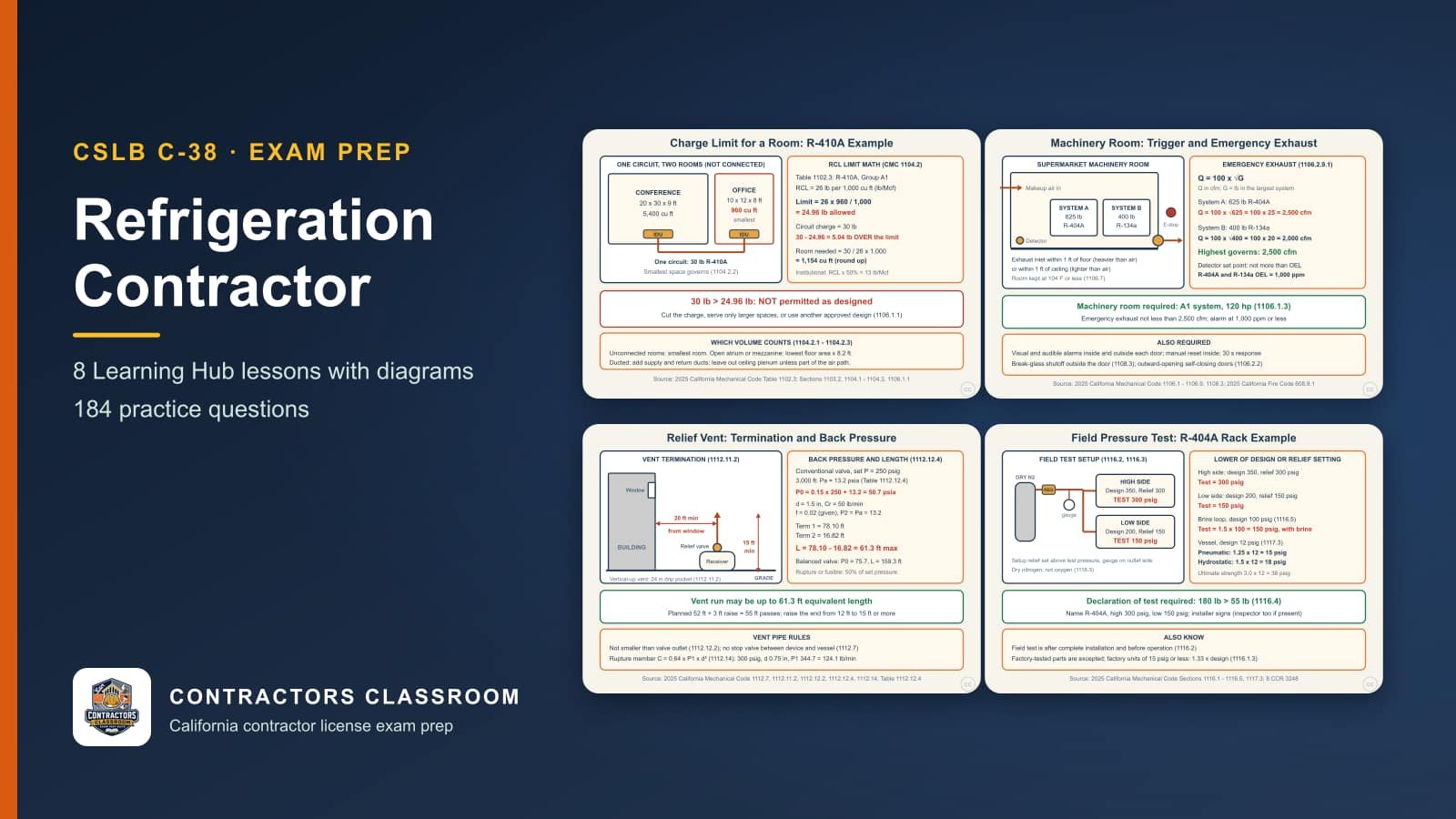
Diagrams from the C-38 refrigeration contractor lessons: Refrigerant Charge Limit for a Room: RCL from CMC Table 1102.3, Machinery Room Triggers and Emergency Exhaust (CMC 1106), Relief Valve Vent Piping: Termination, Back Pressure and Length (CMC 1112) and Field Pressure Test: Pressure, Test Gas and Declaration (CMC 1116)
184practice questions
2categories
8Learning Hub lessons
$249Law & Business included

What the exam covers: Refrigeration (C-38)

The CSLB exam for the California refrigeration contractor license (C-38) is a closed-book, multiple-choice test. CSLB's official study guide divides it into five major sections and gives each an approximate weight: Planning and Estimating (about 18%), Refrigeration System Installation (about 26%), Refrigeration System Repair (about 22%), Refrigeration System Maintenance (about 18%), and Safety (about 16%).

Refrigeration System Installation carries the most weight, about 26%, so it deserves roughly that share of your study time, with Refrigeration System Repair next at about 22%.

Contractors Classroom turns that outline into 184 practice questions in 2 categories (Planning and Estimating and Cal-OSHA & EPA Section 608 Refrigerant Safety), plus 8 Learning Hub lessons with diagrams (such as "Refrigerant Charge Limit for a Room: RCL from CMC Table 1102.3" and "Machinery Room Triggers and Emergency Exhaust (CMC 1106)"). Law and Business, which most applicants take alongside their trade exam, is included at no extra charge.

Exam sections and approximate weights

  • Planning and Estimating~18%
  • Refrigeration System Installation~26%
  • Refrigeration System Repair~22%
  • Refrigeration System Maintenance~18%
  • Safety~16%

Practice question categories

  • Planning and Estimating75 practice questions
  • Cal-OSHA & EPA Section 608 Refrigerant Safety109 practice questions

What the Refrigeration Contractor exam covers, section by section

Planning and Estimating (~18%)

Before any compressor is set, a refrigeration project needs a plan that fits the customer's cooling or freezing needs. That means understanding the load, the building and the equipment layout, the order for installing components and tying in utilities, and the time required. The estimate then converts equipment, refrigerant, piping, electrical work and labor into a price that holds up as work proceeds. Walk-in boxes, reach-in cases and remote racks each have different capacities and line lengths, so choosing the right type early prevents undersized compressors or oversized, wasteful ones. Planning also notes power supply, drain locations and roof or pad space for the condensing unit.

  • Match equipment, layout and installation sequence to the cooling or freezing load the customer needs
  • Price equipment, refrigerant, controls, piping, electrical work and labor so the bid stays accurate

Refrigeration System Installation (~26%)

Installing a refrigeration system means getting a complex set of parts to work as one. The site must be ready with proper access, structure and power, equipment is set and connected with piping, electrical and controls, and the system is evacuated, charged and brought up to operation. Specialty systems, such as walk-in boxes or display cases, add their own details. Refrigerant lines are brazed with nitrogen flowing through them to keep scale out of the system, and a deep vacuum pulled afterward removes moisture and air that would otherwise freeze, corrode or choke the metering device.

  • Verify structure, power and clearances, and ready the area for new equipment
  • Mount compressors, condensers and evaporators and connect piping and wiring
  • Evacuate, charge and start the system, then confirm it reaches proper temperatures
  • Handle special systems such as walk-in coolers, display cases or low-temperature units

Refrigeration System Repair (~22%)

Repair work starts with listening to the symptom and measuring what the system is doing. Technicians follow refrigerant, airflow and temperature clues to the faulty component, and since motors, relays, controls and wiring often cause failures, they also trace electrical faults with meters. Once the cause is clear, parts are replaced or adjusted and the system is checked back to normal operation. A gauge manifold, clamp meter and thermometers show whether a low-side problem comes from a leak, a restriction or a weak evaporator fan. Burned windings and welded contactors point toward electrical causes rather than charge.

  • Diagnose poor cooling by reading pressures, temperatures and airflow
  • Use meters to trace failed motors, contactors, controls and wiring faults
  • Replace or adjust faulty parts and verify the system runs properly afterward

Refrigeration System Maintenance (~18%)

A well-maintained refrigeration system runs longer, uses less energy and protects stored products. Routine visits include cleaning coils, inspecting belts, motors and seals, checking charge and controls, and noting small problems before they become failures. Documentation is equally important: written records show the work met the applicable requirements, which matters to owners and inspectors alike. Dirty condenser coils, loose belts and iced evaporators are the most common drains on efficiency, and catching them on routine visits avoids spoiled product. Leak-check logs and refrigerant records give inspectors a clear history.

  • Clean coils, inspect belts, motors and seals, and check operation on a regular schedule
  • Keep service records showing that the system and the work meet applicable codes

Safety (~16%)

Refrigeration technicians work with pressurized refrigerant, live electrical circuits, heavy equipment and cold or enclosed spaces. They protect themselves with suitable gear, lock out power before servicing, and handle refrigerant and tools carefully. On the site, ventilation, tidy work areas and awareness of other trades help prevent accidents and keep occupants safe. Refrigerant can freeze skin on contact and displace oxygen in a closed room, and a worker trapped in a cold box needs an inside release. Pressurized cylinders and heavy compressors call for careful handling and sound footing.

  • Wear gloves, eye protection and other suitable gear, and follow lockout practices around live circuits
  • Keep ventilation, access and surroundings safe when working around refrigerants, heavy equipment and enclosed cold rooms

Code books behind the Refrigeration Contractor exam

The exam outline published for this trade lists these references.

  • 2025 California Mechanical CodeThe core installation code for the C-38 refrigeration exam. Its refrigeration chapters set charge limits by room volume, the point at which equipment needs its own room, emergency exhaust, relief device venting, piping and valve rules, and field pressure testing. It is the reference behind much of Refrigeration System Installation and the code compliance topics in Refrigeration System Maintenance.
  • 2025 California Electrical CodeRefrigeration equipment runs on motors, controls and heating elements, and this code governs their circuits: conductor and overcurrent sizing for compressors, disconnect placement, motor protection and grounding. It feeds the Troubleshooting electrical problems topic in Refrigeration System Repair and the electrical connections made at installation.
  • California Health and Safety CodeThis statute contains state rules that apply to refrigerants and refrigeration work, including limits on releasing refrigerant and requirements that affect how systems are installed, serviced and documented. It supports the documenting code compliance bullet in Refrigeration System Maintenance and the hazard side of the Safety section. Read it for the legal limits on venting and for record-keeping duties.
  • Fundamentals of HVACRA foundational textbook on the refrigeration cycle, pressure and temperature relationships, electrical theory, motors and controls. It is a good place to build the theory behind startup procedures and the symptom-to-cause reasoning asked about in Refrigeration System Repair. Its chapters on safety and electrical basics also help candidates who are new to the trade.
  • Modern Refrigeration and Air ConditioningA detailed text on compressors, condensers, evaporators, metering devices, controls, defrost, charging and evacuation. It is the study source for installing and starting refrigeration equipment and for diagnosing pressure, temperature and flow problems in the repair section. Read its charging and evacuation chapters alongside the pressure test topics.
  • Refrigeration & Air Conditioning TechnologyA second technical textbook covering commercial refrigeration systems, electrical controls, refrigerants, service procedures and system maintenance. It reinforces installation, repair and maintenance topics from another angle, helpful when a concept needs a second explanation. Its service sections suit the maintenance bullets of the exam outline.
  • State of California General Industry & Electrical Safety Orders (Cal/OSHA)The Title 8 safety orders cover refrigeration machinery rooms and ammonia or high-pressure hazards, electrical work, handling compressed gas cylinders, hazard communication and respiratory protection. They are the reference behind the Safety section's personnel and job site topics and the refrigerant safety questions in the practice bank.

Key terms for the Refrigeration Contractor exam

Refrigerant concentration limit
The most refrigerant, in pounds per thousand cubic feet, that room air may hold after one circuit leaks completely. Codes use it to cap the charge in systems serving occupied spaces, so the smallest room served usually decides the allowed amount.
Machinery room
A separate, ventilated room built to house refrigeration equipment when the charge or system type passes certain thresholds. It brings tight self-closing doors, detectors, alarms, emergency shutoff and exhaust requirements that ordinary equipment spaces do not have.
Emergency exhaust
Power-driven ventilation in a machinery room sized from the charge of the largest system, ready to clear a rupture. Air inlets sit low for refrigerant vapors that sink and high for vapors that rise, and makeup air must replace what is removed.
Refrigerant detector
A sensor in or near a machinery room that alarms when refrigerant reaches a set concentration, often tied to ventilation or shutoff. Its alarm level, self-test behavior and placement where a leak would collect are typical exam points.
Relief valve vent line
The discharge pipe that carries relieved refrigerant to a safe place outdoors. Its length, bends and size create back pressure that can reduce the valve's capacity, so the pipe cannot be smaller than the valve outlet and cannot contain a shutoff.
Rupture disc
A thin metal membrane built to burst at a set pressure and relieve a vessel. It is often installed ahead of a relief valve to prevent weeping, with a gauge between them that reveals a rupture.
Fusible plug
A plug made of low-melting alloy that softens at a set temperature, opening the vessel to relieve pressure during a fire. Unlike a relief valve it cannot reseal, and the vent pipe attached to it must be handled accordingly.
Dry nitrogen pressure test
A leak and strength test of refrigerant-containing parts using regulated, dry nitrogen. Oxygen and compressed air are not used, and the test setup needs a pressure regulator with an outlet gauge and a relief device.
Declaration of test
A dated, signed statement recording the refrigerant and the pressure applied to each side of the circuit during a field test of a larger system. It is paperwork, but it also proves the test was done, and it is one of the code compliance records a contractor keeps.
Micron gauge
An electronic vacuum gauge that reads very low absolute pressure. Evacuation is judged by how low the reading falls and whether it rises when the pump is isolated, because a rising reading signals moisture or a leak.
Standing pressure test
A hold period after pressurizing a system, during which the gauge must show no meaningful drop. Because temperature shifts change pressure, a small movement may be explained by the weather, so judging the result takes care.
Tracer gas
A small amount of detectable gas blended into the nitrogen used for a pressure test so a leak detector can find tiny leaks. It is added in a limited proportion, and the mix must remain nonflammable and nonreactive.
Global warming potential
A number comparing how strongly a refrigerant traps heat against carbon dioxide. High-potential refrigerants bring stricter leak-tightness rules in new store systems and drive the move toward lower-impact alternatives.
Floating suction pressure
A control approach that raises the target suction pressure when cooling demand is light. A warmer suction setting makes the compressors work less, which lowers energy use without hurting product temperatures.
Liquid subcooling
Cooling liquid refrigerant below its condensing temperature before it reaches the expansion device. It adds refrigerating capacity per pound of refrigerant and helps prevent flash gas, which is why low-temperature store systems are expected to use it.
Saturated condensing temperature
The temperature at which refrigerant condenses at the pressure inside the condenser. Designs hold it only a set number of degrees above outdoor air or wet-bulb temperature, because each extra degree raises compressor power.
Heat recovery from refrigeration
Capturing the heat that refrigeration systems reject and using it to warm space or water instead of releasing it outdoors. Retail food stores are expected to recover a share of that heat for heating, which links refrigeration to the building's energy design.
Compressor overload protector
A thermal or current-sensing device that opens the motor circuit when heat or amperage gets too high. It can be built into the motor or mounted outside, and line-duty and pilot-duty types connect differently, a distinction that appears in motor protection questions.
Diaphragm element
A flexible membrane that moves as pressure changes, operating a switch, valve or gauge. It is the standard pressure-sensing element, in contrast to a bimetal strip that responds to temperature, a float that tracks liquid level or a vane that senses airflow.
Refrigerant recovery
Removing refrigerant from a system into a listed recovery cylinder rather than venting it. Federal certification rules cover who may handle refrigerant, and the practice questions on this topic blend those rules with California safety requirements.

Where to spend practice time for the Refrigeration Contractor exam

  • Installation and startupRefrigeration System Installation is about 26 percent of the exam, the biggest single block, covering site preparation, setting equipment, startup and specialty systems. Practice the order of work from piping and pressure test through evacuation and charging, and learn why store and warehouse systems carry extra leak-tightness and efficiency rules.
  • Repair and electrical diagnosisRefrigeration System Repair is about 22 percent of the exam and joins mechanical and electrical troubleshooting. Drill the way symptoms lead to causes: low suction, high head pressure, short cycling, a motor that will not start. Know which control reacts to pressure, temperature, level or airflow, and which overload protects the compressor.
  • Planning math and job costingPlanning and Estimating is about 18 percent of the exam, and the practice bank has a large set of calculation questions. Rehearse totaling materials, crew labor, overhead applied only to labor and markup applied only to parts, in the right order. Writing out each line before touching the calculator prevents the usual mix-ups.
  • Maintenance and code recordsRefrigeration System Maintenance is about 18 percent of the exam and includes documenting code compliance. Review what gets recorded after a test, a leak check or a charge change, which signs and labels must be present, and how detection and emergency devices are kept working. Think of the records as part of the job.
  • Charge limits, rooms and relief pipingRefrigerant safety is the largest practice category, and it uses calculations: charge limit from room volume, emergency exhaust from the largest system's charge, relief vent back pressure and length. Work each formula with different refrigerants and room sizes, and recall which situations call for a machinery room.
  • Personal and job site safetySafety is about 16 percent of the exam. Review handling of compressed gas cylinders, nitrogen pressure hazards, electrical shock at control panels, refrigerant exposure and recovery rules. Matching each hazard to its control, such as a regulator, a lock, a detector or a ventilation step, builds fast recall.

Scenarios to talk through before the Refrigeration Contractor exam

  • Indoor coils in small roomsA remote condensing unit will serve evaporators in two rooms that are not connected by ducts or openings. Which room decides the allowed charge, what limit do you look up for the refrigerant, and what could you change if the planned charge is too large? Say what the owner could do with the room layout instead. Mention how the smallest occupied space is chosen.
  • Does this plant need its own roomA store plans a large system with a big charge. Explain how you would judge if the plant needs a machinery room, what detectors, alarms and doors it needs, and where the emergency exhaust inlet goes for a refrigerant heavier than air. Add what the alarm should do when it detects a leak. Name who must be able to reach the room in an emergency.
  • Long relief vent runThe relief valve on a receiver must vent to the outdoors through a long pipe with several bends. How does that run affect back pressure and valve capacity, where must the discharge end, and why may you not put a shut-off in the line? Explain what type of device could protect the valve from leaking.
  • Pressure test dayThe piping is complete and you are ready to test. Which gas do you use and which gases are off limits, what gauges and relief devices belong on the test setup, how would a tracer gas help, and what record do you leave behind? Mention what you would do if the pressure falls during the hold. Say what you would do with the declaration afterward.
  • Evacuation that will not holdAfter a leak test, the micron gauge reaches a low reading but climbs when the pump is isolated. What could cause the rise, how do you tell moisture from a leak, and what would you do before charging the system? Explain what you would verify about your hoses and fittings first. Mention what you would replace or tighten first.
  • Walk-in cycles on short runsA walk-in freezer compressor starts and stops quickly, with frost reaching the suction line. Which controls and measurements do you consider, from pressure-sensing elements to superheat and the metering device, and what order would you check them in? Say what you would compare against a target before touching the valve.
  • Cutting energy use in a storeA retail food store wants lower energy use from its rack. Discuss how floating suction, condenser fan speed control, a lower condensing temperature, liquid subcooling and heat recovery each help, and what they require from you at installation. Include the paperwork a code reviewer might ask to see afterward. Say which of these items depends on outdoor conditions.
  • Recovery during a retrofitYou are converting an older system and must remove its charge. How do you handle recovery and cylinders, what rules limit venting, what electrical and cylinder hazards deserve attention, and which records show the work met code? Explain where the recovered refrigerant may go and where it may not. Say what records stay on site afterward.

Learning Hub lessons

Each lesson has guided steps, a diagram, a worked example and a quick check inside the classroom.

Preview the lesson diagrams

  1. Refrigerant Charge Limit for a Room: RCL from CMC Table 1102.3Steps: What the Concentration Limit Protects; Read the RCL in Table 1102.3; Choose the Volume That Counts; Turn the RCL Into a Pound Limit; When the Circuit Is Over the Limit
  2. Machinery Room Triggers and Emergency Exhaust (CMC 1106)Steps: When a Machinery Room Is Required; Emergency Exhaust: Q = 100 x the Square Root of G; Where the Exhaust Inlet and Makeup Air Go; Detectors, Alarms and the Emergency Shutoff; Doors, Walls and Access; Fire Code Thresholds That Ride Along
  3. Relief Valve Vent Piping: Termination, Back Pressure and Length (CMC 1112)Steps: Where the Vent Must End; Rules for the Vent Pipe and Valve; Allowable Back Pressure P0; Maximum Equivalent Length of the Vent; Rating Rupture Members and Fusible Plugs
  4. Field Pressure Test: Pressure, Test Gas and Declaration (CMC 1116)Steps: What Gets Tested and at What Pressure; Test Gas and Gauge Setup; The Exceptions to Know; Declaration, Brine and Vessel Tests; Cal/OSHA and Fire Code Follow-Up
  5. Supermarket Leak-Tight Installation: CALGreen 5.508.2 Pressure Test and EvacuationSteps: Who Section 5.508.2 Covers; Piping Rules That Reduce Leaks; Valves, Relief Devices and Receivers; The 300 psig Standing Pressure Test; The Three-Stage Evacuation
  6. Refrigerated Warehouse Condensers: Design Condensing Temperature and Efficiency (Energy Code 120.6(a))Steps: When Section 120.6(a) Applies, and the Insulation Table; Air-Cooled Condensers: Design Condensing Temperature; Evaporative and Water-Cooled Condensers; Condenser Efficiency: Table 120.6-B; Other Condenser and Compressor Controls
  7. Warehouse Evaporators: Specific Efficiency, Fan Control and Static Pressure (Energy Code 120.6(a)3)Steps: Which Evaporators Section 120.6(a)3 Covers; Fan Motors; Variable Speed and Off-Cycle Airflow; Specific Efficiency: Table 120.6-A-2; Static Pressure and the Quick-Chill Exception
  8. Retail Food Store Refrigeration: Heat Recovery, Subcooling and Condenser Rules (Energy Code 120.6(b))Steps: Which Stores Section 120.6(b) Covers; Condensers; Compressor Systems and Liquid Subcooling; Display Case Lighting; Heat Recovery and the Charge Allowance

See the classroom in action

Frequently asked questions

How do I get a California refrigeration contractor license?

A refrigeration technician or commercial refrigeration installer who wants to contract independently applies under C-38. CSLB generally requires documented journey-level experience, a bond, and passing scores on both the Law and Business exam and the C-38 exam. Rules change, so confirm them with CSLB.

What does the refrigeration contractor exam ask about refrigeration system installation?

Refrigeration System Installation is the heaviest part of the C-38 exam, at about 26%. Expect questions on verify structure, power and clearances, and ready the area for new equipment, mount compressors, condensers and evaporators and connect piping and wiring, and evacuate, charge and start the system, then confirm it reaches proper temperatures. Next in weight come refrigeration system repair (about 22%) and planning and estimating (about 18%).

What kinds of questions are on the refrigeration contractor exam?

The three sample questions in CSLB's C-38 study guide ask about which device reacts to pressure, what protects a compressor motor, and a total job cost with crew labor, overhead and a parts markup. Like every question on the exam, each has four choices and one best answer.

Which codes and books does the C-38 exam reference?

CSLB's C-38 study guide lists the 2025 California Electrical and Mechanical Codes (Title 24), the Cal/OSHA safety orders (Title 8), and trade references such as California Health and Safety Code, Fundamentals of HVACR, and Modern Refrigeration and Air Conditioning. Use them to study; the exam itself is closed-book.

Is the refrigeration contractor exam open book?

No. The C-38 study guide says no reference materials may be used, even though it names California Health and Safety Code and Fundamentals of HVACR among the books to study from. A calculator is provided, and guessing is not penalized.

Can I take the refrigeration contractor exam outside California?

CSLB's exam FAQ says trade exams are given in California or Oregon only, so C-38 is not offered in other states, although Law and Business can be taken out of state. Check the current PSI list when you schedule.

How are the 184 C-38 practice questions organized?

They are split into 2 categories, largest first: Cal-OSHA & EPA Section 608 Refrigerant Safety (109) and Planning and Estimating (75). Cal-OSHA & EPA Section 608 Refrigerant Safety holds about 59% of the questions. 8 Learning Hub lessons add diagrams and worked examples for the harder topics. The missed-question review collects every question you get wrong.

Is there a free trial for refrigeration contractor exam prep (C-38)?

Yes. The free C-38 preview opens the real classroom with no sign-up and gives you the first question from every C-38 category, including Cal-OSHA & EPA Section 608 Refrigerant Safety and Planning and Estimating, plus Law and Business. The full course is a one-time $249 purchase.

Is refrigeration contractor exam prep available in Spanish?

The website and the eight demo videos are available in Spanish. The classroom and the 184 C-38 practice questions are in English for now; translating the questions is not part of the course yet.

Ready to practice for real?

Try the real classroom free, no sign-up, or get the full course for your trade.

Independent exam preparation. Contractors Classroom is not affiliated with the Contractors State License Board, and no course can guarantee a passing result.


