CSLB C-55

Water Conditioning Contractor License Exam Prep (C-55)

Getting ready for the California water conditioning contractor license exam (CSLB C-55)? Study with 184 practice questions in 2 categories and 5 Learning Hub lessons, made for water softener and treatment installers, with the Law and Business exam included.

One-time purchase, no subscription. Law & Business included.

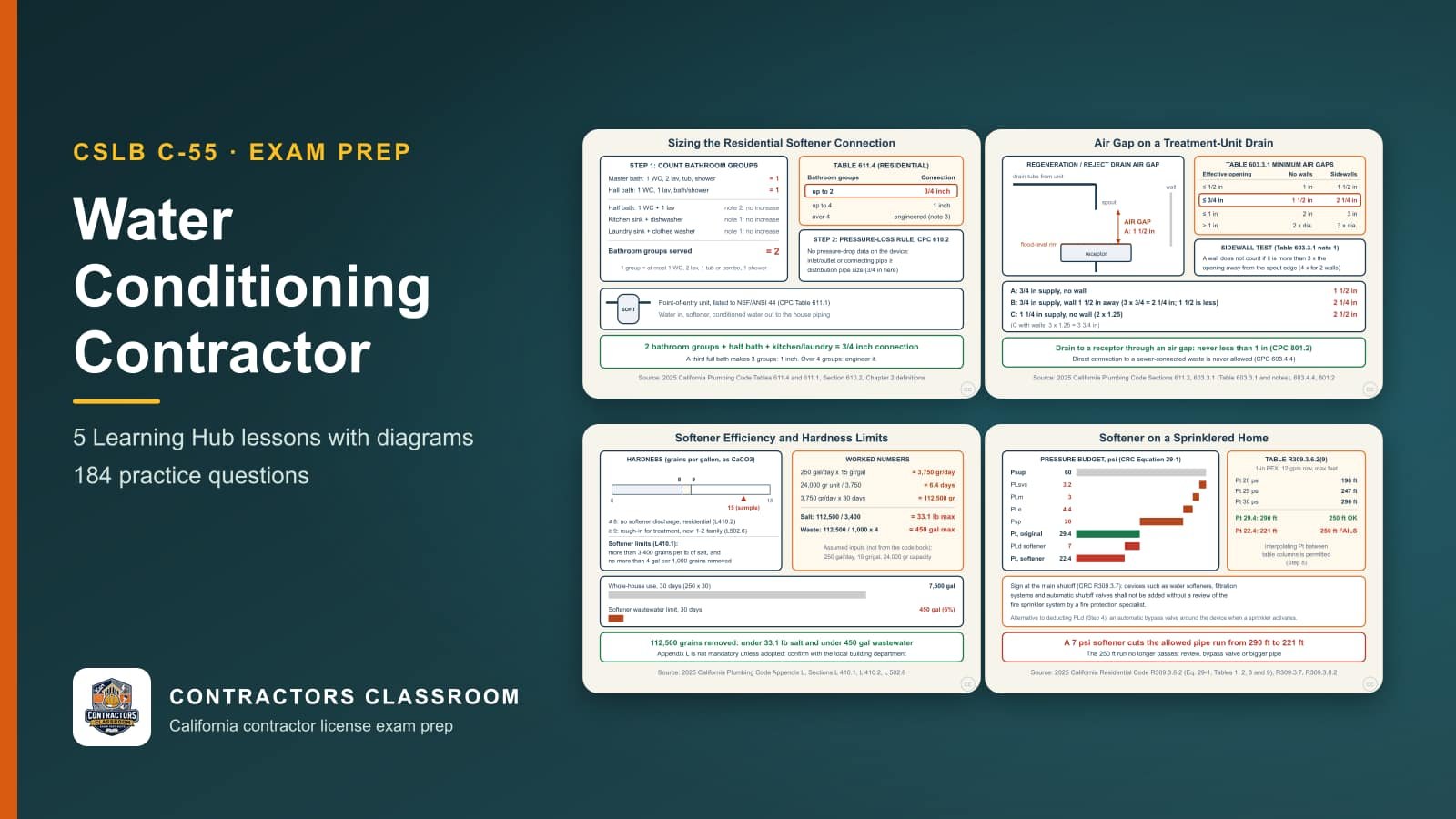
Diagrams from the C-55 water conditioning contractor lessons: Sizing the Residential Softener Connection (CPC 611.4), Air Gap on a Treatment-Unit Drain (CPC 611.2), Softener Efficiency and Hardness Limits (CPC Appendix L) and Adding a Softener to a Sprinklered Home (CRC R309.3)
184practice questions
2categories
5Learning Hub lessons
$249Law & Business included

What the exam covers: Water Conditioning (C-55)

The CSLB exam for the California water conditioning contractor license (C-55) is a closed-book, multiple-choice test. CSLB's official study guide divides it into four major sections and gives each an approximate weight: Planning and Estimating (about 28%), Water Systems Component Installation and Startup (about 24%), Troubleshooting, Maintenance, Repair, and/or Replacement of Water Systems and Components (about 31%), and Safety (about 17%).

Troubleshooting, Maintenance, Repair, and/or Replacement of Water Systems and Components carries the most weight, about 31%, so it deserves roughly that share of your study time, with Planning and Estimating next at about 28%.

Contractors Classroom turns that outline into 184 practice questions in 2 categories (Planning and Estimating and Cal-OSHA Chemical & Plumbing Safety), plus 5 Learning Hub lessons with diagrams (such as "Sizing the Residential Softener Connection (CPC 611.4)" and "Air Gap on a Treatment-Unit Drain (CPC 611.2)"). Law and Business, which most applicants take alongside their trade exam, is included at no extra charge.

Exam sections and approximate weights

  • Planning and Estimating~28%
  • Water Systems Component Installation and Startup~24%
  • Troubleshooting, Maintenance, Repair, and/or Replacement of Water Systems and Components~31%
  • Safety~17%

Practice question categories

  • Planning and Estimating75 practice questions
  • Cal-OSHA Chemical & Plumbing Safety109 practice questions

What the Water Conditioning Contractor exam covers, section by section

Planning and Estimating (~28%)

Treatment work begins with knowing what is in the water and what the customer actually needs. A candidate should be able to interpret test results, inspect the property and its plumbing, match a type of system to the problem, and then put together a clear scope and price for the installation. Getting this stage right prevents mismatched equipment and unhappy customers later. A homeowner with hard water, for instance, needs a different answer than a business worried about taste, chlorine, or sediment, so the right fit depends on sampling results, flow demand, and floor space near the main line.

  • Interpret test results to identify minerals, contaminants, and other water quality concerns
  • Inspect the property, plumbing, space, and power available at the installation point
  • Match a treatment system to the water problem and the customer's needs
  • Prepare a scope of work with an accurate price for equipment and labor

Water Systems Component Installation and Startup (~24%)

Installing a treatment unit means more than setting a tank in a corner. Water has to be routed in and out with the right pipe and shutoffs, wastewater must leave through an approved path that prevents contamination of the supply, power has to be connected correctly, and the finished system needs to be brought online and adjusted. Each connection affects both performance and the safety of the household supply. Typical hardware includes softeners, carbon filters, sediment cartridges, and reverse osmosis units, each needing correctly sized fittings, a drain air gap, and a check for leaks and pressure before the owner takes over. Pressure, flow rate, and the location of the main shutoff are noted so the unit can be tied in without starving fixtures downstream.

  • Connect piping with shutoff and bypass valves so the unit can be isolated
  • Mount tanks, filters, and treatment units securely on a suitable base
  • Route wastewater to an approved drain and protect the potable supply from backflow
  • Wire controls and connect power in a safe, code-compliant manner
  • Start the system, flush it, and tune settings to match the water

Troubleshooting, Maintenance, Repair, and/or Replacement of Water Systems and Components (~31%)

Most of the ongoing income in this trade comes from keeping existing systems working. Here the focus is on routine care, finding the reason a unit stopped performing, deciding whether a part can be fixed or must be swapped out, and sanitizing equipment afterward so that servicing does not introduce bacteria into the water. Careful diagnosis saves customers from paying for parts they never needed. A softener that no longer softens, a filter housing that drips, or a drop in flow often traces back to exhausted resin, a fouled cartridge, a stuck valve head, or a salt bridge, so a technician checks the simple causes first.

  • Perform scheduled service such as refilling media, cleaning parts, and checking performance
  • Work through symptoms methodically to isolate the real cause of a failure
  • Decide when to fix a component and when to replace the whole unit
  • Sanitize the system after opening it so the water stays safe to drink

Safety (~17%)

Treatment installers deal with pressurized lines, electrical connections, heavy tanks, and sometimes strong chemicals. Safety in this area covers protecting the worker's own body, storing and handling substances correctly, keeping spills and discharges out of the environment, and using hand and power tools in ways that avoid injury. Because water treatment happens inside homes and businesses, the surroundings deserve the same care as the equipment. Handling salt bags, chlorine, and acid-based cleaners means knowing how they react, keeping ventilation and eyewash in mind, and making sure brine from regeneration does not run into storm drains or gardens. Pipe wrenches, tubing cutters, and a pressure gauge are ordinary tools here, and each deserves a quick inspection before use.

  • Protect the worker's body through proper gear, lifting habits, and safe practices
  • Store, label, and handle chemicals such as salt, acids, and disinfectants safely
  • Prevent spills and discharges from reaching soil, drains, or waterways
  • Use ladders, cutters, and power tools correctly and keep them in good condition

Code books behind the Water Conditioning Contractor exam

The exam outline published for this trade lists these references.

  • 2025 California Plumbing CodeThe plumbing code governs how conditioning equipment ties into a building: softener connection size by bathroom groups served, pressure loss through treatment devices, listing standards for treatment units, backflow protection, drain air gaps and the disinfection sequence for new or repaired systems. Each idea turns up as a short calculation or recall question in the installation, drain and disinfection topics.
  • California Health & Safety CodeThe cited parts of this statute cover the Safe Drinking Water Act and the rules for water treatment equipment, including how devices are tested and how claims about them are limited. For a water conditioning contractor it frames what treatment equipment may do and is the legal backdrop for system selection and service in the planning and repair sections. Reading how the statute treats drinking water systems and treatment devices also explains why registration and testing language shows up in product literature.
  • State of California General Industry & Electrical Safety Orders (Cal/OSHA)The Title 8 safety orders deal with chemical exposure limits for substances like chlorine, eyewash and spill rules for corrosives, storage and handling of oxidizers, electrical safety around powered equipment and tool guarding. They are the reference behind hazardous materials and environmental safety in the Safety section. Pair the chlorine exposure limits with the disinfection procedure so the numbers and the safe handling steps are studied together.
  • Water Quality Association Knowledge BaseAn industry reference library on water chemistry, hardness, iron, chlorine, taste and odor, softening, filtration, reverse osmosis and disinfection, with practical service guidance. It supports water analysis and system selection in Planning and Estimating and the troubleshooting and maintenance topics in the largest section of the exam. Its plain-language articles are a good way to meet unfamiliar contaminants before looking at the code.

Key terms for the Water Conditioning Contractor exam

Grains per gallon
The unit most water test reports use for hardness. Multiplying the grains per gallon by the gallons a household uses each day gives the hardness load a softener must remove, which determines how often it must regenerate. Hardness above a few grains is usually the signal that softening makes sense.
Ion exchange
The process in which resin beads swap hardness minerals such as calcium and magnesium for sodium or potassium ions. It is how a household softener works, and the resin has only so much room, so it eventually needs restoring.
Resin bed
The column of tiny plastic beads inside a softener tank that holds the exchange sites. Iron fouling, chlorine damage or compaction can weaken it, so loss of capacity is a common service complaint.
Regeneration
Restoring a softener's resin by washing it with brine so it releases hardness and takes on sodium again. A cycle includes backwash, brine draw and slow rinse, fast rinse and refilling the brine tank. A timer or a meter that counts gallons can start the cycle.
Brine tank
The container that holds salt and the salt solution used in regeneration. Problems such as salt bridges, mushing or a blocked draw line stop brine from reaching the resin, which makes the softener seem to run but not soften.
Backwash
Sending water up through a media bed in reverse direction to lift and flush out trapped particles and loosen the bed. Filters and softeners both use it, and a drain too small for the flow can leave the bed dirty.
Salt efficiency
How many grains of hardness a softener removes for each pound of salt used in regeneration. Higher figures mean less salt discharged into wastewater, which is why efficiency ratings appear in conservation rules.
Reverse osmosis
A treatment in which pressure pushes water through a semipermeable membrane that holds back dissolved salts and many contaminants. It yields treated water for drinking and a reject stream that must go to a proper drain. Higher feed pressure and warmer water generally improve output.
Total dissolved solids
The combined amount of dissolved minerals and salts in water, read in parts per million with a conductivity meter. Comparing feed and product readings shows whether an RO membrane is still rejecting properly. A rising product reading is an early sign of a tired membrane.
Activated carbon
Highly porous carbon that adsorbs chlorine, tastes, odors and some organic chemicals as water passes through. It is the usual answer for improving taste and odor, but it needs replacement because it eventually saturates. It does not remove hardness minerals.
Micron rating
The particle size a sediment filter is built to catch. A smaller number means finer filtration but faster clogging and more pressure loss, so the choice balances cleanliness against flow. Filters are often staged from coarse to fine.
Point-of-entry unit
Treatment equipment installed where water enters the building, so every tap receives treated water. Whole-house softeners and large filters are examples, and their connection size must carry the whole demand.
Point-of-use unit
A device that treats water at a single outlet, such as an under-sink reverse osmosis system for the kitchen faucet. It serves drinking water only, so installers must handle its drain, air gap and supply connection separately.
Bathroom group
A code term for a set of fixtures at one bathroom, counted together rather than one by one. Softener connection tables are entered by the number of these groups, with kitchen and laundry fixtures not adding a size increase.
Air gap
An open vertical space between the end of a drain line and the overflow rim of the receptor below it. Because nothing physically connects the two, sewage cannot be drawn back into a softener or RO unit.
Bypass valve
A valve set that routes water around a treatment unit for service or when treated water is not wanted. Feeding outside hose faucets through the bypass keeps softened water, and the regenerant that makes it, from being wasted on lawns. Opening it must never allow treated and untreated water to cross-connect.
Oxidizing filter
A media filter that converts dissolved iron, manganese or hydrogen sulfide into solid particles and traps them. It is regularly backwashed, and its media must suit the contaminants found in the water analysis. Air or chemical feed may also be part of the system.
Neutralizing filter
A tank of mineral media, often calcite, that raises the pH of acidic water as it passes. It protects copper and other piping from pinhole corrosion and may need its media topped up as it dissolves.
Shock chlorination
Disinfecting a new or repaired water system by filling it with a strong chlorine solution, letting it stand, and flushing it clean. The dose depends on converting bleach strength into parts per million, and chlorine exposure must be controlled. Let the solution stand for the full contact time before flushing.
Eyewash station
A plumbed or self-contained fixture that flushes the eyes after contact with corrosive chemicals. A hose, sink faucet or shower does not count, and it must be reachable in seconds from where salts, acids or chlorine are handled. Know where the nearest one is before opening a chemical container.

Where to spend practice time for the Water Conditioning Contractor exam

  • Troubleshooting and repairTroubleshooting, Maintenance, Repair and Replacement is the biggest section at about 31 percent of the exam, adding disinfection. Practice cause-and-effect pairs: hard water after regeneration, salty taste, low flow, resin loss, fouled membranes, drain noise. For each, name the first check and the likely part to repair or replace. Include the disinfection steps in this review.
  • Water analysis and system selectionPlanning and Estimating is about 28 percent of the exam and starts with water analysis and the job site. Practice reading a test report for hardness, iron, pH, chlorine and dissolved solids, and match each finding to equipment such as a softener, carbon filter, oxidizing filter, neutralizer or RO unit. Practice choosing between point-of-entry and point-of-use equipment for each case.
  • Hardness load and sizing mathCalculation questions recur in planning: grains of hardness per day, days between regenerations, salt use, wastewater volume, and energy cost for small devices. Work them from first principles and keep units straight. Also practice sizing the connection by bathroom groups and remembering to include pressure loss through the device. Check every answer against the pressure the home actually has.
  • Installation, drains and startupInstallation and startup is about 24 percent of the exam. Review piping and valve layouts with bypass, air gaps and indirect drains, backflow protection, electrical connections and the rule that unsafe outlets are corrected by an electrician, plus startup and calibration steps. Sketching a softener hookup from the meter inward helps. Know which fixtures can use untreated water to save regenerant.
  • Disinfection and chlorine mathDisinfection appears under repair and replacement. Practice the sequence of flushing, filling with chlorine solution, waiting and flushing again, and convert percent bleach to parts per million with a dilution relation. Pair it with chlorine exposure and spill rules, since the chemistry and the safety questions travel together.
  • Chemical and environmental safetySafety is about 17 percent of the exam and focuses on salts, chlorine, acids and other chemicals, personal protection, environmental discharge and tool and equipment safety. Review eyewash needs, safe storage and mixing, spill response and where brine and rinse water may be sent, so the correct control comes to mind quickly.

Scenarios to talk through before the Water Conditioning Contractor exam

  • Reading a hardness reportA lab report shows hardness in grains per gallon along with iron and pH. How do you turn household water use into a daily hardness load, what does it tell you about regeneration frequency, and which other findings might need separate equipment? Say what you would ask the customer about household habits.
  • Sizing a softener connectionA house has several bathrooms, a kitchen, a laundry and a hose bib line. How do bathroom groups set the connection size, what happens when the count is high, and why must pressure loss through the device be included? Explain what the code asks for when the count passes the table.
  • Drain for an RO unitYou are installing an under-sink RO system. Where does the reject line end, how do you create the air gap and measure the effective opening, and which TDS readings on the feed and product water show the membrane still works? Explain what would happen if the drain were connected tightly instead.
  • Orange stains in fixturesA customer has orange stains and a softener that seems to lose capacity. Think about iron in the water, resin bed fouling, an oxidizing filter ahead of the softener, backwash flow, and the service steps you would take on the existing resin. Say how a proper test of the incoming water would guide your choice.
  • Pinholes in copperA home has pinhole leaks in copper pipe and the water tests acidic. Which treatment fits, how does the media change the pH, what maintenance does it need, and how would you check for other conditions that attack pipe? Explain how you would monitor the media over the following months. Say how you would tell the owner to treat the existing pipe.
  • Softener in a sprinklered homeA homeowner with a fire sprinkler system on the domestic supply asks for a whole-house softener. How does the device affect available pressure to the sprinklers, which options protect that pressure, and what must be checked at final? Mention the alternative that avoids deducting that pressure. Say who should be told about the added device.
  • Disinfecting after a repairAfter replacing a section of supply pipe you must disinfect. Walk through the printed sequence, how you convert household bleach strength into the target parts per million, how long it stands, and what chlorine exposure and storage precautions apply. Say how you would handle a spill of the stronger solution. Say how you would confirm no chlorine remains at the taps.
  • Startup in an older homeAt startup you find an ungrounded two-prong outlet beside the softener location, and the owner wants outside faucets on soft water. What do you do about power, how can a bypass help the second concern, and what do you calibrate? State what makes the outlet unsafe and who must correct it. Say what you would write on the service record.

Learning Hub lessons

Each lesson has guided steps, a diagram, a worked example and a quick check inside the classroom.

Preview the lesson diagrams

  1. Sizing the Residential Softener Connection (CPC 611.4)Steps: Where the Code Sizes a Softener; Count Bathroom Groups, Not Fixtures; Read the Table: 3/4 Inch Up to 2, 1 Inch Up to 4; Over Four Groups Is an Engineering Job; Do Not Forget the Pressure Loss; Match the Listing Standard (Table 611.1)
  2. Air Gap on a Treatment-Unit Drain (CPC 611.2)Steps: Why the Drain Needs an Air Gap; Find the Effective Opening; Read Table 603.3.1; Test for Sidewalls; Never Go Below 1 Inch, and Use Listed Gaps as Listed; Where the Drain Goes Next
  3. Softener Efficiency and Hardness Limits (CPC Appendix L)Steps: Know the Status of Appendix L; The Two Hardness Thresholds; The Efficiency Limits on the Softener Itself; Turn Hardness Into a Daily Load; Convert the Load Into Salt and Wastewater Caps; Other Treatment Devices in Appendix L
  4. Adding a Softener to a Sprinklered Home (CRC R309.3)Steps: Why a Softener Is a Fire-Safety Device Too; The Pressure Equation (CRC Equation 29-1); Put the Softener in PLd; Check the Allowed Pipe Length; Two Ways to Handle the Device; Final Inspection Item
  5. Chlorine Disinfection: Dose and Safety (CPC 609.10)Steps: When Disinfection Applies; The Printed Sequence; Turn Percent Bleach Into ppm; Know the Exposure Limit for Chlorine; Eyewash and Storage Rules; Spills and Chemical Containers

See the classroom in action

Frequently asked questions

How do I get a California water conditioning contractor license?

A water softener installer or water treatment installer who wants to contract independently applies under C-55. CSLB generally requires documented journey-level experience, a bond, and passing scores on both the Law and Business exam and the C-55 exam. Rules change, so confirm them with CSLB.

What does the water conditioning contractor exam ask about troubleshooting, maintenance, repair, and/or replacement of water systems and components?

Troubleshooting, Maintenance, Repair, and/or Replacement of Water Systems and Components is the heaviest part of the C-55 exam, at about 31%. Expect questions on perform scheduled service such as refilling media, cleaning parts, and checking performance, work through symptoms methodically to isolate the real cause of a failure, and decide when to fix a component and when to replace the whole unit. Next in weight come planning and estimating (about 28%) and water systems component installation and startup (about 24%).

What kinds of questions are on the water conditioning contractor exam?

The three sample questions in CSLB's C-55 study guide ask about why outside faucets are bypassed on a water softener, the energy cost of a reverse osmosis system, and how to handle non-polarized receptacles safely. Like every question on the exam, each has four choices and one best answer.

Which codes and books does the C-55 exam reference?

CSLB's C-55 study guide lists the 2025 California Plumbing Code (Title 24), the Cal/OSHA safety orders (Title 8), and trade references such as California Health & Safety Code and Water Quality Association Knowledge Base. Use them to study; the exam itself is closed-book.

Is the water conditioning contractor exam open book?

No. The C-55 study guide says no reference materials may be used, even though it names California Health & Safety Code and Water Quality Association Knowledge Base among the books to study from. A calculator is provided, and guessing is not penalized.

Can I take the water conditioning contractor exam outside California?

CSLB's exam FAQ says trade exams are given in California or Oregon only, so C-55 is not offered in other states, although Law and Business can be taken out of state. Check the current PSI list when you schedule.

How are the 184 C-55 practice questions organized?

They are split into 2 categories, largest first: Cal-OSHA Chemical & Plumbing Safety (109) and Planning and Estimating (75). Cal-OSHA Chemical & Plumbing Safety holds about 59% of the questions. 5 Learning Hub lessons add diagrams and worked examples for the harder topics. The missed-question review collects every question you get wrong.

Is there a free trial for water conditioning contractor exam prep (C-55)?

Yes. The free C-55 preview opens the real classroom with no sign-up and gives you the first question from every C-55 category, including Cal-OSHA Chemical & Plumbing Safety and Planning and Estimating, plus Law and Business. The full course is a one-time $249 purchase.

Is water conditioning contractor exam prep available in Spanish?

The website and the eight demo videos are available in Spanish. The classroom and the 184 C-55 practice questions are in English for now; translating the questions is not part of the course yet.

Ready to practice for real?

Try the real classroom free, no sign-up, or get the full course for your trade.

Independent exam preparation. Contractors Classroom is not affiliated with the Contractors State License Board, and no course can guarantee a passing result.


