CSLB C-60

Welding Contractor License Exam Prep (C-60)

Getting ready for the California welding contractor license exam (CSLB C-60)? Study with 184 practice questions in 2 categories and 6 Learning Hub lessons, made for welders, with the Law and Business exam included.

One-time purchase, no subscription. Law & Business included.

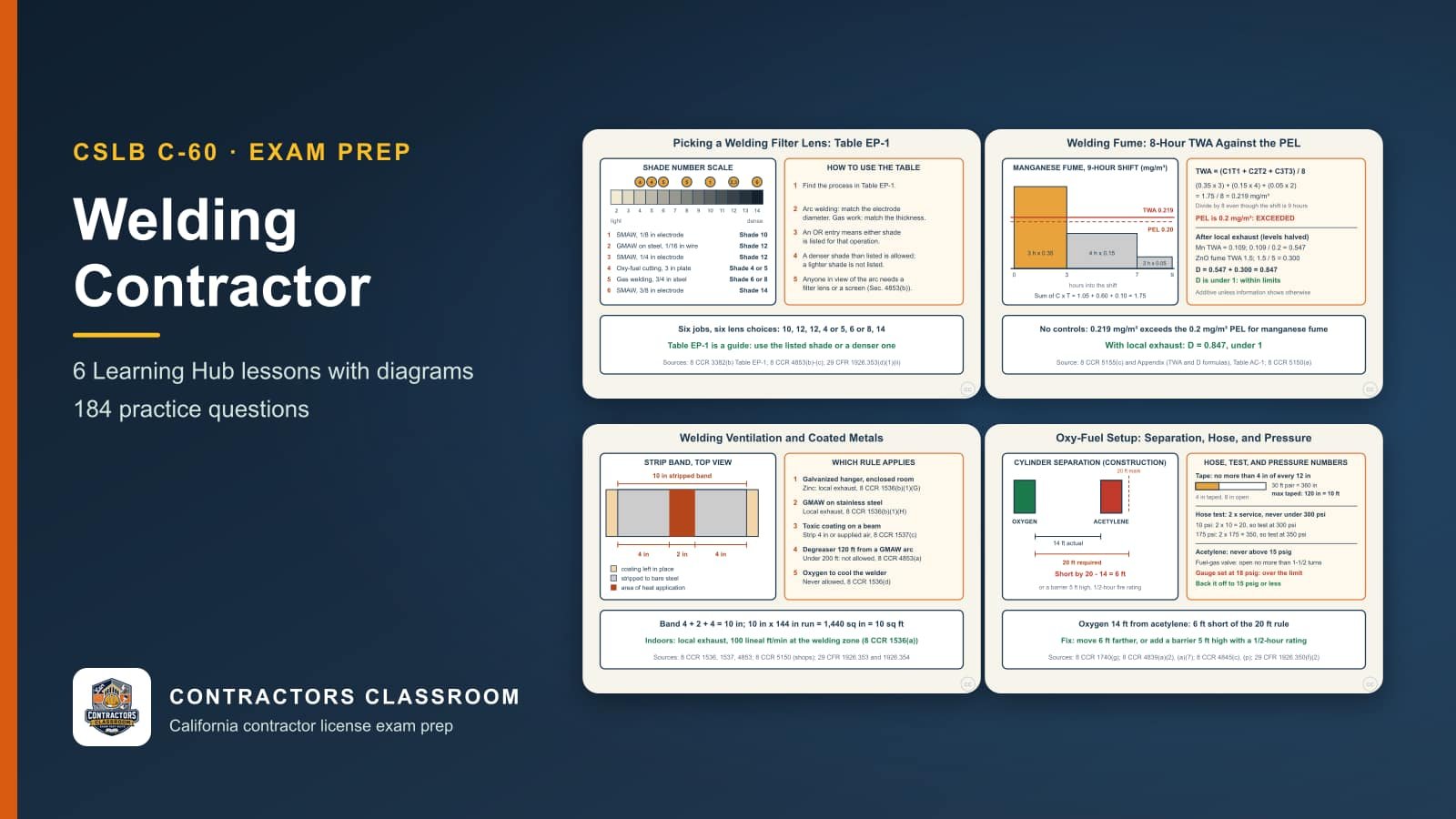
Diagrams from the C-60 welding contractor lessons: Choosing the Filter Lens Shade (Table EP-1), Welding Fume: Calculating the 8-Hour TWA and the Additive Limit, Welding Ventilation, Toxic Metals, and Coated Surfaces and Oxy-Fuel Setup: Cylinder Separation, Hose, and Pressure Limits
184practice questions
2categories
6Learning Hub lessons
$249Law & Business included

What the exam covers: Welding (C-60)

The CSLB exam for the California welding contractor license (C-60) is a closed-book, multiple-choice test. CSLB's official study guide divides it into five major sections and gives each an approximate weight: Planning and Estimating (about 17%), Welding Preparation (about 22%), Welding, Brazing, and Soldering (about 28%), Cutting Processes (about 11%), and Safety (about 22%).

Welding, Brazing, and Soldering carries the most weight, about 28%, so it deserves roughly that share of your study time, with Welding Preparation next at about 22%.

Contractors Classroom turns that outline into 184 practice questions in 2 categories (Planning and Estimating and Cal-OSHA Hot Work, Fire Watch & Fume Safety), plus 6 Learning Hub lessons with diagrams (such as "Choosing the Filter Lens Shade (Table EP-1)" and "Welding Fume: Calculating the 8-Hour TWA and the Additive Limit"). Law and Business, which most applicants take alongside their trade exam, is included at no extra charge.

Exam sections and approximate weights

  • Planning and Estimating~17%
  • Welding Preparation~22%
  • Welding, Brazing, and Soldering~28%
  • Cutting Processes~11%
  • Safety~22%

Practice question categories

  • Planning and Estimating75 practice questions
  • Cal-OSHA Hot Work, Fire Watch & Fume Safety109 practice questions

What the Welding Contractor exam covers, section by section

Planning and Estimating (~17%)

Welding work starts at the desk. A contractor needs to read fabrication drawings and written requirements, work out which machines, consumables, and gases the job will consume, and recognize what type of metal is involved, since the base material drives nearly every later decision about process and filler. Accurate estimating keeps a shop from running short of gas or wire midway through a job. A shop quoting structural steel, for instance, thinks about plate and tube sizes, weld length, and electrode or wire consumption, and a spark test or magnet check can quickly separate carbon steel from stainless.

  • Read fabrication drawings and written requirements to understand joint types and quality expectations
  • Estimate machines, filler metal, gases, and consumables the job will use
  • Recognize steel, stainless, aluminum, and other metals by their properties and markings

Welding Preparation (~22%)

A clean weld depends on what happens before the arc is struck. Candidates are expected to understand arranging the work area so it is safe and workable, connecting and adjusting power sources, torches, and gas supplies, and getting the metal itself clean, fitted, and held in position. Time spent here usually saves rework once welding starts. Mill scale, paint, oil, and rust are ground or wire-brushed away, edges are beveled for penetration, and tack welds hold the fit-up so heat does not pull the joint out of alignment.

  • Arrange the work area with good access, ventilation, grounding, and clear footing
  • Connect and adjust machines, cables, regulators, and gas supplies for the process
  • Clean, bevel, fit, and clamp the metal so the joint is ready to weld

Welding, Brazing, and Soldering (~28%)

Here the actual joining takes place. The material covers the different arc and gas methods used in the field, the hand skills that keep a bead consistent and sound, what happens after the metal cools, and the lower-temperature techniques that bond parts without melting the base metal. Reliable results come from steady technique rather than speed. Stick, MIG, TIG, and oxy-fuel welds each call for suitable filler and shielding, and chipping slag, brushing between passes, and looking for porosity or undercut catch problems before they get buried.

  • Compare common arc and gas processes and when each one suits a job
  • Control travel speed, angle, and heat to produce sound, even beads
  • Inspect, clean, and treat the weld after it cools to confirm quality
  • Join parts with filler metals that melt below the base metal

Cutting Processes (~11%)

Torch and plasma cutting turn up constantly on repair and fabrication jobs. This area looks at preparing the cutting gear, controlling the cut so edges come out straight and usable, and dealing with the rough, slag-covered edges that remain before the piece can be fitted or welded. Clean, accurate cuts make everything downstream easier. Oxy-fuel cutting relies on a preheat flame and a stream of oxygen, while plasma uses an ionized gas arc, so tip size, pressure, and travel speed must suit the plate, followed by grinding off the dross.

  • Set up torches, gases, or plasma units correctly for the thickness being cut
  • Guide the cut steadily to keep edges straight and kerf consistent
  • Remove slag and dress cut edges so pieces fit and weld cleanly

Safety (~22%)

Few trades combine as many hazards as welding: intense light, fumes, sparks, compressed gas, and hot metal. Safety here focuses on keeping the shop or field site orderly and well equipped, stopping stray sparks and slag from igniting something, and dressing and protecting the person doing the work. Flash burns from arc light, hot slag in boots, fumes from coated or galvanized metal, and leaking hoses or flashback at the torch are hazards that good habits and flame-resistant clothing are meant to head off.

  • Maintain cylinders, cables, and machines and keep the work area orderly
  • Prevent fires by clearing combustibles, shielding areas, and keeping extinguishers ready
  • Wear helmets, gloves, clothing, and respiratory protection suited to the task

Code books behind the Welding Contractor exam

The exam outline published for this trade lists these references.

  • The Independent Shop's Guide to Welding Safety and HealthA safety and health guide written for smaller welding shops. It explains fume and gas exposure, ventilation, arc radiation and eye protection, noise, fire prevention and housekeeping in plain language. It is a main source for the job site and equipment safety and personnel safety topics that make up the Safety section of the exam.
  • Modern WeldingA comprehensive textbook covering welding processes, equipment, joints, metals, electrodes, procedures, cutting, brazing and soldering. It is the best single study source for the technical sections, from welding preparation through welding techniques and cutting, and it also supports the metal identification topics in Planning and Estimating. Read its chapters on electrode selection and joint design alongside the safety material.
  • Safety in Welding, Cutting, and Allied Processes, AWS Z49.1The recognized safety standard for welding and cutting. It covers fire and explosion prevention, protection of people from arc rays and fumes, ventilation, electrical safety, compressed gas cylinders, and safe practice in enclosed spaces. It feeds the Safety section and the setup of equipment in the preparation and cutting sections.
  • Standard Symbols for Welding, Brazing, and Nondestructive Examination, A2.4The drawing language of the trade. It defines the reference line, arrow, tail, basic weld symbols, dimensions and supplementary symbols that tell a welder what joint to make and how. Candidates use it for reviewing plans and specifications in Planning and Estimating and for preparing and executing the weld. Practice with the symbols until each one is recognized at a glance.
  • State of California General Industry & Electrical Safety Orders (Cal/OSHA)With the Construction Safety Orders, this Title 8 set contains the state's rules for welding, cutting and brazing: fire watch and fire prevention, ventilation and fume limits, eye protection, cylinder handling, arc welding equipment and electrical safety. It is the reference behind the Safety section, which is about 22 percent of the exam.
  • Structural Welding Code - Steel, D1.1The widely used code for welding structural steel. It covers qualified procedures, welder qualification, joint design, preheat, weld quality, inspection and the thickness range of steel it applies to. It supports the code and specification topics in Planning and Estimating, and welding procedures and post-weld work in the largest section. Knowing its scope helps in judging whether a project needs qualified procedures.

Key terms for the Welding Contractor exam

Filter lens shade
A number that tells how dark a welding lens is. Higher numbers block more light, and the right number depends on the process and the current, or on metal thickness in gas work. Anyone who can see the arc needs suitable protection.
Stickout
The length of wire that extends beyond the contact tip toward the work in wire-feed welding. It changes heating of the wire, arc stability, penetration and spatter, so operators hold it steady and adjust it on purpose.
Shielded metal arc welding
Stick welding with a flux-coated rod that melts into the joint while the coating burns to form shielding gas and a slag layer. It is portable and works outdoors, but needs slag removal between passes.
Gas metal arc welding
A process that feeds solid wire continuously through a gun while a shielding gas covers the pool. It is fast and clean, but drafts can blow the gas away, so it is best used indoors or with wind screens.
Flux-cored arc welding
Welding with a tubular wire filled with flux, either self-shielded or used with added gas. It deposits metal quickly and handles thick plate, but makes more fume and spatter and leaves slag.
Gas tungsten arc welding
A precise process using a non-consumable tungsten electrode and an inert gas, with filler rod added by hand when needed. It makes clean welds on thin material and non-ferrous metals, but is slower than wire processes.
Preheat and interpass temperature
Preheat is warming the base metal before welding to slow cooling and lower cracking risk, while interpass temperature is the metal's temperature between passes. Thick or hardenable steel makes both important.
Fillet weld
A weld with a roughly triangular cross-section that joins two surfaces at an angle, as in T-joints and lap joints. Its size is measured by leg length, and the throat is the effective strength dimension.
Groove weld
A weld made in a shaped opening between two members, usually in butt joints. The groove shape, root opening and number of passes are planned so the weld penetrates the full thickness when required.
Welding symbol
A standardized drawing mark on a reference line with an arrow, tail and weld shapes that tells a welder joint type, size and process. Sides of the line matter: arrow side and other side mean different things.
Low-hydrogen electrode
A stick electrode whose coating introduces very little hydrogen into the weld, such as the E7018 type. It must be kept dry in a warm holding oven, because absorbed moisture leads to cracking in the weld and nearby metal.
Shielding gas
Argon, carbon dioxide, helium or a blend that flows around the arc to keep air from the molten pool. The mix changes arc feel, spatter and penetration, and a draft or empty cylinder shows up as defects.
Porosity
Small gas pockets trapped in a weld, caused by dirty metal, moisture, drafts or failed gas coverage. It weakens the weld and is one of the first defects checked when a bead looks pitted.
Undercut
A groove melted into the base metal beside a weld that was not refilled, typically from too much current or too fast travel. It creates a stress point that can start a crack.
Brazing
Joining metals by melting a filler that flows into a close joint by capillary action, with the base metals staying solid. It needs clean surfaces, flux and the right clearance, and relies on heat control rather than melting the parts.
Flashback arrestor
A safety device fitted to torch or regulator lines that stops a flame from running back into the hose and regulator. It works with check valves, and both must be present and functioning for oxy-fuel work.
Time-weighted average exposure
A welder's fume exposure averaged over an eight-hour shift, found by weighting each concentration by its duration. The result is compared with the allowable limit, and when two fumes are present their fractions are added.
Duty cycle
The share of a ten-minute period that a welding machine can deliver its rated current without overheating. A lower cycle at higher amperage means more cool-down time, so choosing a machine for heavy work depends on it.
Kerf
The width of metal removed by a cutting torch or plasma arc. Cut quality is judged by its width, squareness and slag, and layouts must allow for kerf so parts come out to size.
Spark test
A quick way to tell steels apart by grinding a sample and watching the sparks, since carbon content changes their length and shape. It helps identify an unknown metal before choosing a filler or procedure.

Where to spend practice time for the Welding Contractor exam

  • Welding, brazing and soldering processesThis is the largest section at about 28 percent, covering processes, techniques, post-weld steps, brazing and soldering. Compare stick, wire-feed and tungsten methods by shielding, equipment, position and defects, and practice linking symptoms to causes: porosity, undercut, spatter, poor penetration. Include basic travel angle, bead shape and cleaning after welding.
  • Preparing the site, equipment and metalWelding Preparation is about 22 percent and spans job sites, equipment setup and material preparation. Practice choosing amperage, polarity and gas for a given metal and thickness, cleaning and fitting joints, and checking cables, regulators and hoses before striking an arc. Compare joint designs and when beveling or a backing is needed.
  • Fire, fume and equipment safetySafety is also about 22 percent: site and equipment safety, preventing fires and personnel safety. Drill the fire watch and combustible clearance rules, ventilation and coated or toxic metals, cylinder handling and separation, and how to read exposure averages. Also review eye protection by process and the hazards of the arc welding circuit.
  • Plans, symbols and metal identificationPlanning and Estimating is about 17 percent and includes going through plans and specifications, working out the equipment and materials needed, and identifying metals. Practice reading a welding symbol, converting steel weights and prices from tons to hundredweights, and telling steels apart by appearance, magnet, spark or label. Review the thickness range of structural steel covered by the structural code.
  • Cutting processes and finishingCutting Processes is the smallest block at about 11 percent, covering equipment setup, cutting techniques and finishing. Compare oxy-fuel, plasma and arc cutting by the metals they handle, and review torch tip and pressure selection, kerf, edge cleanup and how to cut safely without starting fires. Short, focused practice can cover this section efficiently. Keep a one-page comparison chart.
  • Structural code and welder qualificationThe structural steel code is named on the exam outline, so learn what it covers and which welds fall under it. Review the idea of a qualified procedure, welder qualification, preheat and inspection, and practice recognizing when work is a structural application and so needs more than ordinary shop practice.

Scenarios to talk through before the Welding Contractor exam

  • Welding on coated steel in a stairwellYou are asked to weld a repair on painted and galvanized steel in a tight stairwell. Discuss ventilation, local exhaust, how to test or strip the coating, which lens shade protects both you and a helper, and what you would refuse to do. Explain who else must be protected in that stairwell.
  • Repairing a structural beamA steel beam supporting a mezzanine needs a repair weld. How do you decide whether the structural code applies, what preheat and interpass limits to follow, why a low-hydrogen electrode needs care, and how do you read the welding symbol on the detail? Explain what records you would keep for the work.
  • Spatter and pitting outdoorsA welder using flux-cored wire outdoors reports heavy spatter and a pitted bead. Reason through stickout, travel angle, shielding gas coverage, wind, moisture and wire condition, and list what you would change first to find the cause. Explain which changes you would test on scrap metal first. Note the wire diameter and the gas flow rate you would check.
  • An oxy-fuel cart in the shopA new employee rolls an oxy-fuel cart to a bench. How should the cylinders be secured and separated, what valve and regulator checks come before lighting, why are flashback arrestors and check valves important, and how should the torch be shut down and stored? Explain what the next shift should know before starting.
  • Welding near wood framingA welder must weld a bracket close to wood framing and stored materials. Lay out how you protect or move combustibles, who serves as fire watch and for how long, what extinguisher is at hand, and what you check after the job before leaving. Explain how you would keep the area under watch afterward.
  • Unmarked steel in the yardA pile of unmarked steel arrives for a job. How could a spark test, magnet or other quick check help you identify it, why does that matter for filler and preheat, and how would you convert the pile's weight and price per hundredweight into a cost? Explain which results would make you reject the material for the job.
  • Brazing copper fittingsYou are brazing copper joints in a tight mechanical room. Discuss joint clearance, cleaning, flux, how to heat the parts rather than the filler, what protects nearby materials from the flame, and what you do after the joint cools. Explain what you would do about the pipe's interior and the leftover residue.
  • A machine that keeps overheatingAn arc welding machine overheats during a long day of heavy passes, and the return cable has a taped splice. Consider duty cycle, cable size for the current, damaged leads, ground connection quality, and what you inspect and replace before welding again. Explain what you would do before trying the machine again.

Learning Hub lessons

Each lesson has guided steps, a diagram, a worked example and a quick check inside the classroom.

Preview the lesson diagrams

  1. Choosing the Filter Lens Shade (Table EP-1)Steps: Why the Shade Number Matters; Table EP-1 Is Organized by Process and Size; Gas Welding and Cutting Use Metal Thickness; Read the Table as a Guide, Not a Floor; Protect Everyone Who Can See the Arc
  2. Welding Fume: Calculating the 8-Hour TWA and the Additive LimitSteps: Fume Limits Are Written as Numbers; The Time-Weighted Average Formula; Compare the TWA to the PEL, and Check the Short-Term Limit; When Two Fumes Are Present, Add the Fractions; If the Number Is Over, Control the Source
  3. Welding Ventilation, Toxic Metals, and Coated SurfacesSteps: Two Sets of Rules With Nearly Identical Wording; Indoors, Local Exhaust Comes First; Toxic Base Metals, Fluxes, and Coatings in Enclosed Spaces; Coatings: Test First, Then Strip 4 Inches; Four Things Never to Do
  4. Oxy-Fuel Setup: Cylinder Separation, Hose, and Pressure LimitsSteps: Moving and Storing Cylinders; Separate Oxygen From Fuel Gas; Pressure Limits and Valve Handling; Hose Rules With Numbers; Torch Checks and Shutdown
  5. Hot Work: Permit, Fire Watch Timing, and the Extinguisher RuleSteps: When a Hot Work Permit Is Required; Where Hot Work Is Not Allowed Without Approval; Protecting Combustibles; Fire Watch: Duration, Coverage, and Extinguisher; Area Review, Pre-Hot-Work Check, and Signs
  6. Arc Welding Circuit: Return Cable Capacity, Splices, and ShutdownSteps: Holders and Cables Must Match the Current; The 10-Foot Rule and Damaged Cable; Size the Return Cable for the Total Output; Contact, Grounding, and Inspection; Shutdown and Confined Space Habits

See the classroom in action

Frequently asked questions

How do I get a California welding contractor license?

A welder or welding contractor who wants to contract independently applies under C-60. CSLB generally requires documented journey-level experience, a bond, and passing scores on both the Law and Business exam and the C-60 exam. Rules change, so confirm them with CSLB.

What does the welding contractor exam ask about welding, brazing, and soldering?

Welding, Brazing, and Soldering is the heaviest part of the C-60 exam, at about 28%. Expect questions on compare common arc and gas processes and when each one suits a job, control travel speed, angle, and heat to produce sound, even beads, and inspect, clean, and treat the weld after it cools to confirm quality. Next in weight come welding preparation (about 22%) and safety (about 22%).

What kinds of questions are on the welding contractor exam?

The three sample questions in CSLB's C-60 study guide ask about the minimum steel thickness covered by AWS D1.1, the cost of structural steel by weight, and how to control spatter in flux-cored arc welding. Like every question on the exam, each has four choices and one best answer.

Which codes and books does the C-60 exam reference?

CSLB's C-60 study guide lists the Cal/OSHA safety orders (Title 8) and trade references such as AWS D1.1 Structural Welding Code - Steel, Safety in Welding, Cutting, and Allied Processes (AWS Z49.1), and Standard Symbols for Welding, Brazing, and Nondestructive Examination. Use them to study; the exam itself is closed-book.

Is the welding contractor exam open book?

No. The C-60 study guide says no reference materials may be used, even though it names AWS D1.1 Structural Welding Code - Steel and Safety in Welding, Cutting, and Allied Processes (AWS Z49.1) among the books to study from. A calculator is provided, and guessing is not penalized.

Can I take the welding contractor exam outside California?

CSLB's exam FAQ says trade exams are given in California or Oregon only, so C-60 is not offered in other states, although Law and Business can be taken out of state. Check the current PSI list when you schedule.

How are the 184 C-60 practice questions organized?

They are split into 2 categories, largest first: Cal-OSHA Hot Work, Fire Watch & Fume Safety (109) and Planning and Estimating (75). Cal-OSHA Hot Work, Fire Watch & Fume Safety holds about 59% of the questions. 6 Learning Hub lessons add diagrams and worked examples for the harder topics. The missed-question review collects every question you get wrong.

Is there a free trial for welding contractor exam prep (C-60)?

Yes. The free C-60 preview opens the real classroom with no sign-up and gives you the first question from every C-60 category, including Cal-OSHA Hot Work, Fire Watch & Fume Safety and Planning and Estimating, plus Law and Business. The full course is a one-time $249 purchase.

Is welding contractor exam prep available in Spanish?

The website and the eight demo videos are available in Spanish. The classroom and the 184 C-60 practice questions are in English for now; translating the questions is not part of the course yet.

Ready to practice for real?

Try the real classroom free, no sign-up, or get the full course for your trade.

Independent exam preparation. Contractors Classroom is not affiliated with the Contractors State License Board, and no course can guarantee a passing result.


