- Concrete masonry unit
- A precast hollow block, usually eight inches deep, used to build reinforced walls with grout-filled cells. Its nominal size includes the mortar joint, so counting units and square footage depends on knowing nominal against actual dimensions.
- Bed joint
- The horizontal layer of mortar that a unit rests on, as opposed to the vertical head joint at its end. Full, even bed joints affect wall strength, water resistance and appearance, so mortar coverage and thickness are common quality checks.
- Running bond
- A pattern where each course is shifted half a unit from the one below so vertical joints never line up. It spreads loads, resists cracking along joints and sets how reinforcing steel and cells align in block walls.
- Bond beam
- A horizontal course of special U-shaped or notched block, filled with grout and reinforcing bars, that ties a wall together at the top or at intervals. It also supports roof or floor connections, so its steel must be positioned before grouting.
- Grout lift
- One stage of filling wall cells with grout, limited in height so the fluid pressure does not blow out units and the mix can be consolidated. Waiting for earlier lifts to stiffen before adding the next is part of the method.
- Cleanout
- An opening left at the base of a tall grouted cell so mortar droppings and debris can be washed or blown out and the steel inspected before closing. Leaving fins and fallen mortar behind blocks grout flow and bond.
- Type S mortar
- A mix classification with high compressive and flexural bond strength, commonly specified for below-grade work, retaining walls and reinforced walls under lateral load. Choosing the right type for exposure and loading, and batching by volume, are routine exam topics.
- Weep holes
- Openings left at the base of veneer, above flashing, that let moisture trapped behind the facing drain out. Plugging them with mortar, or omitting the flashing above them, turns a drainage plane into a water trap.
- Veneer tie
- A corrosion-resistant metal anchor fastened to the backing wall and set in the mortar joint to hold anchored brick or stone to the structure. Size, spacing and extra ties around openings are checked, and the tie must keep the air space open.
- Adhered veneer
- Thin stone or masonry units bonded directly to a backing with mortar, usually over lath and a scratch coat, with no air space or ties. Surface preparation and bond are critical because the facing relies on adhesion, not mechanical anchors.
- Hearth extension
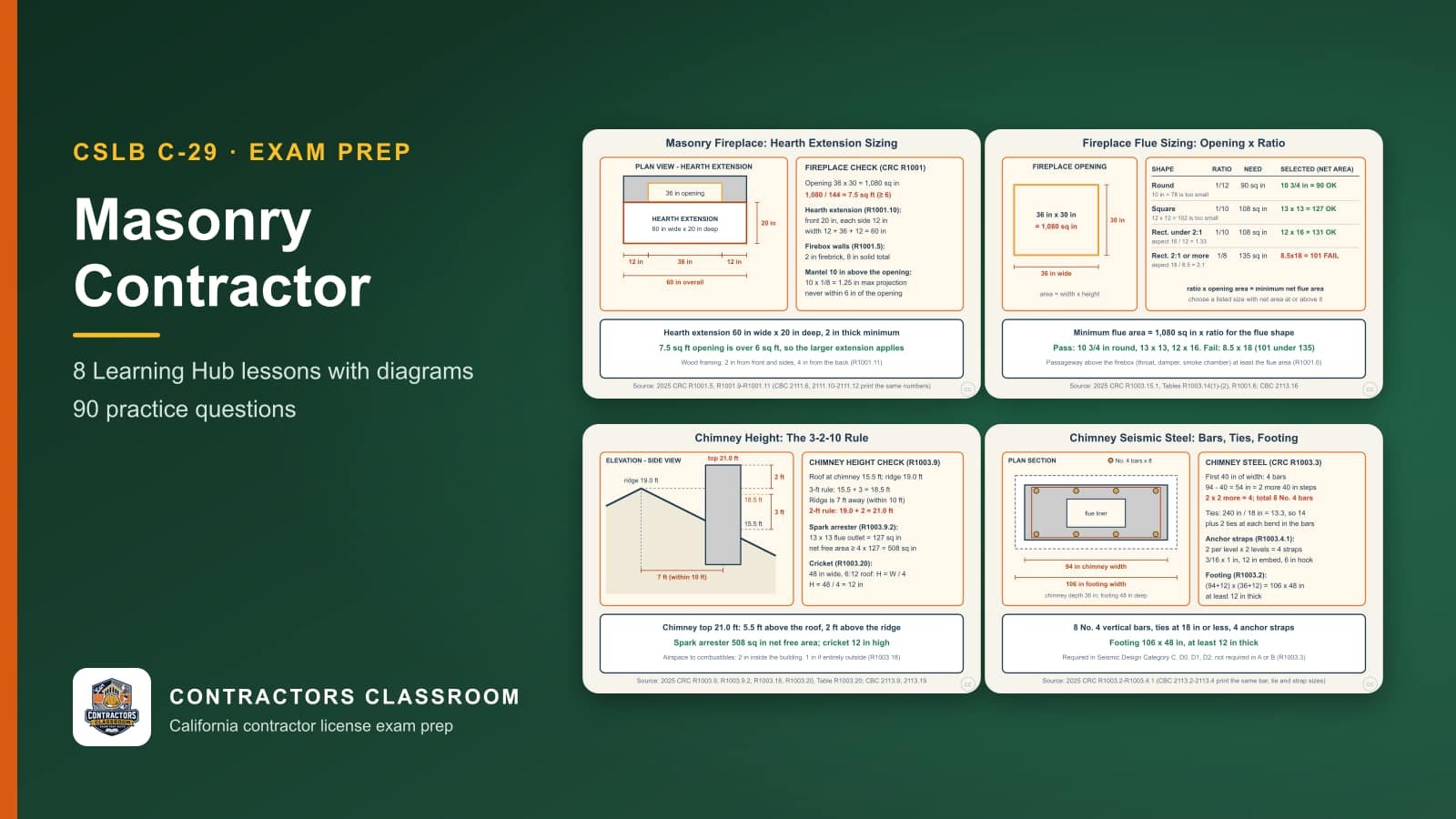
- The noncombustible floor surface in front of a fireplace opening that protects framing and finishes from sparks and rolling embers. Its depth and width beyond the opening, and its thickness, are set by code and appear in fireplace questions.
- Smoke chamber
- The sloped masonry transition between the firebox throat and the flue that funnels smoke upward. Its smoothly parged interior walls and inward slope reduce turbulence and keep the draft working, and its construction is a distinct checkpoint.
- Flue liner
- A fire-clay or code-accepted equivalent tile lining that contains hot gases and protects surrounding masonry. Its cross-sectional area is tied to the fireplace opening, and sections must be joined and supported correctly all the way up.
- Chimney cricket
- A small peaked saddle built on the high side of a wide chimney where it meets a sloped roof, to shed water around the stack instead of letting it pool behind. It is flashed like a roof detail.
- Spark arrester
- A screened cap at the top of a flue that keeps burning fragments from escaping and starting roof or brush fires. Mesh size and material limits apply, and it must stay clear enough not to choke the draft.
- Limited access zone
- A marked strip beside a wall that is being built, which only the crew actually working on it may enter, because an unbraced wall could fall. Its width tracks wall height, and the marking remains until bracing or completion makes the wall stable.
- Efflorescence
- A white, powdery salt deposit left on masonry surface when water moving through the wall evaporates. It signals moisture entering or passing through the assembly, and the cleaning and repair step is to find the source of that water.
- Repointing
- Raking out deteriorated mortar joints to a safe depth and refilling them with fresh mortar, ideally matched in strength and color to historic work. A mix harder than the old brick can damage the units, so matching matters.
- Edge restraint
- A rigid border of concrete, steel or plastic that locks interlocking pavers in place and stops the sand bed from spreading outward under traffic. Without it, rows shift and joints open, so it goes in before the pavers are fully set.