CSLB C-34

Pipeline Contractor License Exam Prep (C-34)

Getting ready for the California pipeline contractor license exam (CSLB C-34)? Study with 184 practice questions in 2 categories and 6 Learning Hub lessons, made for pipeline and underground utility contractors, with the Law and Business exam included.

One-time purchase, no subscription. Law & Business included.

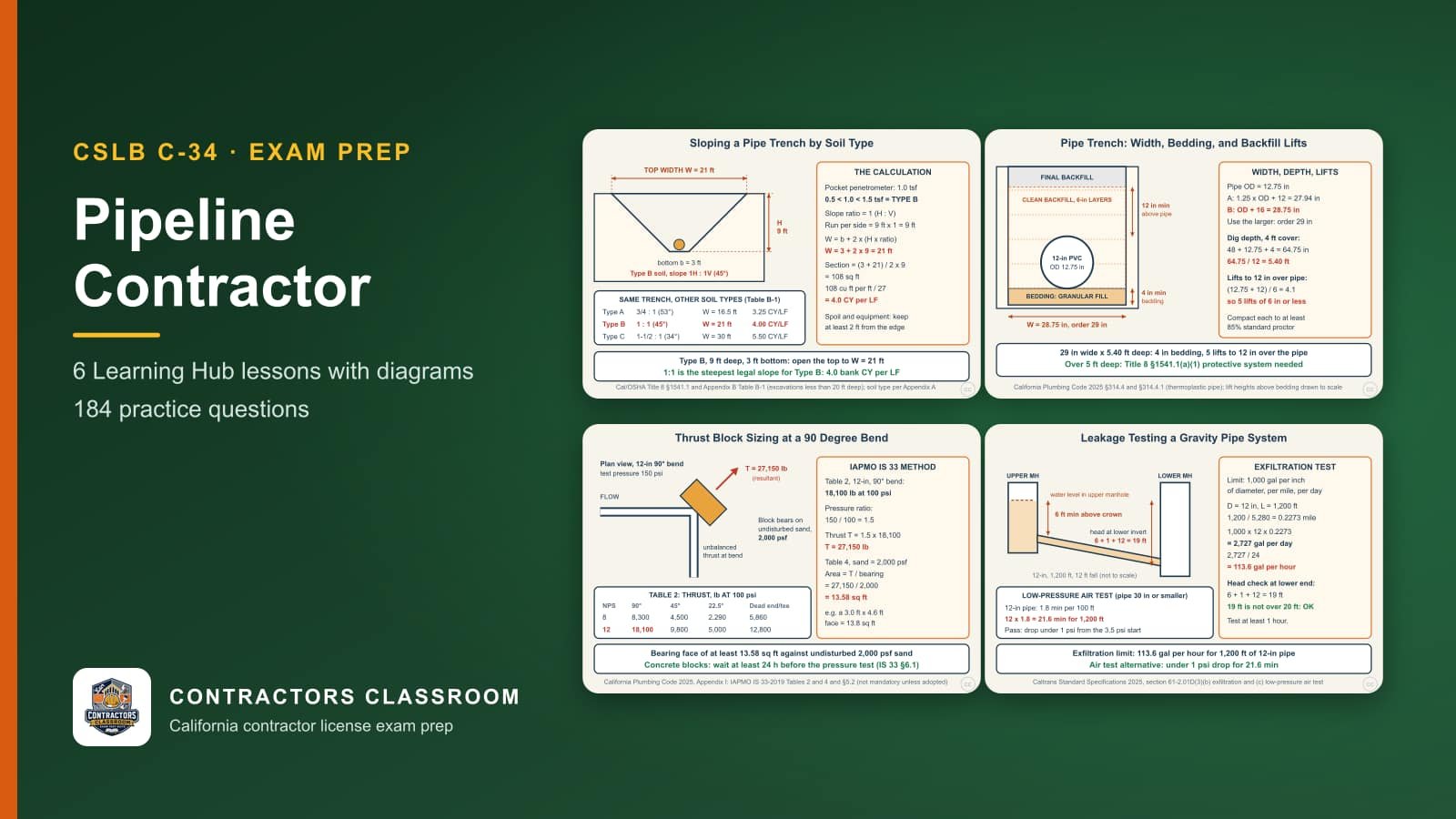
Diagrams from the C-34 pipeline contractor lessons: Sloping a Pipe Trench by Soil Type (Title 8 Appendix B), Pipe Trench Width, Bedding, and Backfill Lifts, Thrust Block Sizing at Bends, Tees, and Dead Ends and Leakage Testing a Gravity Pipe: Exfiltration and Air Test
184practice questions
2categories
6Learning Hub lessons
$249Law & Business included

What the exam covers: Pipeline (C-34)

The CSLB exam for the California pipeline contractor license (C-34) is a closed-book, multiple-choice test. CSLB's official study guide divides it into five major sections and gives each an approximate weight: Planning and Estimating (about 21%), New Pipeline Installation (about 35%), Removal, Repair, and Maintenance of Existing Systems (about 12%), Specialty Pipeline Projects (about 12%), and Safety (about 20%).

New Pipeline Installation carries the most weight, about 35%, so it deserves roughly that share of your study time, with Planning and Estimating next at about 21%.

Contractors Classroom turns that outline into 184 practice questions in 2 categories (Planning and Estimating and Cal-OSHA Confined Space & Excavation Safety), plus 6 Learning Hub lessons with diagrams (such as "Sloping a Pipe Trench by Soil Type (Title 8 Appendix B)" and "Pipe Trench Width, Bedding, and Backfill Lifts"). Law and Business, which most applicants take alongside their trade exam, is included at no extra charge.

Exam sections and approximate weights

  • Planning and Estimating~21%
  • New Pipeline Installation~35%
  • Removal, Repair, and Maintenance of Existing Systems~12%
  • Specialty Pipeline Projects~12%
  • Safety~20%

Practice question categories

  • Planning and Estimating75 practice questions
  • Cal-OSHA Confined Space & Excavation Safety109 practice questions

What the Pipeline Contractor exam covers, section by section

Planning and Estimating (~21%)

A pipeline project is planned from the ground up: its length, depth and route, the type of pipe, and the conditions crews will meet. Defining that scope clearly lets a contractor sequence the work, figure out pipe, fittings, bedding material and equipment, and attach realistic costs. Errors in these early calculations tend to reappear later as shortages, rework and delays in the trench. Soil type, groundwater and nearby utilities shape how deep and how wide the trench must be, so they feed straight into the quantity of excavation, shoring and spoil hauling.

  • Define the route, pipe type and work sequence so the scope is clear
  • Calculate pipe, fittings, bedding and equipment needs and convert them into costs

New Pipeline Installation (~35%)

Putting new pipe in the ground is a methodical process. The site is cleared and marked, trenches are opened to line and grade, and pipe sections are placed, joined and backfilled. Afterward the line is flushed clean, pressure or leak tested to prove it holds, and the surface is restored. Skipping any of these steps risks failures that are expensive to dig up and correct. Compacting bedding and backfill in lifts keeps the pipe from settling or shifting, and a clean trench bottom lets each joint seat fully before the next length goes in. Tracer wire or warning tape laid above the pipe helps future crews find it.

  • Clear, mark and prepare the route, including access and utility conflicts
  • Excavate, lay, join and bed pipe to the planned slope and alignment
  • Flush and test completed lines, then restore pavement and landscape

Removal, Repair, and Maintenance of Existing Systems (~12%)

Existing lines present unknowns that new construction does not. Before anything is cut, crews find where pipes run and shut off or isolate the section involved. Routine servicing keeps working systems dependable, while damaged or obsolete pipe is either fixed and put back into service or properly sealed off and abandoned so it cannot cause problems later. Tapping into a live main usually calls for temporary bypasses or planned shutoffs so customers lose service for as short a time as possible. Abandoned pipe left in place is often filled with grout so it cannot collapse under pavement.

  • Trace buried lines and close valves or plug sections before any cutting
  • Service valves, joints and fittings to keep operating lines reliable
  • Replace failed sections or cap and fill retired lines so they stay harmless

Specialty Pipeline Projects (~12%)

Beyond standard runs of pipe, some structures need extra know-how. Grease interceptors keep fats out of sewers, hydrants bring fire protection to a water main, and manholes provide access for inspection and cleaning. Specialty pipes or conduits, carrying materials other than ordinary water or sewage, call for the right materials, support and joining methods. Interceptors and manholes are heavy, so crane or excavator lifting, a level compacted base and sealed pipe penetrations decide whether they stay watertight for years. Hydrants also need thrust blocks or restraints so water pressure cannot push the fitting loose.

  • Set grease interceptors with correct inlet and outlet connections
  • Connect hydrants to water mains with proper support and valving
  • Build or place manholes with sound bases, tight joints and accessible covers
  • Install unusual or protective pipes and conduits using methods matched to their purpose

Safety (~20%)

Pipeline crews work in deep, narrow and sometimes airless places, so hazards are serious. People stay protected with proper gear and training, heavy machines and tools are operated with care, and trenches get shoring or sloping to stop collapse. Enclosed spaces require testing and ventilation before entry, and chemicals or contaminated soil are handled so no one is exposed. Gas detectors, harnesses and retrieval gear keep confined-space entries manageable, while a competent person inspects the trench daily and after rain. Barriers and spotters protect both crew and passersby around open excavations.

  • Use protective gear, safe lifting and training suited to pipeline crews
  • Control machinery, tools and walkways so crews avoid being struck or tripped
  • Support trench walls and test air in confined spaces before anyone enters
  • Recognize and handle hazardous substances such as contaminated soil or fumes

Code books behind the Pipeline Contractor exam

The exam outline published for this trade lists these references.

  • 2025 California Plumbing CodeFor pipeline work the plumbing code supplies the rules on building sewer size, slope and cleanouts, trench width and bedding for plastic pipe, water service piping, testing, thrust restraint and backflow protection. It is the code reference behind much of New Pipeline Installation and the grease interceptor portion of Specialty Pipeline Projects.
  • The “Greenbook”: Standard Specifications for Public Works ConstructionThis is the public works specification used by many agencies for sewer, storm drain and water work. It spells out materials, trench and backfill requirements, pipe laying, manholes, testing and acceptance. It is the reference behind the public works character of New Pipeline Installation and the manhole and hydrant topics in the specialty section.
  • Excavation and Grading HandbookA field handbook on how earth is dug, moved and compacted: soil types, swell and shrinkage, equipment capacity, slopes, haul calculations and grade control. It supports the quantity and hauling math in Planning and Estimating and the site preparation topics of the installation section.
  • Moving the Earth: The Workbook of ExcavationA broad reference on excavation methods, equipment selection, production rates and earthwork calculations. It helps candidates reason about which machine handles which job, how much a crew can move, and how trench volumes turn into trucks and hours, all of which feed planning and trenching questions.
  • Pipe and Excavation ContractingA contractor-oriented guide covering trench layout, pipe laying, bedding, backfill, appurtenances and the costing of underground work. It is a practical bridge between the codes and the day-to-day sequence of an installation, and it supports both estimating and the main installation section.
  • Pipeline Rules of Thumb HandbookA quick-reference collection of pipeline formulas, flow and pressure relationships, pipe properties, corrosion control and testing guidance. Its calculations and conversions suit the cost and material calculation bullet and the cleaning, testing and finishing topics.
  • Trenchless Technology Piping: Installation and InspectionA reference on installing pipe without open trenches: directional drilling, boring, pipe bursting, sliplining and lining existing pipe, with notes on checking the finished work. It supports questions on repairing or replacing existing lines and on specialty pipes and conduits.
  • State of California General Industry & Electrical Safety Orders (Cal/OSHA)The Title 8 safety orders include the excavation and trenching rules: soil classification, sloping and shoring, access and egress, spoil placement, utilities and water in trenches, plus atmosphere hazards below grade. They are the reference for the Safety section, where trench work carries a large share.

Key terms for the Pipeline Contractor exam

Corporation stop
A valve screwed directly into the water main where a service line begins. It lets the service be shut off right at the main, so repairs downstream do not need the main itself to be shut down.
Curb stop
A shut-off valve on the service line near the curb or property edge, reached through a box and turned with a long key. It gives the utility and the owner a way to isolate a service without digging.
Tapping sleeve
A split clamp bolted around an existing main so a new branch can be connected while the main stays in service. A tapping valve and machine then cut the opening, which avoids shutting off customers for the connection.
Air release valve
A valve at a high point of a pressurized pipeline that vents trapped air. Air pockets restrict flow and cause surges, so the placement of these valves is part of laying out a long main.
Thrust block
A mass of concrete poured against undisturbed soil behind a bend, tee or dead end of pressurized pipe. It passes the push of the water to the ground, and its bearing area depends on line pressure, pipe size and the soil's strength.
Shoring box
A prefabricated steel frame lowered into a trench so crews work inside its protection. It is set with an excavator, moved ahead as pipe is laid, and its rated depth and weight affect equipment choice.
Soil classification
Sorting soil as stable rock or as Type A, B or C before choosing how a trench wall is protected. Cohesive, dry, undisturbed soil rates better than wet, layered or previously disturbed ground, which sets how flat a slope must be.
Maximum allowable slope
The steepest ratio of horizontal run to vertical rise that a trench wall may have in a given soil type. Weaker soil requires a flatter angle, and the ratio is used to compute how wide the opening becomes at the top.
Bedding
The layer of granular material placed under and around a pipe to give even support along its length. Thickness and extent follow the pipe material and specification, and poor bedding is a common reason pipe settles or joints fail.
Compaction lift
One layer of backfill placed and compacted before the next is added. Thin lifts let compaction reach the whole layer, which keeps the trench from settling later and protects the pipe below.
Swell factor
The increase in volume soil shows once it is dug and loosened. Hauling and import-export figures must use the loose volume, so a trench's in-place cubic yards translate into more truck loads than the hole alone suggests.
Invert elevation
The height of the inside bottom of a pipe at a given point. Comparing inverts at consecutive manholes gives the fall of a gravity line, which is how grade is set and checked in the trench.
Exfiltration test
A water test of a gravity sewer or drain in which a section is filled and the loss to the surrounding ground is measured over time. The result is compared with an allowable leakage that depends on pipe diameter and length.
Low-pressure air test
A method for proving a gravity pipe tight by plugging both ends, introducing a small air pressure and watching for a drop over a set time. Plugs must be braced, because stored air can push them out forcefully.
Cathodic protection
A way of stopping corrosion on buried steel by making the steel the protected side of an electrochemical cell, using sacrificial anodes or impressed current. Galvanizing alone is not accepted protection for underground steel gas pipe.
Pipe-to-soil potential
The voltage measured between a buried pipe and a reference electrode placed in the soil. A reading more negative than a stated threshold shows the pipe is protected, and the results are documented on a schedule.
Grease interceptor
A large tank that slows kitchen wastewater so fats and oils rise and stay trapped while clearer water flows out. It keeps grease from hardening in the sewer, and it only works if it is cleaned out on a regular basis.
Tracer wire
Insulated wire laid along nonmetallic pipe so a locating instrument can find it later. Without it, a buried plastic line cannot be traced from the surface, which creates risk for future excavators.
Pipe bursting
A trenchless replacement method that pulls a cone-shaped head through an old pipe, breaking it outward while new pipe follows behind. It limits street cutting, though bypassing and service reconnections still need planning.
Abandonment in place
Retiring a pipe but leaving it in the ground, after cutting it off from active lines and capping or filling it. Filling the pipe with grout or slurry prevents later collapse and keeps it from acting as an underground drain.

Where to spend practice time for the Pipeline Contractor exam

  • New pipeline installationNew Pipeline Installation is the largest block, about 35 percent of the exam, covering site preparation, laying pipe, cleaning, testing and finishing. Practice the order of work in a trench: grade, bedding, pipe, joints, tests, backfill in lifts, restoration. Be ready to compare pressure testing of supply lines with leakage testing of gravity lines.
  • Quantities, hauling and cost mathPlanning and Estimating is about 21 percent of the exam and relies on calculation. Work trench volume from length, width and depth, convert in-place yards to loose yards with a load factor, then count truck loads and equipment hours. Writing units beside every number catches most mistakes before they reach the answer.
  • Trench safety and below-grade hazardsSafety is about 20 percent of the exam and heavily weighted toward trenches and underground atmospheres. Practice classifying soil, finding the allowed slope, comparing sloping with shoring, and recalling what must be done before anyone climbs in. Also review hazardous materials found underground and equipment safety around open excavations.
  • Thrust blocks and corrosion controlPressure lines raise questions that gravity lines do not. Practice where thrust blocks go, how soil strength changes their size, why they must be ready before a pressure test, and how cathodic protection is checked on buried steel gas pipe. Compare these with the way gravity sewers are graded and tested.
  • Locating, repairing and abandoning linesAbout 12 percent of the exam covers finding and isolating existing pipe, maintaining it, and repairing or abandoning it. Review notification before digging, hand exposure of marked lines, tapping and shutoff valves, trenchless repair choices, and how a retired line is capped or filled so it cannot collapse.
  • Specialty pipeline projectsSpecialty Pipeline Projects is another 12 percent and names grease interceptors, fire hydrants, manholes and specialty pipes or conduits. For each, learn what it is for, what it connects to and what usually goes wrong when it is installed carelessly. Drawing a manhole with its inverts and a hydrant branch with its valve builds recall.

Scenarios to talk through before the Pipeline Contractor exam

  • Trench in mixed soilYou must open a deep pipe trench where the soil changes from firm clay to loose sand. How do you classify the soil, what slope ratio or protective system follows, where does the spoil go, and how do you decide between a shoring box and sloping? Mention what you would do if water appears in the trench. Name who is responsible for judging the soil at the site.
  • Tapping a live mainA new service must connect to an active water main without shutting off the street. Describe the fittings involved, from tapping sleeve to corporation stop and curb stop, the order of work, and how the service can be isolated later for repairs. Name the pressure test you would perform before the service goes live.
  • Bend on a pressurized mainA pressurized main turns at a bend and ends at a dead end near a hydrant. Where do thrust blocks go, which three facts set their size, what must be true of the ground behind them, and when must they be ready relative to the test? Include what you would check if the soil behind the block is soft.
  • Accepting a gravity lineA new sewer run must prove it is tight before restoration. Compare an exfiltration test with a low-pressure air test, explain how you size the allowable loss, how you brace plugs safely, and what happens if a joint fails twice. State what you would do before repeating the test after a repair.
  • Buried steel gas lineAn underground steel gas line needs corrosion control. Why is galvanizing alone not enough, what do pipe-to-soil readings tell you, how often are sacrificial anodes tested, and where do insulating fittings belong at risers and dissimilar metals? Explain what records you would keep for the owner. State what happens when a reading is outside the pass criteria.
  • Retiring an old lineAn old pipe under a street is no longer needed. Compare abandoning it in place with removing it, describe how it is cut off, capped or filled, and consider when a trenchless method such as pipe bursting would reduce street cutting. Mention what hazards might be present inside an old pipe. Explain what you would do about service connections that remain.
  • Hauling and grade planningYou are planning export of excavated soil from a long trench. How do swell factor and truck size change the number of loads, and how would you use invert elevations at both ends to set the fall and check the dig depth? Say how a mistake in either number would show up in the field.
  • Restaurant connectionA restaurant needs a grease interceptor tied into the sewer, with a manhole nearby. Walk through setting the interceptor, matching inverts, bedding and backfilling the pipe in lifts, and what the owner must do afterwards to keep it working. Add how a tracer wire or marker would help future crews find it.

Learning Hub lessons

Each lesson has guided steps, a diagram, a worked example and a quick check inside the classroom.

Preview the lesson diagrams

  1. Sloping a Pipe Trench by Soil Type (Title 8 Appendix B)Steps: Why Every Pipe Trench Needs a Protective System; Classify the Soil First: Type A, B, or C; Read the Maximum Allowable Slope From Table B-1; Turn the Ratio Into a Top Width and a Cross-Section; Check the Right-of-Way, Then Housekeeping Rules
  2. Pipe Trench Width, Bedding, and Backfill LiftsSteps: The Trench Bottom and the Inspection Window; Size the Trench Width From the Pipe OD; Bedding, Layers, and Compaction; Public-Works Variations in the Caltrans Specifications; Work Out the Dig Depth, Then Apply the Safety Test
  3. Thrust Block Sizing at Bends, Tees, and Dead EndsSteps: Why and Where Thrust Blocks Go; What Sets the Block Size; Read the Thrust From Table 2 and Scale It to Your Pressure; Divide by the Safe Bearing Load of the Soil; Have the Blocks in Place Before You Test
  4. Leakage Testing a Gravity Pipe: Exfiltration and Air TestSteps: When and How Much Gets Tested; The Exfiltration Limit and Its Head Rules; Turn the Limit Into Gallons for Your Run; Low-Pressure Air Test (Pipe 30 Inches or Smaller); When the Line Fails
  5. Cathodic Protection of Underground Steel Gas Pipe: Criteria and Test ScheduleSteps: What the Code Requires Underground; The Pass Criteria: Pipe-to-Soil Voltage; The Test Schedule for Sacrificial Anodes; Impressed Current, Failed Tests, and Records; Installation Details That Protect the System
  6. Pressure Testing a Trenched Supply Line (Method A)Steps: Set Up the Test Before You Backfill; Method A: 125 psi, 1 Hour, 5 psi Drop; Method B and Special Cases; Water Supply Lines on a Structure; The Building-Code Version

See the classroom in action

Frequently asked questions

How do I get a California pipeline contractor license?

A pipeline contractor or underground pipe installer who wants to contract independently applies under C-34. CSLB generally requires documented journey-level experience, a bond, and passing scores on both the Law and Business exam and the C-34 exam. Rules change, so confirm them with CSLB.

What does the pipeline contractor exam ask about new pipeline installation?

New Pipeline Installation is the heaviest part of the C-34 exam, at about 35%. Expect questions on clear, mark and prepare the route, including access and utility conflicts, excavate, lay, join and bed pipe to the planned slope and alignment, and flush and test completed lines, then restore pavement and landscape. Next in weight come planning and estimating (about 21%) and safety (about 20%).

What kinds of questions are on the pipeline contractor exam?

The three sample questions in CSLB's C-34 study guide ask about dump-truck loads needed to haul out trench paving, what a corporation stop is, and the right equipment for setting a shoring box. Like every question on the exam, each has four choices and one best answer.

Which codes and books does the C-34 exam reference?

CSLB's C-34 study guide lists the 2025 California Plumbing Code (Title 24), the Cal/OSHA safety orders (Title 8), and trade references such as Excavation and Grading Handbook, The “Greenbook”: Standard Specifications for Public Works Construction, and Moving the Earth: The Workbook of Excavation. Use them to study; the exam itself is closed-book.

Is the pipeline contractor exam open book?

No. The C-34 study guide says no reference materials may be used, even though it names Excavation and Grading Handbook and The “Greenbook”: Standard Specifications for Public Works Construction among the books to study from. A calculator is provided, and guessing is not penalized.

Can I take the pipeline contractor exam outside California?

CSLB's exam FAQ says trade exams are given in California or Oregon only, so C-34 is not offered in other states, although Law and Business can be taken out of state. Check the current PSI list when you schedule.

How are the 184 C-34 practice questions organized?

They are split into 2 categories, largest first: Cal-OSHA Confined Space & Excavation Safety (109) and Planning and Estimating (75). Cal-OSHA Confined Space & Excavation Safety holds about 59% of the questions. 6 Learning Hub lessons add diagrams and worked examples for the harder topics. The missed-question review collects every question you get wrong.

Is there a free trial for pipeline contractor exam prep (C-34)?

Yes. The free C-34 preview opens the real classroom with no sign-up and gives you the first question from every C-34 category, including Cal-OSHA Confined Space & Excavation Safety and Planning and Estimating, plus Law and Business. The full course is a one-time $249 purchase.

Is pipeline contractor exam prep available in Spanish?

The website and the eight demo videos are available in Spanish. The classroom and the 184 C-34 practice questions are in English for now; translating the questions is not part of the course yet.

Ready to practice for real?

Try the real classroom free, no sign-up, or get the full course for your trade.

Independent exam preparation. Contractors Classroom is not affiliated with the Contractors State License Board, and no course can guarantee a passing result.


