- Channel letters
- Individually built three-dimensional letters with a back, sides called returns and a translucent face, usually lit from inside. They are the signature product of storefront signage, and their materials and wiring are both exam topics.
- Reverse channel letters
- Letters with an opaque face and an open back that light the wall behind them, producing a halo effect. They are mounted off the wall on spacers so that light can spread, and their LED placement differs from front-lit letters.
- Letter return
- The side wall of a channel letter that gives it depth. Aluminum returns resist corrosion better than sheet steel, which is one reason fabricators choose them for outdoor, long-lasting signs.
- Sign cabinet
- The box-like enclosure that holds lamps, LED modules, power supplies and wiring behind a flat face. Its construction affects weather sealing, drainage, heat, service access and the weight the supports must carry.
- Letter raceway
- A metal channel mounted on a wall that carries power wiring and power supplies for channel letters attached to it. It lets the letters mount without penetrating the wall at every character and keeps electrical parts accessible.
- Pier footing
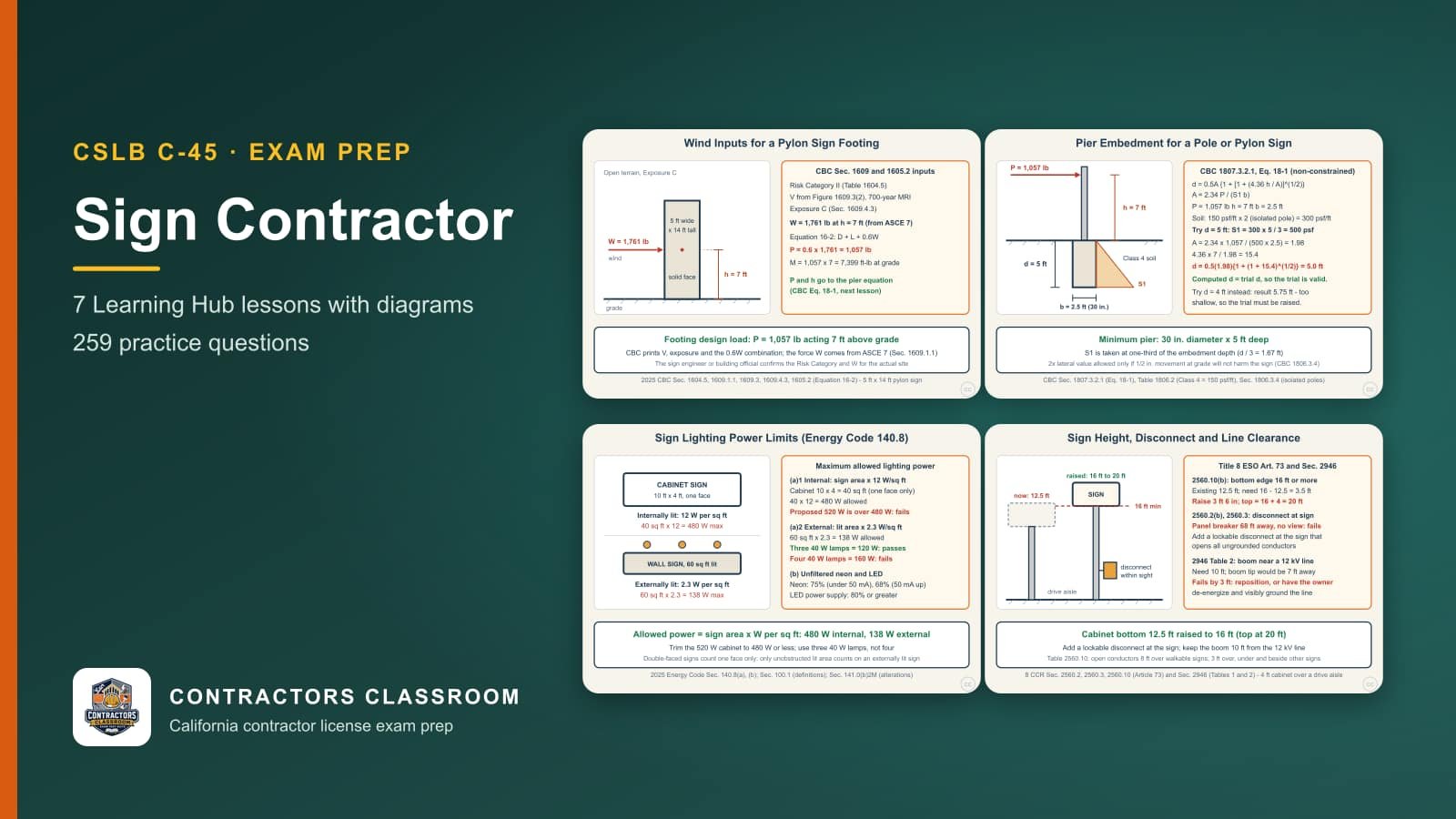
- A drilled hole filled with concrete that anchors a pole or pylon sign. Its depth and diameter come from the wind overturning force and the soil, not from guesswork, and the pole is set on or in it with anchor bolts.
- Exposure category
- A letter classification of the terrain around a sign, from sheltered urban ground to open flat country. Open terrain raises the wind pressure used in design, so it directly changes the footing and pole requirements.
- Neon transformer
- A high-voltage power source, rated in kilovolts and milliamperes, that strikes and runs neon tubing. It must be matched to the tube length and gas, listed, and mounted with correct grounding and cable.
- GTO cable
- Insulated high-voltage wire used between a neon transformer and the tube electrodes. Its insulation rating must meet or exceed the transformer output, and it needs protective sleeving and careful routing.
- LED sign power supply
- The unit that converts line voltage to the low DC the LED modules use, available as constant-voltage or constant-current types. Selecting the wrong type or undersizing the unit shortens module life and causes flicker or failure.
- Fluorescent sign ballast
- A device that starts a fluorescent lamp and then limits the current through it. A failed ballast is a common cause of a dark cabinet, so testing it is part of sign troubleshooting.
- Sign disconnect
- A switch that cuts power from all ungrounded conductors to a sign so it can be serviced safely. Either it sits where the sign can be seen from it, or it can be padlocked in the open position, and every sign needs one.
- Light-transmitting plastic
- Translucent sheet such as acrylic or polycarbonate used for sign faces, classified by how it burns. The code limits its use and size on certain buildings, so the burn classification must be known before specifying it.
- Foam plastic sign
- A sign built from lightweight cellular plastic, popular for carved or dimensional lettering. Because it is combustible, the building code restricts where it can be used, especially on covered mall storefronts.
- Tactile characters and Braille
- Raised letters and Braille placed on signs that identify permanent rooms and spaces, so a person who cannot see can read them by touch. The code sets finish, stroke, spacing and mounting height and location.
- Internally illuminated sign
- A sign whose light source is inside the face, such as a lit cabinet or channel letters. The Energy Code caps its lighting power per square foot of sign area, using a different limit than for externally lit signs.
- Projecting sign over right-of-way
- A sign that hangs from a building into the public sidewalk airspace. The code controls its minimum clearance above grade and how far it may extend, so it can't hit pedestrians or vehicles.
- Electronic message display
- A sign of LED pixels driven by a controller that changes copy or images. Its fabrication, cooling, data wiring and brightness control are separate from static signs and part of the digital display topics.
- Boom truck
- A truck with a crane-style arm that sets poles and lifts sign sections. Working it near overhead conductors requires minimum clearances and a spotter, because contact with a line can energize the whole machine.