CSLB C-32

Parking and Highway Improvement Contractor License Exam Prep (C-32)

Getting ready for the California parking and highway improvement contractor license exam (CSLB C-32)? Study with 184 practice questions in 2 categories and 7 Learning Hub lessons, made for striping and highway improvement contractors, with the Law and Business exam included.

One-time purchase, no subscription. Law & Business included.

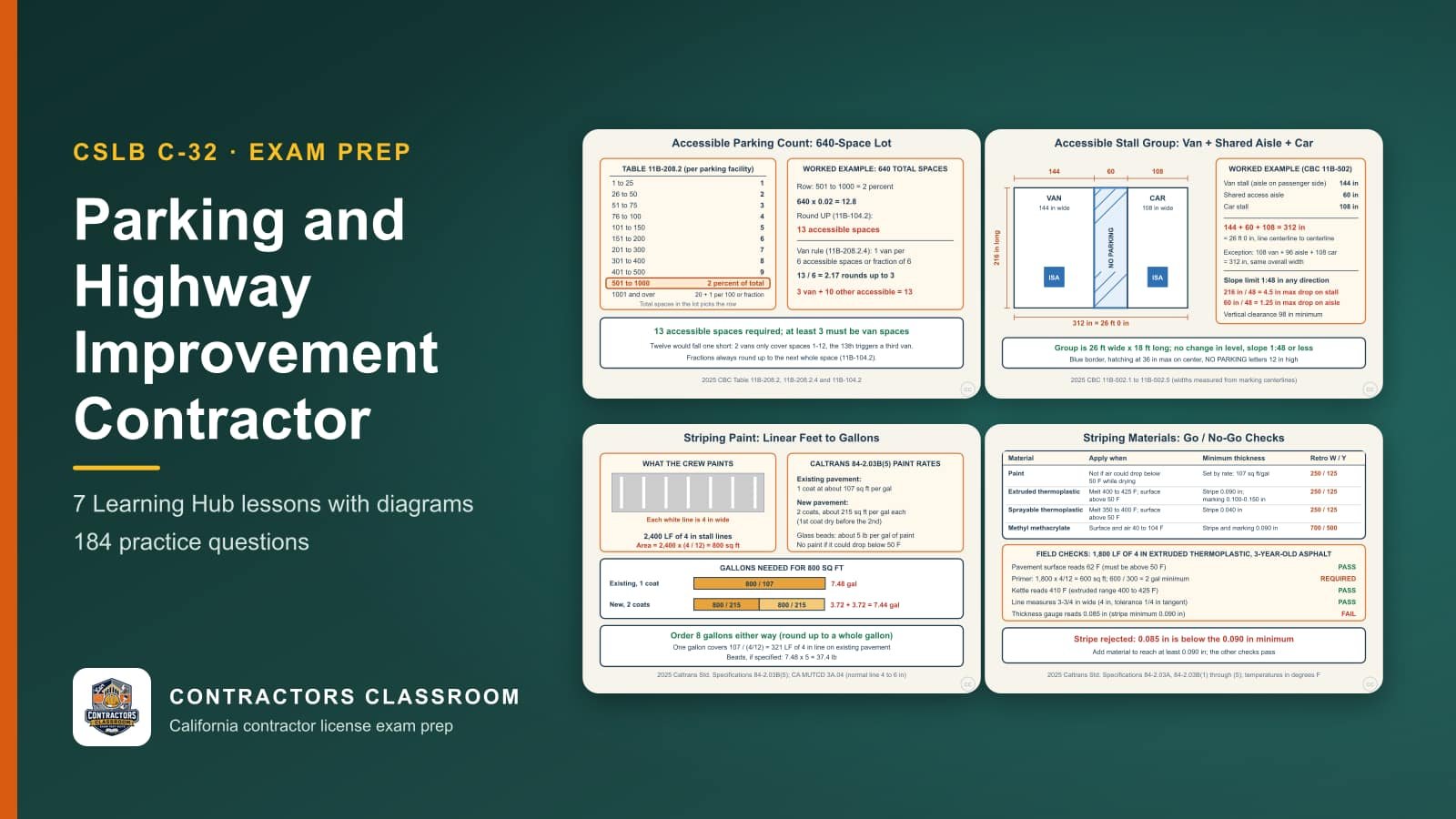
Diagrams from the C-32 parking and highway improvement contractor lessons: Accessible Parking Count and Van Spaces, Accessible Stall Layout, Slope and Markings, Striping Paint Quantity: Linear Feet to Gallons and Striping Materials: Temperature, Thickness and Acceptance Checks
184practice questions
2categories
7Learning Hub lessons
$249Law & Business included

What the exam covers: Parking and Highway Improvement (C-32)

The CSLB exam for the California parking and highway improvement contractor license (C-32) is a closed-book, multiple-choice test. CSLB's official study guide divides it into six major sections and gives each an approximate weight: Planning and Estimating (about 23%), Surface Coatings (about 20%), Striping, Pavement Markers, Wheel Stops, and Other Accessories and Equipment (about 14%), Special Applications (about 8%), Incidental Pavement Repair (about 8%), and Safety (about 27%).

Safety carries the most weight, about 27%, so it deserves roughly that share of your study time, with Planning and Estimating next at about 23%.

Contractors Classroom turns that outline into 184 practice questions in 2 categories (Planning and Estimating and Cal-OSHA Traffic & Surface Safety), plus 7 Learning Hub lessons with diagrams (such as "Accessible Parking Count and Van Spaces" and "Accessible Stall Layout, Slope and Markings"). Law and Business, which most applicants take alongside their trade exam, is included at no extra charge.

Exam sections and approximate weights

  • Planning and Estimating~23%
  • Surface Coatings~20%
  • Striping, Pavement Markers, Wheel Stops, and Other Accessories and Equipment~14%
  • Special Applications~8%
  • Incidental Pavement Repair~8%
  • Safety~27%

Practice question categories

  • Planning and Estimating75 practice questions
  • Cal-OSHA Traffic & Surface Safety109 practice questions

What the Parking and Highway Improvement Contractor exam covers, section by section

Planning and Estimating (~23%)

A striping or coating job is won or lost before the first drop of paint. The estimator walks the site to note its condition and layout, studies drawings and specifications for what is required, calculates materials and the hours to apply them, coordinates with owners and other trades, and watches the forecast, since temperature and moisture control how coatings cure. Oil spots, crack patterns and drainage low spots influence how much cleaning, crack filling and sealer will be needed.

  • Walk the site to judge pavement condition, access and layout challenges
  • Interpret drawings for required markings and coating products
  • Calculate paint, sealer and equipment quantities from measured areas
  • Estimate crew hours and sequence work with owners and other trades
  • Check forecasts because weather affects application and curing

Surface Coatings (~20%)

Sealcoats and similar coatings protect pavement only when they are mixed and put down correctly. Material is blended to the right consistency with additives, the surface is swept, cleaned and repaired so the coating can grip, and the product is spread evenly. Rushed prep or a poor mix shows up quickly as peeling and uneven coverage. Sand or polymer additives help the coating resist wear, and mixing in batches keeps color and thickness consistent. Edging around curbs and drains with a brush gives crisp borders.

  • Blend coating and additives to the right consistency for the product
  • Clear dirt, oil and weeds and fill cracks so the coating bonds
  • Spread coating evenly with sprayers or squeegees, keeping edges uniform

Striping, Pavement Markers, Wheel Stops, and Other Accessories and Equipment (~14%)

Lines, arrows and stalls only help drivers if they are laid out accurately and last. Crews measure and mark the pattern before painting, remove old markings that would confuse, then apply paint and set raised markers. Speed bumps, wheel stops and signs round out a lot's traffic flow and must be fastened securely. Chalk lines, templates and stencils keep stall widths and arrows consistent, and glass beads dropped on wet paint improve reflectivity at night. Raised markers are set in adhesive that must cure before traffic returns.

  • Measure and mark stall, arrow and lane patterns before painting
  • Remove outdated markings cleanly so old lines do not mislead
  • Paint lines and set raised markers with solid bonding and placement
  • Anchor speed bumps and wheel stops and mount signs securely

Special Applications (~8%)

Some surfaces call for coatings and markings beyond a standard parking lot. Game courts require exact line placement and a surface suited to play, airports and heliports follow strict visibility and layout conventions, and warehouses and factories need durable markings that handle heavy equipment while keeping aisles and hazards clearly identified. Court surfaces often get cushioned layers or color coats, while hangars and aprons demand paint that resists fuel and tire marks.

  • Coat and line sports courts with accurate layouts and a playable finish
  • Apply runway and helipad markings that stay visible and follow aviation conventions
  • Mark floors for aisles, equipment paths and hazards in industrial buildings

Incidental Pavement Repair (~8%)

Striping and coating crews often meet damaged asphalt that would undermine their work. Cracks, potholes and failing patches have to be diagnosed for cause, since a cosmetic fix will fail again if water or base problems remain. Once a repair plan is set, bad pavement is cut out, removed and replaced so the new surface blends in. Patches should be compacted in lifts and sealed at the edges so water cannot creep underneath.

  • Look for causes behind cracking, potholes and settlement before choosing a fix
  • Cut out failed areas, haul away debris and patch with compacted new material

Safety (~27%)

Pavement work happens in live parking lots and roadways, with hot materials, solvents and moving equipment all around. Crews protect themselves and the public with cones, barricades and flaggers, keep work areas organized and well marked, prevent spills and runoff from reaching drains, and follow California workplace safety rules. Solvent-based traffic paint is flammable and sprayers can kick up overspray, so crews keep ignition sources away and watch wind direction.

  • Set up cones, signs and barricades to separate crews from vehicles
  • Protect workers and visitors from hot material, fumes and machinery
  • Keep paint, sealer and cleanup water out of storm drains and soil
  • Follow California workplace safety rules, including crew training and hazard information

Code books behind the Parking and Highway Improvement Contractor exam

The exam outline published for this trade lists these references.

  • 2025 Standard PlansThe Standard Plans are the state's typical detail sheets, including pavement marking layouts for lane lines, arrows, crosswalks and stop bars, along with curb, sign and temporary traffic control details. For a striping contractor they teach what a correct layout looks like. They feed the Striping, Pavement Markers and Accessories section and the traffic control items in Safety.
  • 2025 Standard SpecificationsThis is the written standard for highway work. For this trade it covers paint, thermoplastic and methyl methacrylate marking materials, the surface and air temperature limits for applying them, film thickness, glass bead rates, marking removal, and surface treatments such as slurry and fog seals. It is the reference behind Surface Coatings and Striping.
  • Advisory Circular 150/5340-1M – Standards for Airport MarkingsThis federal circular sets the colors, shapes, dimensions and placement of markings on runways, taxiways and aprons, such as centerlines, hold-position lines and threshold bars. Airport paint work follows it rather than street conventions, so it is the reference behind the airport portion of the Special Applications section.
  • The Asphalt Handbook: Manual Series No. 4This manual explains asphalt materials, mix behavior, pavement structure, construction practice, and maintenance treatments such as crack sealing, fog seals, slurry seals and patching. It helps a candidate recognize why pavements fail and which treatment matches the failure. It supports Surface Coatings, mix design topics and Incidental Pavement Repair.
  • CalDAG 2024: California Disabled Accessibility Guidebook, An Interpretive Manual and ChecklistThis guidebook interprets the state accessibility rules with diagrams and checklists for parking: how many accessible stalls a lot needs, van stalls, stall and aisle sizes, slopes, signs, ground markings and curb ramps. It is the layout reference for the accessories and layout topics in the Striping section.
  • California Manual on Uniform Traffic Control Devices, 2026 Edition, Revision 9The California MUTCD standardizes signs, markings, colors and signals. For this trade it governs stripe widths and patterns, curb color meanings, pavement words and symbols, and the temporary traffic control part used around work zones. It feeds both the layout topics in Striping and the traffic control topics in Safety.
  • State of California Construction & Electrical Safety Orders (Cal/OSHA)The construction safety orders cover hazards that striping and sealing crews face daily: working around moving vehicles, handling solvents, hot thermoplastic and sealers, hazard communication, noise, powered equipment and general site conditions. They are the reference for the Safety section, including personnel and job site safety and the Cal/OSHA requirements it lists.
  • Underground Service Alert GuidelinesThese guidelines come from the state law that requires notifying the regional one-call center before digging. A striping and signage crew digs for sign posts, bollards and pole footings, so it needs to know when a ticket is required, how long it stays valid and how marked utilities must be respected. They support the job site safety topics in Safety.
  • WATCHBook: Work Area Traffic Control HandbookThis handbook shows standard work-zone layouts: sign spacing, tapers, buffer spaces, flagger stations, lane closures and detours. Because striping crews often work in open lanes, its diagrams explain how to set up and take down a zone. It is the practical reference for the traffic control topics in Safety.

Key terms for the Parking and Highway Improvement Contractor exam

Slurry seal
A cold-applied mixture of emulsified asphalt, fine aggregate, mineral filler and water that is squeegeed over worn pavement as a thin wearing surface. It seals small cracks and restores texture, but its mix design and ground temperature limits matter, and covers and collars must be protected.
Fog seal
A very light spray of diluted asphalt emulsion over an existing surface to renew its look, bind loose fines and slow oxidation. It is also used on freshly ground areas after marking removal, and too heavy a coat leaves a slick surface.
Alligator cracking
A network of interconnected cracks shaped like reptile skin, caused by fatigue of the surface under repeated loading, usually from a weak base or poor drainage. Sealing the surface will not cure it; the failed area must be removed and the base repaired.
Thermoplastic striping
A marking material supplied as solid resin that is melted and applied hot, either extruded or sprayed, then cools into a durable film. It needs a primer on most surfaces, application temperatures within a defined range, and a minimum film thickness to perform.
Methyl methacrylate
A two-component reactive marking material that cures chemically and bonds firmly to asphalt and concrete. It lasts longer than paint, is applied within a wide temperature range, and is chosen where wear from traffic is heavy.
Waterborne traffic paint
A water-based striping and marking paint that dries by evaporation and coalescence. It must go on clean, dry pavement and must not be thinned, and rain, fog or a falling temperature before it dries can ruin the line.
Glass beads
Tiny glass spheres dropped into wet paint or hot thermoplastic and embedded about halfway so they reflect headlight beams back to the driver. Their application rate per gallon of paint is a standard quantity, and missing or buried beads make a stripe invisible at night.
Retroreflectivity
The property of a marking that sends light back toward its source, measured in millicandelas per square meter per lux. Specifications set minimum readings by material and color, so a line can fail acceptance even when it looks fine in daylight.
Raised pavement marker
A small reflective or non-reflective button bonded to the road surface to supplement or substitute for painted lines. It is placed on a layout, bedded in adhesive, and removed with the stripe it belonged to when the traffic pattern changes.
Wheel stop
A precast or recycled-material block anchored to the pavement at the head of a stall to keep a vehicle from rolling forward into a walkway, wall or accessible route. Placement depends on the stall depth and the clear width needed beyond it.
Access aisle
The striped space beside an accessible stall that lets a driver or passenger deploy a ramp or lift and move out of the vehicle. It is outlined and hatched, marked against parking, shares the stall's level surface, and must meet minimum width.
International Symbol of Accessibility
The white figure on a blue field that identifies accessible stalls, routes and signs. Its minimum size and position relative to the stall centerline are fixed, and reflectorized signs carrying it must be mounted at a minimum height.
Fire lane
A marked access route that must stay clear so fire apparatus can reach a building. It has minimum width and headroom, is identified by curb paint or signs with required wording, and cannot hold calming devices that slow or block fire trucks.
Taper
The sloped line of channelizing devices that guides traffic gradually out of a closed lane. Its length depends on lane width and speed, and cutting it short forces abrupt merging that endangers both drivers and workers.
Channelizing device
A cone, drum, tubular marker or barricade used to direct traffic around a work area. Choice and spacing vary with speed and duration, and on striping jobs these devices travel with the moving operation.
Flagger
A trained worker who controls traffic through a work zone with a paddle or flags, from a position visible to approaching drivers. The station needs advance warning signs, good sight distance and a safe retreat path.
Underground Service Alert ticket
The request number issued by the regional one-call center before ground is broken, such as for sign posts or bollards. It starts a waiting period so utility owners can mark their lines, and the markings must be respected and the ticket kept current.
Touchdown and liftoff area
The load-bearing surface on a heliport where a helicopter lands or departs. Its markings, such as the outline, the H symbol and perimeter lines, follow aviation standards rather than ordinary parking conventions.
Acrylic court coating
A pigmented, sand-filled acrylic system rolled or squeegeed over asphalt or concrete to give game courts a uniform, cushioned playing surface. Layers are applied in sequence, then court lines are taped and painted to exact dimensions.

Where to spend practice time for the Parking and Highway Improvement Contractor exam

  • Traffic control and site safetySafety is the heaviest slice at about 27 percent, covering work-zone traffic, worker protection on the site, environmental safety and Cal/OSHA requirements. Practice drawing a lane closure with advance warning, taper, buffer and flagger stations, then drill solvent and sealer handling, runoff control to storm drains, and how a moving striping truck is protected from approaching traffic.
  • Quantities, coverage and weatherPlanning and Estimating is about 23 percent of the exam and rewards clean arithmetic. Practice turning linear feet of stripe into square feet and gallons using stated coverage rates, converting a gallon back into linear feet, rounding orders up, and estimating crew hours. Also review how temperature, humidity and rain change whether coatings may be applied, and how site condition affects the cleaning and crack work you price.
  • Slurry, sealers and surface prepSurface Coatings is about 20 percent, spanning mix design, surface preparation and application. Compare slurry seal, fog seal and sealer coat by purpose, and recall what each needs on the ground first: cleaning, oil spot treatment, crack filling and masking of utility covers. Work through ground temperature limits, cure time before opening to traffic, and signs of a mix that is too wet or too dry.
  • Stall layout, curb colors and accessibilityStriping, markers, wheel stops and accessories is about 14 percent, and layout questions reward careful sketching. Practice setting out accessible stalls and their aisles by measuring to the middle of each painted line, working out how many accessible and van stalls a lot of a given size needs, placing signs and wheel stops, and recalling what each curb color means.
  • Marking materials and removing old linesThe layout section also includes removing obsolete markings and applying pavement markers. Compare paint, thermoplastic and methyl methacrylate by temperature window, thickness, bead use and durability, and recall acceptance checks such as straightness, width tolerance and reflectivity. For removal, contrast grinding with water blasting, depth limits and how damaged areas are sealed afterward.
  • Special applications and pavement repairSpecial Applications and Incidental Pavement Repair are about 8 percent each, together a fair share of questions. Review how game courts, airports, heliports and warehouse floors differ in surface and marking standards. For repair, practice matching a failure pattern such as alligator cracking or raveling to its likely cause, then choosing between sealing, patching or full removal and replacement.

Scenarios to talk through before the Parking and Highway Improvement Contractor exam

  • A restripe over old linesA lot restripe changes the stall pattern, but the old lines are still visible and the crew is eager to start painting. Think through the order of work: which removal method fits, what depth limit applies, how damaged areas are treated afterward, and how drivers are protected from seeing two layouts at once.
  • Paint runs short on day twoHalf the stripes are finished and the tank gauge shows far less paint than the take-off predicted. Compare broken-line and solid-line paid length, coat count on new pavement, bead use and any thinning. Where would you look for the discrepancy, and how would you recompute what remains?
  • Fog at dawn on a thermoplastic jobA crew arrives to apply thermoplastic on an older roadway, but the surface is damp from fog and the thermometer is near the lower limit. Which conditions must the surface and air meet, what role does primer play, and what are the consequences of applying anyway versus waiting?
  • Slurry seal around utility coversBefore slurry seal goes down on an apartment complex, you notice concrete collars and valve covers scattered throughout the drive aisles. Describe how they are protected, how the fresh mix is handled around them, and what happens if the mix is too wet or too dry when it meets the surface.
  • Stall count for a clinic lotA small outpatient clinic lot is being restriped, and the plans show fewer accessible stalls than you expect for the total number of spaces. Think about how the total is counted, how van stalls fit inside the accessible count, which special occupancy rule might apply, and whom you would contact before painting.
  • Closing a lane to stripe at nightThe owner wants a two-lane road restriped during off-peak hours with one lane open. Sketch the traffic control: advance warning, taper, buffer, flagger positions and channelizing devices. Which references would you consult, and how does the moving striping truck itself get protected?
  • Cracks and oil spots before sealingA lot is scheduled for a surface coating, but the pavement shows heavy cracking, oil stains and low spots that hold water. Discuss which of these can be treated before coating, which point to a failure that sealing will not cure, and how you would explain the choice to the property manager.
  • A helipad and a game courtA hospital asks for a rooftop landing area outline and a staff recreation court on the same project. Compare the surfaces and markings each requires, which standards govern one but not the other, and which preparation and curing steps you would plan before a single line is laid.

Learning Hub lessons

Each lesson has guided steps, a diagram, a worked example and a quick check inside the classroom.

Preview the lesson diagrams

  1. Accessible Parking Count and Van SpacesSteps: Who Sets the Count and What Counts as a Space; Read Table 11B-208.2 by Total Spaces; Above 500 Spaces: Percent, Plus the Rounding Rule; Van Spaces Come Out of the Accessible Total; Special Occupancies and Location
  2. Accessible Stall Layout, Slope and MarkingsSteps: Measure From the Centerline of the Paint; Stall and Aisle Sizes; Surface, Slope and Headroom; Pavement Markings; Signs and Wheel Stops
  3. Striping Paint Quantity: Linear Feet to GallonsSteps: A Stripe Is a Long Thin Rectangle; Use the Published Coverage Rate; Divide Area by Rate, Then Round Up; Turn a Gallon Into Linear Feet; Beads, Weather and Checking the Tank
  4. Striping Materials: Temperature, Thickness and Acceptance ChecksSteps: Know Which Material You Are Applying; Conditions That Apply to Every Material; Thermoplastic: Primer, Temperature and Thickness; Methyl Methacrylate and Paint Limits; Accept or Reject the Finished Line
  5. Removing Obsolete Markings: Limits and Pay QuantitySteps: When Removal Comes First; What a Removal Item Includes; Grinding Limits; High-Pressure Water Blasting; Pay Quantity
  6. EV Charging Stalls: Required Counts and Accessible StallsSteps: Two Codes, Two Counts; Read CALGreen Table 5.106.5.3.1; What EV Capable Means for the Installer; Accessible EVCS: Table 11B-228.3.2.1; Stall Size and Paint Under 11B-812
  7. Curb Colors and Fire Lane ClearancesSteps: The Five Curb Colors; How Curb Markings Are Used; Fire Lane Width and Headroom; Fire Lane Marking and Speed Humps; Choosing Paint and Dead Ends

See the classroom in action

Frequently asked questions

How do I get a California parking and highway improvement contractor license?

A striping contractor or highway improvement contractor who wants to contract independently applies under C-32. CSLB generally requires documented journey-level experience, a bond, and passing scores on both the Law and Business exam and the C-32 exam. Rules change, so confirm them with CSLB.

What does the parking and highway improvement contractor exam ask about safety?

Safety is the heaviest part of the C-32 exam, at about 27%. Expect questions on set up cones, signs and barricades to separate crews from vehicles, protect workers and visitors from hot material, fumes and machinery, and keep paint, sealer and cleanup water out of storm drains and soil. Next in weight come planning and estimating (about 23%) and surface coatings (about 20%).

What kinds of questions are on the parking and highway improvement contractor exam?

The three sample questions in CSLB's C-32 study guide ask about what to consider when painting red curbs, how far a gallon of striping paint stretches, and how to protect utility covers during slurry sealing. Like every question on the exam, each has four choices and one best answer.

Which codes and books does the C-32 exam reference?

CSLB's C-32 study guide lists the Cal/OSHA safety orders (Title 8) and trade references such as Caltrans 2025 Standard Plans and Standard Specifications, California Manual on Uniform Traffic Control Devices, and The Asphalt Handbook. Use them to study; the exam itself is closed-book.

Is the parking and highway improvement contractor exam open book?

No. The C-32 study guide says no reference materials may be used, even though it names Caltrans 2025 Standard Plans and Standard Specifications and California Manual on Uniform Traffic Control Devices among the books to study from. A calculator is provided, and guessing is not penalized.

Can I take the parking and highway improvement contractor exam outside California?

CSLB's exam FAQ says trade exams are given in California or Oregon only, so C-32 is not offered in other states, although Law and Business can be taken out of state. Check the current PSI list when you schedule.

How are the 184 C-32 practice questions organized?

They are split into 2 categories, largest first: Cal-OSHA Traffic & Surface Safety (109) and Planning and Estimating (75). Cal-OSHA Traffic & Surface Safety holds about 59% of the questions. 7 Learning Hub lessons add diagrams and worked examples for the harder topics. The missed-question review collects every question you get wrong.

Is there a free trial for parking and highway improvement contractor exam prep (C-32)?

Yes. The free C-32 preview opens the real classroom with no sign-up and gives you the first question from every C-32 category, including Cal-OSHA Traffic & Surface Safety and Planning and Estimating, plus Law and Business. The full course is a one-time $249 purchase.

Is parking and highway improvement contractor exam prep available in Spanish?

The website and the eight demo videos are available in Spanish. The classroom and the 184 C-32 practice questions are in English for now; translating the questions is not part of the course yet.

Ready to practice for real?

Try the real classroom free, no sign-up, or get the full course for your trade.

Independent exam preparation. Contractors Classroom is not affiliated with the Contractors State License Board, and no course can guarantee a passing result.


