CSLB C-46

Solar Contractor License Exam Prep (C-46)

Getting ready for the California solar contractor license exam (CSLB C-46)? Study with 184 practice questions in 2 categories and 6 Learning Hub lessons, made for solar installers, with the Law and Business exam included.

One-time purchase, no subscription. Law & Business included.

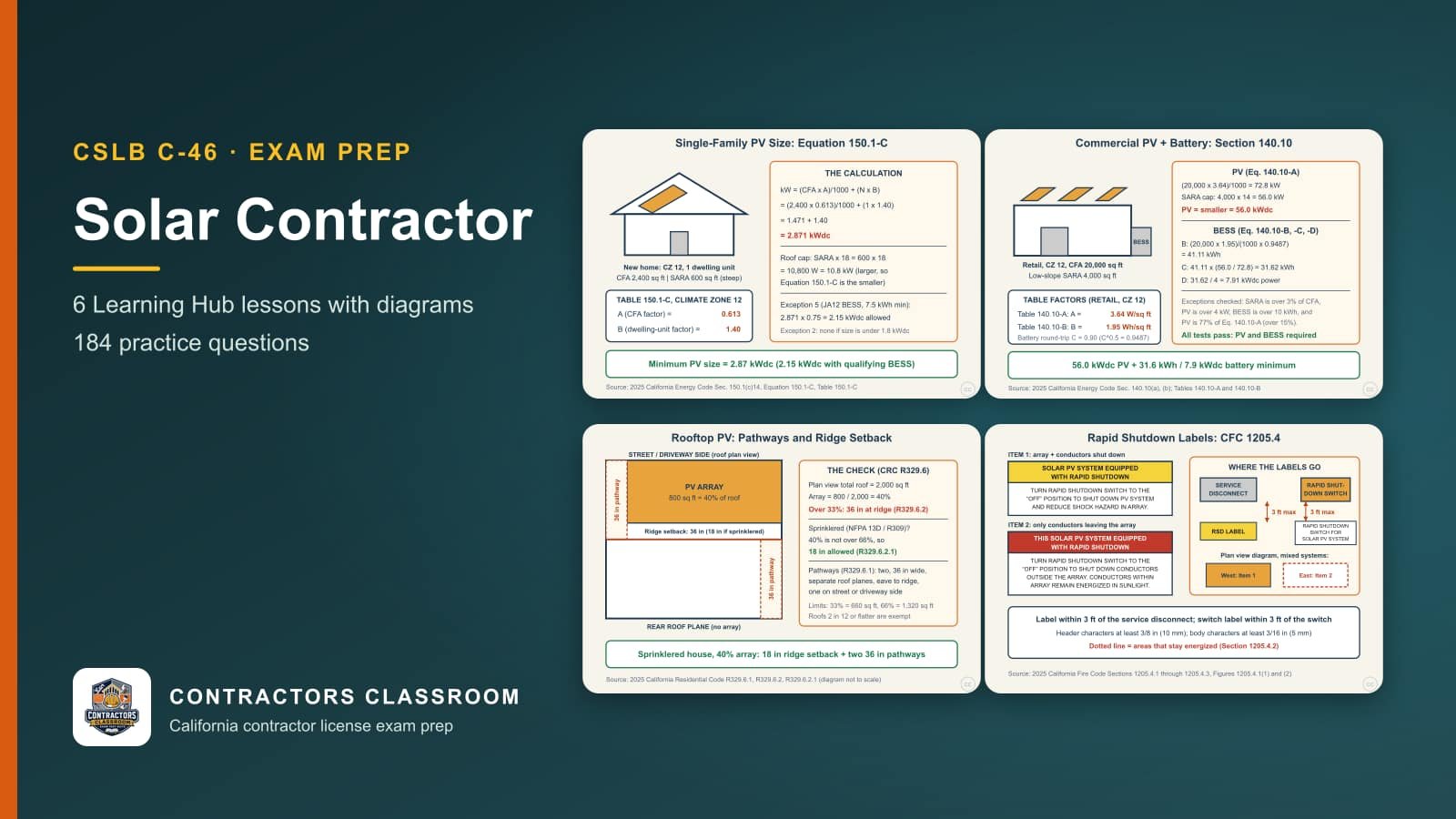
Diagrams from the C-46 solar contractor lessons: Single-Family PV Sizing: Equation 150.1-C, Commercial PV and Battery Sizing: Section 140.10, Rooftop PV Fire Access: Pathways and Ridge Setbacks and Rapid Shutdown Labels and DC Conductor Rules
184practice questions
2categories
6Learning Hub lessons
$249Law & Business included

What the exam covers: Solar (C-46)

The CSLB exam for the California solar contractor license (C-46) is a closed-book, multiple-choice test. CSLB's official study guide divides it into six major sections and gives each an approximate weight: Planning and Estimating (about 14%), Solar Panel/Collector Installation (about 17%), Photovoltaic (PV) System Installation and Commissioning (about 28%), Solar Thermal Installation (about 7%), Service, Operation, and Maintenance (about 15%), and Safety (about 19%).

Photovoltaic (PV) System Installation and Commissioning carries the most weight, about 28%, so it deserves roughly that share of your study time, with Safety next at about 19%.

Contractors Classroom turns that outline into 184 practice questions in 2 categories (Planning and Estimating and Cal-OSHA Solar Fall Protection & Arc Flash Safety), plus 6 Learning Hub lessons with diagrams (such as "Single-Family PV Sizing: Equation 150.1-C" and "Commercial PV and Battery Sizing: Section 140.10"). Law and Business, which most applicants take alongside their trade exam, is included at no extra charge.

Exam sections and approximate weights

  • Planning and Estimating~14%
  • Solar Panel/Collector Installation~17%
  • Photovoltaic (PV) System Installation and Commissioning~28%
  • Solar Thermal Installation~7%
  • Service, Operation, and Maintenance~15%
  • Safety~19%

Practice question categories

  • Planning and Estimating75 practice questions
  • Cal-OSHA Solar Fall Protection & Arc Flash Safety109 practice questions

What the Solar Contractor exam covers, section by section

Planning and Estimating (~14%)

Solar jobs start by learning what the customer wants and whether the site can deliver it, looking at roof condition, shading, orientation, electrical service and available space. Arrays, wiring and equipment are designed to fit that site, plans are interpreted for the installers, and costs for equipment, labor and permits are totaled into an estimate the client can understand.

  • Judging shade, roof or ground space, orientation and electrical service against the owner's goals
  • Sizing arrays, wiring and equipment so the design suits the site and the load
  • Reading drawings and diagrams to find layouts, equipment locations and wiring routes
  • Totaling equipment, labor and related expenses into a job cost the client can review

Solar Panel/Collector Installation (~17%)

Before any energy is produced, the array has to be attached securely. On roofs, installers locate framing, set mounting hardware and keep panels aligned and properly spaced. Ground-mounted systems rely on footings or posts, grading and clearances. Both types require openings through roofing or cladding to be sealed so that water stays out for the life of the system.

  • Locating rafters, installing mounting hardware and aligning collectors on roof surfaces
  • Setting posts or footings and racking for collectors in open ground with proper orientation
  • Sealing roof openings with flashing and sealant so mounting hardware never becomes a leak path

Photovoltaic (PV) System Installation and Commissioning (~28%)

A photovoltaic system links panels, inverters, disconnects and wiring into a working source of electricity. Grid-tied systems must coordinate with the utility, while standalone systems manage their own batteries and loads. Energy storage adds charge control and its own safety needs. Once built, components are labeled, tested and configured, and the owner is shown how the system operates.

  • Wiring panels, inverters and disconnects into a complete grid-connected system that operates correctly
  • Adding battery storage with proper charge control, enclosures and protective devices
  • Meeting utility interconnection steps so the system can feed power to the grid safely
  • Sizing standalone systems around batteries and loads, and labeling components clearly for later technicians
  • Testing and configuring equipment, enabling monitoring and walking the owner through operation

Solar Thermal Installation (~7%)

Solar thermal systems collect heat rather than electricity, circulating a fluid or water through collectors to a storage tank or a pool. Hot water installations involve collectors, piping, pumps, controls and a storage tank, with attention to freeze protection. Pool heating setups are simpler, but still need correct plumbing, flow and control connections to deliver steady warmth.

  • Connecting collectors, tanks, pumps and controls so household hot water is heated by the sun
  • Plumbing pool collectors with correct flow, valves and controls to warm swimming water

Service, Operation, and Maintenance (~15%)

Solar equipment needs periodic attention, and trouble often appears first as lower output or an alarm on the monitoring screen. Technicians inspect modules, wiring, inverters and storage for damage, loose connections or soiling, and examine collectors, pumps and piping on thermal systems. When parts fail, they are swapped with compatible ones, and the system is retested to confirm that it performs as expected.

  • Inspecting panels, wiring and inverters for damage, loose connections and falling production
  • Checking collectors, pumps, piping and controls on heating systems for leaks and poor circulation
  • Swapping failed components for compatible ones and retesting before returning the system to service

Safety (~19%)

Solar installers deal with sunlit electrical circuits that cannot simply be switched off, along with roof edges and heavy equipment. Protecting the public means fencing work zones and securing materials. Within the crew, unsafe conditions such as exposed wiring or unstable footing need to be noticed and corrected immediately. Handling of batteries, solvents and other hazardous materials requires proper storage, protective gear and disposal.

  • Barricading work areas and securing tools and panels so bystanders are not exposed to danger
  • Spotting exposed wiring, unstable surfaces and missing protection, then fixing them before work continues
  • Storing, using and disposing of batteries, adhesives and other hazardous materials properly

Code books behind the Solar Contractor exam

The exam outline published for this trade lists these references.

  • 2022 California Building CodeFor solar contractors the building code covers the roof and structure the array sits on: roof live and dead loads, wind, fire classification of roofing, weatherproof penetrations and required access. It feeds the roof-mount and ground-mount topics in Solar Panel/Collector Installation and the site feasibility topics in Planning and Estimating.
  • 2022 California Electrical CodeThe electrical code governs the photovoltaic and energy storage articles: circuit sizing, overcurrent protection, disconnects, rapid shutdown, grounding, wiring methods and labels, plus the rules for connecting to a building's service. It is the main reference behind the PV System Installation and Commissioning section, the largest on the exam.
  • 2022 California Energy CodeThe Energy Code requires solar on many new buildings and prescribes how large the system and any battery must be, with exceptions and roof-area limits. It also covers efficiency rules for water heating and pools. It feeds Planning and Estimating, where system size and compliance are decided.
  • 2022 California Fire CodeThe fire code sets the roof access pathways and ridge setbacks for rooftop arrays, where batteries may be placed and the protections around them, and related fire department access concerns. It supports the roof-mount layout topics in panel installation and the public-hazard topics in the Safety section.
  • 2022 California Mechanical CodeThe mechanical code touches solar thermal work through heat-transfer piping, heat exchangers, pumps, ventilation of equipment spaces and combustion air near backup heaters. It informs the hot water and pool heating topics in Solar Thermal Installation and the thermal evaluation topics in Service, Operation, and Maintenance.
  • 2022 California Plumbing CodeThe plumbing code covers potable water connections to solar water heaters: protection against contamination, pressure and temperature relief, tempering and mixing valves, piping materials and installation. It feeds Solar Thermal Installation and the repair and replacement of thermal components in Service, Operation, and Maintenance.
  • California Distributed Generation ProgramsA public data program on solar and other generation that is interconnected to the grid in California. It helps candidates picture how many systems are installed, how utilities handle interconnection and what typical customer systems look like, which supports the grid interface topics in the PV installation section.
  • California Solar InitiativeA state program that offered incentives for solar installations and shaped how performance, equipment and installer practices were expected to work. Studying its background gives context for customer education, system monitoring and the Planning and Estimating topic of matching a system to client needs.
  • Operating Guidelines for Certifying Solar Water Heating Systems (OG-300)A certification standard for complete solar water heating systems, testing performance and durability so that equipment can carry a rated label. For candidates it explains why collectors and tanks are matched as systems and supports solar thermal topics in hot water installation and thermal system evaluation.
  • Photovoltaic SystemsA textbook that teaches PV from first principles: cell and module behavior, series and parallel wiring, inverters, charge controllers, batteries, grid-tied and stand-alone designs, sizing and commissioning. It is the broadest study source for PV System Installation and Commissioning and for the PV evaluation topics in Service.
  • Solar Hot Water Fundamentals: Siting, Design, and InstallationA practical guide to solar thermal systems: siting collectors, choosing between open- and closed-loop designs, sizing storage, pumps, controls and piping, and installing them correctly. It supports the hot water and pool heating topics in Solar Thermal Installation and the evaluation of thermal systems later.
  • Solar ProgramsThe state energy agency's collection of solar-related programs and information, including equipment listings, efficiency and building standards and consumer resources. It gives background for the compliance and client needs topics in Planning and Estimating and for educating the customer at commissioning.
  • Solar ResearchNational laboratory material on solar resources, technology performance and system modeling. It backs up planning topics such as how much sunlight a site receives, how tilt, shade and temperature change output, and how to evaluate whether a system performs as expected during service.
  • State of California General Industry & Electrical Safety Orders (Cal/OSHA)With the Construction Safety Orders, this Title 8 set governs roof work, ladders and edges, electrical hazards from energized DC conductors, hazardous materials such as battery electrolyte and heat transfer fluids, and protection of bystanders. It is the reference behind the Safety section, about 19 percent of the exam.
  • Ugly's Electrical ReferencesA pocket guide to Ohm's law, power formulas, conductor and overcurrent tables, grounding and equipment data. Solar candidates use it for string voltage and current arithmetic, wire sizing and checking calculations, matching the closed-book math that appears across planning and PV commissioning.
  • Understanding NEC Req for Solar Photovoltaic Systems, 2020An illustrated explanation of the electrical rules for PV systems, written for installers: array circuits, rapid shutdown, disconnects, interconnection, grounding and labeling. It helps turn code language into field practice, so it feeds the system installation topics and the labeling bullet of the PV section.
  • Uniform Solar, Hydronics and Geothermal Code (2021)A model code for solar thermal and hydronic systems, covering collectors, heat-transfer loops, pumps, storage and safety devices. It supplements the plumbing and mechanical codes for solar hot water, pool heating and related components, which feeds Solar Thermal Installation and thermal service work.

Key terms for the Solar Contractor exam

Rapid shutdown
A required feature that cuts voltage inside and near the array to a safe level shortly after it is triggered, so firefighters on a roof are not exposed to full string voltage. Matching labels tell responders how the system works.
Open-circuit voltage
The voltage a module or string shows with nothing connected to it. It climbs in cold weather, and designers use the corrected figure to make sure a string never exceeds what the inverter and conductors can tolerate.
Temperature coefficient
A percentage that says how much a module's voltage or power changes for each degree of temperature shift. Hotter cells make less voltage and power, which is why hot roofs and cold mornings are both design checks.
Maximum power point tracking
Electronics in an inverter or charge controller that keep adjusting the load on the array so it operates where voltage times current is highest. It recovers output as sun, shade and temperature change through the day.
Microinverter
A small inverter bolted behind a single module that converts its DC to AC right at the roof. Shade on one panel affects only that unit, and with no high-voltage DC string, rapid shutdown is simpler.
Power optimizer
A DC-to-DC converter attached to each module that adjusts its output before it reaches a central string inverter. It reduces shading losses and can supply the module-level shutdown the code calls for.
Combiner box
An enclosure where several string circuits are joined onto one output, usually with fuses or breakers for each string. It reduces the number of long home-run conductors and gives one place to isolate and test strings.
Fire access pathway
A clear, unobstructed strip on a roof running from eave to ridge so firefighters can walk up and ventilate. The array layout must leave these corridors, and conduit and equipment cannot sit across them.
Ridge setback
The strip of roof near the peak left free of modules to give firefighters ventilation room. Its depth depends on how much of the roof the array covers, so the coverage percentage is calculated before the layout is drawn.
BESS-ready panel
Service equipment in a new home arranged to accept a battery later, with reserved space, a suitable busbar and designated backup circuits. The point is to avoid tearing up finished work when a battery is added.
Solar access roof area
The portion of a building's roof that gets enough unshaded sun to be useful for panels. The Energy Code uses it to cap how large a required system can be and to decide when exceptions apply.
Net energy metering
A billing arrangement in which a customer's generation offsets or earns credit against power drawn from the grid. California rules for how exported energy is valued have changed over time, so the concept matters more than any one rate.
Peak sun hours
A way to express daily sunshine as the number of hours at a standard reference intensity. Multiplying system size by this figure and by losses gives expected daily energy, the starting point of most output estimates.
Azimuth and tilt
Azimuth is the compass direction a module faces and tilt is its angle from horizontal. In California, south-facing arrays at moderate tilt usually yield the most, and deviations are weighed against roof shape and shade.
Roof standoff and flashing
A post fastened into the rafter that lifts the rail above the roofing, sealed by a flashing that sheds water over the hole. It is the common weak point for leaks, so sealing order and fastener location matter.
Drainback system
A solar water heater in which the heat-transfer fluid empties into a reservoir whenever the pump stops. Because the collectors are dry on cold nights, freezing risk is reduced, and the piping must slope so it drains fully.
Unglazed pool collector
A simple black panel, often polymer, with no glass cover that heats pool water directly as it passes through. It works well at low temperature rises, so it suits swimming pools but not domestic hot water.
Differential controller
A thermal system control that compares collector temperature with tank temperature and starts the pump only when the collector is sufficiently warmer. It also shuts down the pump when gain stops, protecting efficiency.

Where to spend practice time for the Solar Contractor exam

  • PV installation and commissioningThis section is about 28 percent of the exam, the largest. It covers basic PV, energy storage, utility interface, stand-alone systems, labeling and commissioning. Drill string voltage and power arithmetic, inverter types, disconnect and breaker locations, rapid shutdown labels, and what to test and explain to a client at startup.
  • Safety on roofs and around energized DCSafety makes up about 19 percent, a large share for one topic area. It centers on protecting the public, correcting unsafe conditions and handling hazardous materials. Review roof and ladder rules, the fact that PV conductors stay live in daylight, arc flash awareness, battery and fluid handling, and how to keep bystanders away from the work.
  • Panel and collector mountingSolar Panel/Collector Installation is about 17 percent and covers roof mounts, ground mounts and weatherproof penetrations. Practice sketching a rail layout with standoffs on rafters, comparing flush roof mounts with ground arrays, and listing the order for sealing a penetration. Include loads on the roof, wind and fastener checks.
  • Service, evaluation and repairService, Operation, and Maintenance is about 15 percent and asks you to evaluate PV and thermal systems and repair or replace components. Practice symptom-to-cause thinking: low string voltage, tripped inverters, ground faults, a pump that never runs or a collector that stays cool. Know which instruments and checks apply.
  • Planning, sizing and compliancePlanning and Estimating is about 14 percent. It spans client needs, site feasibility, system design and engineering, plan reading and job costs. Practice sizing a system from usage and sun hours, checking roof area and shade, applying Energy Code size limits, and doing the unit conversions between watts, kilowatts and daily energy.
  • Solar thermal and pool heatingSolar Thermal Installation is only about 7 percent, but it uses separate vocabulary and math. Practice computing pool volume in gallons from length, width and depth, comparing open and closed loop designs, and recalling controls, relief valves and freeze protection. Those questions are narrow, so a short focused review can pay off.

Scenarios to talk through before the Solar Contractor exam

  • Laying out a pitched roof arrayA customer wants panels covering as much of a pitched roof as possible, around a vent and an upper window. Think through fire access pathways, the ridge setback, what share of the roof is covered and where conduit can run, and what you would sketch before ordering racking. Say how you would show the plan to the customer.
  • An inverter fault on cold morningsA new system trips on a clear, very cold morning but works later in the day. Discuss open-circuit voltage, the temperature coefficient and string length, how the designer should have checked the limits, and what readings you would take at the combiner box. Say what you would change in the design to prevent a repeat.
  • A chimney shades the arrayAfternoon shade from a chimney falls across two modules of a string. Compare a string inverter, microinverters and power optimizers for this site, explain how maximum power point tracking responds, and note what rapid shutdown labels would show for your choice. Say which option you would favor and what you would tell the customer about trade-offs.
  • Planning for a future batteryThe owner of a new home does not want a battery yet but may add one. What does a BESS-ready panel require, which circuits would be set aside, where could a battery later be located, and what would you tell the owner about space and fire protections? Say how this changes your wiring and labeling today.
  • A leak after the installRain stains appear in a bedroom ceiling a week after a roof array went in. Reason through standoffs, flashing and fastener location, which penetrations you would inspect first, how roof loads from the array play in, and how you would repair and document the fix. Say what you would tell the customer about how soon it can be fixed.
  • Explaining the system to the ownerAt commissioning the owner asks why the bill still has a charge and how exported power is credited. Which points about net energy metering, monitoring and system size would you cover, which tests do you finish first, and what should you leave in writing? Say what you would put in the handoff packet.
  • Heating a backyard poolA homeowner wants solar heat for a rectangular pool. Walk through how you would compute the volume in gallons, why an unglazed collector suits the job, what the differential controller does, and how you would protect the collectors during cold nights. Say which unit conversions you must be careful with.
  • A solar water heater that stays coolA drainback solar water heater delivers lukewarm water on sunny days. Decide what you would check among the pump, the controller sensors, the piping slope and the fluid level, and what safe steps you take around hot components and roof edges while you work. Say how you would confirm the repair with a temperature reading.

Learning Hub lessons

Each lesson has guided steps, a diagram, a worked example and a quick check inside the classroom.

Preview the lesson diagrams

  1. Single-Family PV Sizing: Equation 150.1-CSteps: The Rule: Every New Single-Family Home Gets PV; Equation 150.1-C: Two Terms, Two Table Factors; The Roof Cap: SARA Times 18 or 14; Know the Five Exceptions; Run the Check in Order
  2. Commercial PV and Battery Sizing: Section 140.10Steps: Which Buildings Must Have PV and a Battery; PV Capacity: Equation 140.10-A; The SARA Cap and the Five Exceptions; Battery Size: Equations 140.10-B, -C and -D; Battery Exceptions and the Order of Work
  3. Rooftop PV Fire Access: Pathways and Ridge SetbacksSteps: Which Code Section Applies to the Roof; Two 36-Inch Pathways from Eave to Ridge; Setback at the Ridge: 33 Percent and 66 Percent; Keep Panels Away from the Escape Window and Mind the Conduit; Compute the Percentage First, Then Draw the Setbacks
  4. Rapid Shutdown Labels and DC Conductor RulesSteps: Why Rapid Shutdown Labels Exist; Two Label Types, Chosen by What Shuts Down; Diagram and Location: Within 3 Feet; Mixed Systems and the Switch Label; DC Conductor Routing and Separation
  5. Home Battery Systems: BESS-Ready Panels and Where Batteries May GoSteps: The BESS-Ready Rule for New Homes; The Four Backed-Up Circuits, the Busbar and the Transfer Switch Space; Where a Residential Battery May Be Installed; Size Limits: 20 kWh Per Unit, 600 kWh Per Property, and Table R330.5; Spacing, Alarms and Vehicle Impact
  6. Roof Loads Under a PV Array: The Two Load CasesSteps: Why the Roof Must Be Checked Before You Mount; Two Load Cases Where the Array Covers the Roof; Get the Roof Live Load from Table R301.6; Wind, Fire Class and Penetrations; Buildings Under the CBC: Section 1607.22

See the classroom in action

Frequently asked questions

How do I get a California solar contractor license?

A solar installer or solar panel installer who wants to contract independently applies under C-46. CSLB generally requires documented journey-level experience, a bond, and passing scores on both the Law and Business exam and the C-46 exam. Rules change, so confirm them with CSLB.

What does the solar contractor exam ask about photovoltaic (PV) system installation and commissioning?

Photovoltaic (PV) System Installation and Commissioning is the heaviest part of the C-46 exam, at about 28%. Expect questions on wiring panels, inverters and disconnects into a complete grid-connected system that operates correctly, adding battery storage with proper charge control, enclosures and protective devices, and meeting utility interconnection steps so the system can feed power to the grid safely. Next in weight come safety (about 19%) and solar panel/collector installation (about 17%).

What kinds of questions are on the solar contractor exam?

The three sample questions in CSLB's C-46 study guide ask about the power from a photovoltaic source circuit, what heat does to module voltage, and the water volume of a pool to be solar heated. Like every question on the exam, each has four choices and one best answer.

Which codes and books does the C-46 exam reference?

CSLB's C-46 study guide lists the 2022 California Building, Electrical, Energy, Fire, Mechanical, and Plumbing Codes (Title 24), the Cal/OSHA safety orders (Title 8), and trade references such as Photovoltaic Systems, Solar Hot Water Fundamentals, and Operating Guidelines for Certifying Solar Water Heating Systems (OG-300). Use them to study; the exam itself is closed-book.

Is the solar contractor exam open book?

No. The C-46 study guide says no reference materials may be used, even though it names Photovoltaic Systems and Solar Hot Water Fundamentals among the books to study from. A calculator is provided, and guessing is not penalized.

Can I take the solar contractor exam outside California?

CSLB's exam FAQ says trade exams are given in California or Oregon only, so C-46 is not offered in other states, although Law and Business can be taken out of state. Check the current PSI list when you schedule.

How are the 184 C-46 practice questions organized?

They are split into 2 categories, largest first: Cal-OSHA Solar Fall Protection & Arc Flash Safety (109) and Planning and Estimating (75). Cal-OSHA Solar Fall Protection & Arc Flash Safety holds about 59% of the questions. 6 Learning Hub lessons add diagrams and worked examples for the harder topics. The missed-question review collects every question you get wrong.

Is there a free trial for solar contractor exam prep (C-46)?

Yes. The free C-46 preview opens the real classroom with no sign-up and gives you the first question from every C-46 category, including Cal-OSHA Solar Fall Protection & Arc Flash Safety and Planning and Estimating, plus Law and Business. The full course is a one-time $249 purchase.

Is solar contractor exam prep available in Spanish?

The website and the eight demo videos are available in Spanish. The classroom and the 184 C-46 practice questions are in English for now; translating the questions is not part of the course yet.

Ready to practice for real?

Try the real classroom free, no sign-up, or get the full course for your trade.

Independent exam preparation. Contractors Classroom is not affiliated with the Contractors State License Board, and no course can guarantee a passing result.


